


deutsch |  english |  español  |  français  |  italiano  |  nederlands  |  polski  |  português  |  svenska  |  türkçe  |  中文  |  عربي  |  русский

latest news

Greece
Euro crisis deepens

21/05/2012: Revolution and counter-revolution

  Greece

Algeria
Legislative elections give near-majority to the FLN

20/05/2012: Anger from below, manoeuvres from the top

  Algeria

Burma
Two elections, 90% support but no power

19/05/2012: Workers’ organisations must ensure real change

  Burma

 Russia
CWI supporters arrested during Moscow protests

18/05/2012: Police target socialists at protest camp – urgent protests needed!

  Russia, Solidarity

Lebanon
Union leaders call “a strike without credibility”

18/05/2012: Build fighting, democratic trade unions!

  Lebanon

Germany
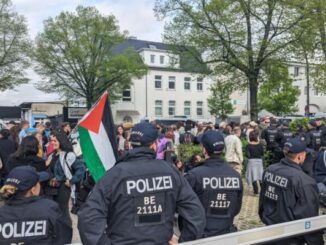
Massive state repression against “Blockupy” movement

18/05/2012: Thousands attempt to occupy squares and blockade the ECB in Frankfurt, Germany. Protests are banned.

  Germany

 Kazakhstan
Activists released

18/05/2012: Leader of the “Leave Peoples’ Homes Alone” campaign and member of the SMK, Larissa Boyar, and others have been released from prison

  Kazakhstan, Solidarity

Greece
New elections due as pro-austerity coalition talks fail

15/05/2012: For a Left government! For anti-austerity, pro-worker, socialist policies!

  Greece

Tunisia
General strikes, power struggles and an economic stalemate

15/05/2012: Republic’s president, Marzouki, afraid of ‘new revolution’

  Tunisia

 Kazakhstan
MEP speaks out against repression

15/05/2012: "Despite this ferocious oppression, the opposition and discontent of the working class cannot be silenced"

  Kazakhstan, Video

US
Socialist candidate challenges corporate politics in Washington state

13/05/2012: "During an election dominated by career politicians who are loyal to big business, I am running as a Socialist Alternative candidate to make sure there is at least one independent left-wing, pro-worker candidate in Washington State worth voting for."

  US

US
In calculated move, Obama supports gay marriage

12/05/2012: Step up the Struggle for Equality

  LGBT, US

Nigeria
Experiences of the explosion of class struggle

12/05/2012: Urgency of a working class alternative proven again

  Nigeria

Russia
Moscow left holds May Day Moscow demonstration

12/05/2012: Lively and political CWI contingent attracts variety of activists

  May Day, Russia

May Day
Demonstration in Uleåborg Finland

12/05/2012: Meeting discusses involvement in Afghanistan

  Finland, May Day

Kazakhstan
Miners’ strike ends in victory for workers

11/05/2012: Campaign Kazakhstan reports that newspapers in Kazakhstan said a strike by miners at KazakhMys ended on 7 May with a complete victory for the workers.

  Kazakhstan

 Irish referendum
No to the austerity treaty!

10/05/2012: On 31 May Irish voters are asked to vote on the European fiscal treaty. This video explains what the treaty is about.

  Ireland Republic, Video

May Day in Nigeria
Fanfare fails to mask workers’ anger

10/05/2012: May Day should have offered opportunity for workers to pose their demands and agitation before the government

  May Day, Nigeria

France
Weekend that shocked Europe

09/05/2012: Austerity rejected in Eurozone’s second biggest economy

  France

Sri Lanka
United left May Day in Colombo

09/05/2012: Socialist organisations march to joint rally

  May Day, Sri Lanka

Britain
Legitimacy of Cameron and Clegg further shattered

07/05/2012: The Con-Dem government suffered a crushing defeat in last Thursday’s elections for local authorities and in the mayoral contests apart from London.

  Britain

The capitalist “vampire squid” and the class struggle in Europe

06/05/2012: As economic crisis worsens and class struggles continue in Spain, Greece, Portugal and elsewhere in Europe, the need for working class fight-back and to build the influence of Marxism grows.

  CWI Comment And Analysis, Europe

Hong Kong
Thousands march on May Day

05/05/2012: Socialist Action (CWI) campaigning against the capitalist 1% and against racism

  Hong Kong, May Day

Sweden
May Day in Gothenburg

05/05/2012: Bobby Seale as guest speaker

  May Day, Sweden

 Kazakhstan
Trial of Vadim Kuramshim resumes

04/05/2012: Solidarity needed to free Vadim!

  Kazakhstan, Solidarity

Pakistan
May Day in Sindh

04/05/2012: Fotos of impressive march

  May Day, Pakistan

Lebanon
Build a mass workers’ movement to get rid of the corrupt ruling class

03/05/2012: For a workers’ programme that puts forward the socialist alternative

  Lebanon, May Day

Germany
Heading towards days of action against Troika austerity

03/05/2012: Days of action planned in Frankfurt/Main against European Central Bank and big finance

  Germany

Britain
"We’re striking back on 10 May"

02/05/2012: Pension cuts, job cuts, service cuts

  Britain

Ireland
Water charges are just paving the way for privatisation

02/05/2012: Irish government doesn’t seem to have learned anything from the massive opposition to its Household Tax

  Ireland Republic

France
Down with Sarkozy and austerity policies!

02/05/2012: Make the rich and the bankers pay for their crisis!

  France

Sweden
Chinese premier’s visit met by vociferous democracy protests

01/05/2012: CWI supporter Zhang Shujie and other activists took to the streets when Wen Jiabao visited Stockholm and Gothenburg

  China, Sweden

May Day 2012
Celebrate working class history and fight for new victories!

30/04/2012: International Workers’ Day and the socialist alternative to austerity and barbarism

  CWI Comment And Analysis, May Day

Australia

Ruling Labor Party punished at Victorian State election

www.socialistworld.net, 06/12/2010
website of the committee for a workers' international, CWI

Big increased vote for Socialist Party candidate, Stephen Jolly

By Socialist Party (CWI Australia) reporters, Melbourne

The Labor Party in Australia was dramatically swept from power at the November 27th Victorian State election. Large swathes of people felt the need to severely punish the incumbent government because of the crisis of public transport, inadequate healthcare and education, and declining living standards across the State.

In the weeks leading up to the election, a conservative coalition victory was seen by the majority of the media and political commentators as the least likely outcome. However, the Liberals, led by Ted Baillieu, managed to gain 12 seats from Labor while the Nationals gained one seat that was held by Independent Craig Ingram. This gives the coalition a two-seat majority in the Lower House and the ability to form government.

The Labor Party only managed to retain 43 of its previous 55 seats in the Lower House, while the Greens walked away empty handed despite much speculation that they could take up to four inner-city seats from Labor.

In the inner-city, Labor shifted to the Left in their rhetoric and pumped big money into their campaign to hold off a ‘Greenslide’. However, the key factor that allowed Labor to hold onto the inner-city was the Liberals decision to preference the Greens last on their How-to-Vote cards.

Across the state Labor, lost more than 200,000 votes compared to the 2006 election. Many of those votes were lost to the Liberals who increased their share of the vote by 115,000.

At the time of writing, the exact composition of the Legislative Council (Upper House) remains unclear. No matter the outcome, Labor and the coalition have fundamental agreement on most issues, including the passing of budgets that will include cuts to jobs and services.

Poor services and living standards undermined

The seats that the Labor Party lost in metropolitan Melbourne are all on the Frankston and Pakenham train lines, two of the most unreliable lines in Melbourne. Public transport was a key issue in the metropolitan region. According to a 2009 analysis of the system, only 10-15% of Melbourne residents are serviced by ‘appropriate and timely’ public transport. This is a direct result of the privatisation of public transport operation and systematic under-investment in public transport infrastructure over decades. This process was started by the last Liberal government in the 1990s and was continued by Labor over the last 11 years.

Anger was also expressed around the rising costs of living. Many of the seats Labor lost are characterised by middle and low income earners who either rent or have home loans. Working people with mortgages have been hit by seven interest rate rises since late 2009 and are feeling the pinch. On top of this, the new water desalination plant and electricity ’smart’ meters introduced by Labor are set to send electricity and water prices soaring. Public hospital waiting lists and the closure of schools through forced amalgamations has also stimulated a working class rejection of Labor.

It is important to recognise that this election result does not reflect an embracing of the coalition or a right-wing shift amongst ordinary people. With the absence of a viable alternative on offer, people decided to punish one big business party by replacing it with another.

An extended honeymoon period for Baillieu is unlikely, particularly after he promised $1.6 billion in cuts to State spending during the campaign. The fact that Bailleau has recalled parliament, before Christmas, to immediately begin implementing, his agenda show the coalition want to be seen as proactive and competent manages of the economy. However, the key issues that led to the backlash against Labor remain, and the new conservative government has no intention of seriously addressing the crises in transport, health and education.

While Labor oversaw the serious deterioration of infrastructure and services, big business was more than pleased with their stewardship of the capitalist system in Victoria. In the final days of the campaign, both the major papers in Victoria came out in favor of a returned Labor government. On the Monday after the election, the Australian Financial Review commented that Labor, “oversaw a golden era” and that “business was quite comfortable with Labor”. It stated, “This newspaper did not think [the Coalition] had outlined a coherent plan to improve the state’s economy and ease the doing of business”.

These comments illustrate just how far the process of the Labor Party’s transformation has gone. Now, in Victoria at least, the Labor Party is no longer the second party of big business, but the preferred choice of the ruling class!

Greens fail to make breakthrough

The Greens much touted hopes of winning up to four inner-city seats were dashed at this election. The Greens will be even further disappointed about the possible loss of one of their incumbent members of the Upper House. Their vote increased by a mere 29,000 votes compared to the 2006 election. In the inner-city, their vote dropped significantly compared to what they received at the August federal election, from 12.3% to 10.3%.

The primary reason the Greens failed to win any seats was because of the collusion of the two major parties in blocking the Greens via a preference deal. In a dramatic break with recent tradition, the Liberal Party decided to direct their preferences to the Labor Party over the Greens. This greatly increased Labor’s ability to hold onto seats in the inner-city. This decision is expected to be repeated by the Liberal Party in other States and is a serious blow to future electoral prospects for the Greens.

Despite the fact that the Greens pose no threat to the capitalist system, big business would prefer to maintain a two-party system. Both Liberal and Labor have proven their commitment to policies that favour big business and very little changes when one is replaced by the other.

However, if the Greens were able to achieve an electoral breakthrough and challenge the two party system, it could also open up space for other parties to develop. This is the last thing the ruling class wants, given the instability in the world economy and the fact their preferred parties of government, Labor and Liberal, are not capable of achieving lasting commitment from voters.

One factor that contributed to the flat-lining of the Greens vote was their refusal to rule out entering a coalition with Labor or the Liberals in the event of a hung parliament. The idea that the Greens could support a government of the Liberals and Nationals was not acceptable to their generally left-leaning support base. If the Greens were a real alternative to the parties of big business they would have adopted the principled position and refused to support either of the two major parties.

In general, the Greens also ran a politically weak campaign. Rather than focusing on policies, they relied on their ‘brand name’ and the lingering buzz from their Federal election win in the seat of Melbourne. This approach clearly failed to enthuse the electorate.

It must be said however that in the absence of a genuine left party developing, the Greens will likely recover. Future anger against the policies of the major parties will probably continue to be reflected on the electoral front, through a new rise in their vote. It is not ruled out that they can win inner-city seats in the future, despite a lack of Liberal preferences.

Socialist Party bucks the trend

The Socialist Party (CWI Australia) stood Stephen Jolly in the seat of Richmond. We saw a near doubling of our vote from 5.6% in the 2006 Victoria State election to 9.6% this time. In areas where there were some community struggles, our vote was more than doubled. At the massive Fitzroy Town Hall polling booth we received a very credible 15.5% of the first preference vote.

Our campaign shows that when posed correctly socialist ideas and methods can win over significant layers of people. Class struggle and the ideas of public ownership, planning and democratic control can appeal too many when they are connected to concrete issues in people’s lives.

With limited resources, the Socialist Party managed to letterbox more than 120,000 leaflets, door knock almost 10,000 homes and mobilise over 200 volunteers throughout the campaign.

Our result shows the potential for a new mass party of the working class. On the basis of a socialist programme, and a campaigning approach, such a party could make spectacular gains in the next period. This will especially be the case against the backdrop of an economic crisis that is still unfolding and a Liberal State government that will attempt to make working people pay for the failures of the profit-driven capitalist system.


Free Vadim! Europe

 video

Kazakhstan: MEP speaks out against repression, 15/05/2012

 further videos

CWI - get involved


solidarity

tamil solidarity campaign kazakhstan

featured links

Paul Murphy, MEP

cwi links

Marxist.net, CWI marxist archive

cwi comment & analysis

world economic crisis

analysis and commentary


cwi publications

marxism in today's world che

Che Guevara: Símbolo de Lucha

Por Tony Saunois

A socialist world is possible, the history of the cwi with new introduction by Peter Planning green growth, a contribution to the debate on enviromental sustainability