
Among the state elections due to take place in Germany in September, two in eastern Germany are set to shake the republic to its core. According to opinion polls, the AfD is the leading party in Saxony-Anhalt with 41.6 per cent and in Mecklenburg-Western Pomerania with 36 per cent. The AfD (Alternative für Deutschland) is a far‑right party, founded in 2013, that espouses a hard‑line nationalist, anti‑immigration platform. This raises the question of what kind of coalition governments will even be possible after these elections. Many people are afraid that the AfD will enter a state government for the first time.
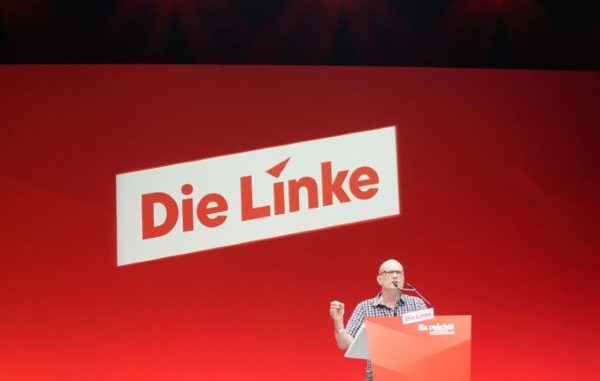
In this situation the question of what Die Linke (the Left Party) should do is being debated. Options include whether Die Linke should join in anti-AfD governments with capitalist parties or, as Sol (CWI in Germany) argues, while supporting parliamentary tactics to prevent AFD governments, putting Die Linke’s main emphasis on campaigning outside parliament to show that it alone is fighting against the federal government’s cuts programme and capitalism itself.
This article by Sascha Staničić, a member of Die Linke and the Sol national executive, was published in the run-up to the Die Linke’s federal party conference in June where Sascha Staničić stood for election to the party’s executive.
socialistworld.net
“We will do everything we can to keep the AfD away from the levers of power. I can tell you that” – this is how the co-chair of Die Linke, Ines Schwerdtner, put her stance on the upcoming state elections in Saxony-Anhalt. This also includes a willingness to tolerate a minority government led by the conservative CDU if it moves closer to Die Linke’s position on social policy. Heidi Reichineck, parliamentary group leader for Die Linke in the Bundestag, put it this way: “We are prepared to work with all democratic parties and parliamentary groups when it comes to achieving something for the people and defending democracy” and “I will not throw my homeland to the wolves of fascism”.
Bad examples: Thuringia and Saxony
As early as 2024, state election results in Thuringia and Saxony meant that it was no longer possible to secure a government with an absolute majority without the AfD and Die Linke. In these cases, Die Linke helped bring CDU-led minority governments to power. I
In Saxony, members of Die Linke voted for the CDU candidate Michael Kretschmer in the second round of voting, even though he would have been elected with a simple majority of the votes. Their support was therefore not necessary to prevent the election of the AfD candidate, as the CDU was the largest parliamentary group and had the SPD’s support secured.
In Thuringia, although the AfD had become the largest parliamentary group, it had fewer votes than the CDU, SPD and BSW combined, which formed the so-called ‘Brombeer’ coalition after the election. This coalition did not hold an absolute majority in the state parliament, and the CDU candidate, Mario Voigt, was elected Minister-President in the first round of voting thanks to votes from the Left Party parliamentary group. The Left Party, the CDU, the BSW and the SPD had agreed in advance on a monthly consultation format involving the parliamentary group leaders and on the Left Party’s involvement in government policy.
In neither case was there any risk of an AfD candidate being elected Minister-President, and the leadership of Die Linke decided to support CDU minority governments for other reasons – because it apparently wishes to contribute to stable capitalist conditions and does not consider that a weak pro-capitalist minority government would be the better option from the working class’s perspective, as such a government would be less able to push through attacks on the rights of wage earners. The consequence of this policy was then also approval (Saxony) or abstention (Thuringia) in the state parliaments regarding capitalist budget plans, which did not signify a shift to the left in policy.
Saxony-Anhalt
Now in Saxony-Anhalt, the situation is different. Here, it is possible that the AfD could secure an absolute majority of seats.
Depending on how many parties fail to clear the five per cent threshold, even the 41.6 per cent that the AfD is currently polling at could be enough to secure an overall majority. According to the latest poll, 14.5 per cent of the votes cast would not be represented in the state parliament at all, as the BSW, the Greens and the FDP would also fail to reach five per cent.
Should this not be sufficient to secure an absolute majority of seats, a simple majority could suffice in the third round of voting for the Minister-President. Article 65 of the State Constitution states: “The person elected as Minister-President is the candidate who, in the first round of voting, receives the votes of the majority of the members of the State Parliament. If no one secures this majority in this round, a new round of voting shall take place within seven days. If, in this ballot as well, the election is not decided by a majority of the members, the State Parliament shall, within a further fourteen days, decide on the early termination of the legislative term. If the early termination of the legislative term is not decided by a majority of the members of the State Parliament, a further ballot shall take place without delay. The person who receives the majority of the votes cast shall be elected.”
This means that, in the third ballot of an election between an AfD candidate and another candidate, an abstention by Die Linke would result in the election of the AfD candidate by a simple majority, as abstentions are not counted. If an AfD politician were the sole candidate and received more ‘no’ votes than ‘yes’ votes, they would not be elected and the incumbent government would have to remain in office on an interim basis. In Mecklenburg-Western Pomerania, the constitutional framework is different. Here, in the third round of voting, the candidate who receives the most votes is elected (a majority of the votes cast is therefore not required). In both federal states, however, the state parliament must vote on whether to call a general election before the third round of voting, which would rule out the election of an AfD candidate.
Fascism and right-wing populism
It is understandable and right that many people want to prevent an AfD state government. The AfD stands for anti-worker and anti-social policies, not just openly racist and anti-women and anti-LGBTQ+ policies. Nothing can be expected from a right-wing populist state government for the vast majority of the wage-earning and socially disadvantaged population. But is it fair to
accuse Saxony-Anhalt and Mecklenburg-Western Pomerania of ‘throwing themselves to the wolves of fascism’ if the AfD were to form a (minority) government?
Fascism is not simply a particularly right-wing and racist variant of capitalist politics. It represents a specific form of capitalist rule based on the eradication of parliamentary democracy and, above all, of working-class organisations such as left-wing parties and trade unions. Fascism is dictatorship, but not simply ‘just’ dictatorship; rather, it is daily terror perpetrated by fascist mass organisations, such as the SA and SS or the Italian Blackshirts.
A glance at the right-wing populist governments of recent years in Hungary, Poland, Italy or the USA is enough to see that, whilst they did implement a significant shift to the right in government policy and represented a more repressive and Bonapartist style of government, they were far from introducing fascist conditions. Neither was the right to organise trade unions and political organisations, nor the right to strike, abolished although attacks on the right to strike do take place as also occur under other pro-capitalist governments. Even though in the US the ICE gangs used terrorist methods of intimidation against migrants, there was no mass terror of the sort historically practised in countries ruled by fascists (or perpetrated by fascist mass organisations even before they seized power).
Nor is the AfD a fascist party, nor does it represent a fascist mass movement in Germany. It still has fewer members than the other major parties. There are fascists within its ranks who wield considerable influence, and it is dangerous. But an AfD-led government would not mark the return of fascism to power, nor would it result in a comparable deterioration in the conditions of struggle for the trade unions and the Left. This is demonstrated, for example, by the strikes and movements that have taken place against right-wing populist-led governments, such as currently in Italy or in the past in Austria.
The question of what qualitative changes an AfD minority government in a German federal state would bring about would therefore first need to be answered in concrete terms, before deciding what price Die Linke should be prepared to pay to prevent such a government.
What would an AfD state government mean?
There is no doubt that the AfD will attempt to push through far-reaching changes by taking power. A crucial difference will be whether it holds an absolute majority in a state parliament or would form a minority government. In the latter case, it could not pass laws without the votes of other parties, but would nevertheless wield the executive powers of the Minister-President and the ministers. It is reasonable to assume that changes would primarily affect the composition and functioning of state bodies – the recruitment of new civil servants, changes within the police and the prison service, the composition of the state constitutional court, etc. – as well as education and cultural policy and the funding of social projects, for example those aimed at the integration of migrants or the rights of LGBTQ+ people. These would be serious setbacks that would make life harder for many people. An AfD election victory would also embolden racists and Nazis and would very likely lead to more attacks on migrants and other people who do not fit into the far-right’s worldview. However, they would hardly amount to a fundamental abolition of democratic rights, and the truth is also that, in these areas, any takeover of government by a CDU-led cabinet would entail significant negative changes.
The aim of preventing the AfD from forming a government must therefore be weighed against the consequences that supporting a CDU minority government would have for Die Linke and also for further strengthening the AfD. After all, the aim for Die Linke should be to weaken the AfD in the long term and strengthen Die Linke.
In our view, the AfD has become so strong because an ever-growing section of the population rejects the political establishment and, quite rightly, feels unrepresented. A large proportion of AfD votes continue to be protest votes, with which voters wish to send a message to the established parties. At the same time, the number of voters who state that they vote for the AfD out of conviction is increasing; this reflects a dangerous process whereby right-wing populists are becoming entrenched in sections of the population (including parts of the working class), and even protest votes are being cast for the AfD by people who are, at the very least, not put off by its racist positions.
However, it is also reasonable to assume that many among them are people who in the past voted for (or would have voted for) the PDS or Die Linke, but are now ticking the box for the AfD because they perceive Die Linke as part of the hated political establishment (or as an aloof, educated left that does not care about their problems). Years of experience with Die Linke participating in government as part of coalitions with the pro-capitalist parties, the SPD and the Greens – during whose terms in office nothing fundamental has changed in the interests of working people – are decisive factors in this.
Die Linke support for a CDU minority government – particularly if there is an alternative to this way of preventing the AfD from taking power, or if it is accompanied by genuine political cooperation with capitalist forces, as in Thuringia and Saxony – is therefore very likely to reinforce the view that Die Linke is not seen as an alternative to the capitalist establishment, whilst the AfD is viewed as the only force standing up to that establishment. This could then be reinforced by certain measures that right-wing populist governments may take and which may find support among sections of the population, such as the AfD in Saxony-Anhalt’s announcement that it would end state funding for the Protestant and Catholic churches.
Conversely, however, it cannot be dismissed that, amongst another section of the population, a vote for Die Linke – if it was seen as possibly leading to the election of an AfD Minister-President – would be met with incomprehension and criticism and could undermine support.
This situation presents an electoral dilemma that cannot be resolved primarily by the electoral tactics employed by Die Linke, but can be minimised through the party’s overall policy. In other words: what matters most is not how Left Party members of the state parliament vote in specific situations, but rather what policies and practical activities the party pursues as a whole, and whether it can then justify a particular voting behaviour in line with those policies.
R2G or case-by-case decision?
Sol (the CWI in Germany) opposes participation in governments with the SPD and the Greens because such coalitions have ultimately always merely managed capitalist ills, have sooner or later adopted anti-worker measures, and have prevented Die Linke (or, previously, the PDS) from consistently standing alongside the working class negatively affected by government policy. At times, government policy may have been slightly less bad for a while than it would have been
under a government involving the CDU, but such coalitions have always weakened the party and made it less of what it must become: an instrument for the class struggle and the socialist transformation of society.
We were told: ‘The CDU will make things worse – should Die Linke be responsible for bringing the CDU into office?’ Our response to this was: ‘If the SPD and the Greens make social promises, we will not prevent them from implementing them.’ We have advocated, where in doubt, helping SPD–Green minority governments into office and then pursuing a case-by-case parliamentary policy: that is, supporting every bill that improves the situation of the working class and rejecting everything that does not – otherwise, no tolerance agreement, no commitments and no promises to such a government. This would afford Die Linke absolute independence and freedom of action. However, the basis for this tactic is not merely the idea of preventing the CDU from participating in a state government; after all, it is not Die Linke’s task to dissuade the SPD or the Greens from forming a coalition with the Conservatives. It is also a matter of ensuring that an SPD–Green minority government, which would have a parliamentary majority thanks to Die Linke’s votes, could be brought under intense pressure through class struggles and street protests, as well as through relevant motions tabled by Die Linke in parliament, to ensure that its social election pledges are actually put into practice. If this does not happen, the result would be the unmasking of the true pro-capitalist and anti-worker nature of the SPD and the Greens, even in the eyes of those sections of the working class who still harbour certain illusions in these parties. A win-win situation for Die Linke.
This cannot simply be applied to the situation that may arise in Saxony-Anhalt or Mecklenburg-Western Pomerania. Whilst, unfortunately, there is still an illusion – particularly amongst trade unionists and activists in social movements – that red-red-green (SPD-Die Linke-Green) governments could implement social and worker-friendly policies, there are no comparable illusions regarding the CDU. The issue here is exclusively about preventing an AfD minority government. It should not be a matter of deterring the CDU from cooperating with the AfD by Die Linke making offers of cooperation. That cannot and must not be Die Linke’s role. If the CDU breaks its mantra-like promises not to form a government with the AfD, this merely shows what sort of people these ladies and gentlemen really are.
Third round of voting
When it comes to voting behaviour in the third round of voting for a Minister-President, what Die Linke argues and the policies, propaganda and campaigning it pursues ‘in the run-up to the election’ are far more important than the voting behaviour itself, provided both are consistent. This means: Die Linke should not compromise on its programme or its demands; it should also – and indeed, in particular – launch political attacks on the CDU or SPD candidates, thereby demonstrating its political independence; it should call for protests (for example, specifically a protest outside the state parliament on election day); it should publicise the motions it intends to table in the state parliament, which would result in massive improvements for the working class, etc.
It should also make it clear that its concern is not with stable government arrangements, but that the weaker a capitalist government is, the easier it becomes for the working class to fend off impending cuts or fight for improvements. A caretaker continuation of an incumbent state
government that had lost its parliamentary majority would undoubtedly lead to a government that is as weak as can be imagined. Ultimately, Die Linke’s political strategy must be geared towards becoming stronger – not merely to win more votes in the next elections, but to become more capable of mobilisation and asserting its position through an increase in membership and a stronger foothold within the working class, thereby building a movement for socialist change. This requires clearly distancing oneself from the pro-capitalist establishment and refusing to make common cause with it.
What does this mean in concrete terms? Let us assume the scenario in which the AfD not only becomes the largest parliamentary group but is also stronger than all the other pro-capitalist parties represented in the state parliament (i.e. excluding Die Linke) combined. According to both state constitutions, this would mean that AfD candidates could be elected in the third round of voting without requiring an absolute majority of the votes. In Mecklenburg-Western Pomerania, this requires only the most votes; in Saxony-Anhalt, a majority of the votes. This is an important distinction. In practical terms, it means that in Saxony-Anhalt, the election of an AfD Minister-President can be prevented if no one stands against them in the third round of voting and there are more ‘no’ votes than ‘yes’ votes for the AfD candidate.
In Mecklenburg-Western Pomerania, this would not be possible; here, the state constitution refers to ‘the most votes’, meaning that ‘no’ votes play no role and a candidate could in fact be elected as the sole candidate with just a single vote. In both cases, however, the state parliament must vote before the third round of voting on whether to call a general election.
The aim of Die Linke’s approach should be to communicate its own policies, to mobilise opposition to any pro-capitalist state government, to preserve its own political independence, and not to be saddled with the responsibility for the election of an AfD Minister-President. Ines Schwerdtner’s statement that she would ‘do everything’ to prevent an AfD Minister-President is wrong, as it implies that one would be prepared to abandon one’s own political principles in order to achieve this goal.
Under no circumstances should we repeat what happened in Saxony and Thuringia in 2024 – namely, helping to elect CDU Minister-Presidents in the first or second round of voting and entering into political agreements with pro-capitalist minority governments, which then logically lead to Die Linke agreeing to austerity budgets in the state parliament.
Ahead of a possible third round of voting, the calling of new elections should be supported. Bringing the legislative term to an end (as it is officially termed) would be the way to prevent a third round of voting, and the incumbent government would remain in office, albeit without a parliamentary majority. There is no such thing as a ‘government-less’ situation, and the consequence would not be the collapse of infrastructure. Other countries, such as Belgium, have also experienced very long periods at national level during which no new government was formed following an election. Above all, this impairs the capitalist class’s ability to push policies through parliament that serve their interests.
Should the other parties not agree to this, Die Linke could, in the case of Saxony-Anhalt, call for no party to field a candidate in the third round of voting, thereby preventing the election of an AfD candidate through a majority of ‘no’ votes. However, the AfD could prevent this scenario by fielding two candidates from its own ranks.
If the other parties refuse both to call for new elections and to withdraw their own candidates in the third round of voting, Die Linke could convincingly argue that it would not bear responsibility should an AfD candidate be elected. On this basis, both possible voting strategies could be plausibly explained: 1) An abstention, due to the behaviour of the other parties. In that case, the party could state that it does not wish to act as kingmaker for a CDU Minister-President and could shift the responsibility for the election of an AfD candidate onto the other parties. At the same time, it could call for an elected AfD Minister-President to be immediately removed from office (however, Die Linke could not table such a motion in parliament on its own, as this would require 25 per cent of MPs). 2) Voting for a CDU candidate, as this would make no practical difference to the acting continuation of the incumbent CDU-led government and would prevent the deterioration in conditions expected if the AfD were to take office.
In Mecklenburg-Western Pomerania, this question is unlikely to arise, as the SPD, CDU and possibly the BSW or the Greens will together be stronger than the AfD and can agree on a centre-right candidate for the third round of voting, who would secure a simple majority even without the votes of Die Linke.
In any case, such an approach should be presented as a purely electoral tactical move and not, as Ines Schwerdtner does, linked to a demand for a different social policy from the CDU, because this would mean entering the realm of political cooperation with the CDU and failing to draw a clear line against the political establishment. The latter, however, is necessary in order to successfully lead the struggle against the AfD and for a socialist transformation of society.
We must not spread the illusion that it is possible to implement policies in the interests of the majority of the population in collaboration with pro-capitalist parties, because this ultimately always leads to stifling class struggles from below and entering into half-hearted compromises. At the same time, the aim is to win back as large a proportion of the AfD’s voter base as possible, particularly those voters from the working class. A Linke that pursues a policy independent of the pro-capitalist parties and clearly distances itself from them has far better prospects of achieving this than a Linke that is not perceived as fundamentally different from the other parties.
The most important thing, however, is that Die Linke immediately channels all its energy into the struggle against social cuts, job losses and militarisation, and also conducts the upcoming election campaigns as part of this struggle – whilst making it clear that the AfD pursues policies that benefit the rich. In this way, it can use the coming weeks and months to establish itself as the force that consistently opposes the pro-capitalist policies of all other parties and also tear off the AfD’s mask as the ‘party of the little people’, behind which a neoliberal-capitalist grimace is concealed.
Work within the parliaments can play an important role in exposing the true character of all the other parties, but the main activities must take place outside parliament. The stronger Die Linke becomes, the larger the demonstrations and strikes, and the more support grows for a socialist alternative to capitalism, the better we will be able to cope with a difficult election result in Saxony-Anhalt and Mecklenburg-Western Pomerania.