
Youth and workers: let’s build a mass strike movement against Macron and his policies!
A youth movement that is spreading and taking root
After the mobilisations of Saturday, October 17, we are now at a turning point in France. The high school movement that began on September 17 in Île-de-France, in a high school in a working-class neighbourhood of Val-de-Marne [94] spread very quickly. They have been driven by the deplorable learning conditions, the deterioration of teaching materials and buildings, but also the absolutely impossible timetables that leave high school students exhausted and unable to see the point of what they are doing in school, since everything is dominated either by the end of their studies after the baccalaureate, or by selection through the ‘Parcoursup’ university entrance system, which is operated in a particularly cruel and completely unfair manner.
Deficits and budget cuts in the universities
Next, the movement pretty quickly spread to the universities. A small movement had already begun there around conditions at the start of the 2026-27 academic year, since all public universities in France started it with a deficit budget. The Macron governments’ successive budget cuts to Education and Higher Education are directly responsible for this situation.
Public services are now starved of all resources, as is public education, from kindergarten right through to university.
The roots of the anger
The revolt in the high schools of the working-class districts of Val-de-Marne [94] and Seine-Saint-Denis [93] in the Île-de-France region has lit the fuse to set off the huge anger that has been building up for several years in a number of schools. Of course, this is rooted in the social and economic situation, and the lack of any clear future for large numbers of youth.
And then there are political factors too. For two years now, we have seen a polarisation in society, and, in particular, a radicalisation and the start of a politicisation of many young people in the face of an increasingly unjust world and society – and, of course, in the face of war, especially since the beginning of the military offensive and genocide in Gaza by Netanyahu.
But, behind everything, lies the economic situation. The government is blaming France’s debt level as an excuse for its attacks on public services. Redundancies are growing in the industrial sector. It’s very difficult to find work, especially for the youth. All these different elements are coming together.
How can we strengthen the student movement?
In the universities, we must talk to our classmates, especially those who are not yet taking part in action and convince them to join us! The tactic of mass blockades outside schools and universities has had its day. Indeed, more and more students leave the campus when there is a blockade because there is nothing for them to do and it is not always easy to join a blockade. At this stage, students who want to participate in the movement must be able to meet and discuss together so that the student movement can speak to everyone. Moreover, the university vice-chancellors have taken advantage of the lack of students on campuses. They downgrade classes, switch to remote learning, or lockout students altogether by closing down university sites!
For mass democratic general assemblies and mass mobilisations
To counteract this, our objective must be to make sure the General Assemblies (GA) are massively attended so that everyone can find their place in the struggle! Signal or WhatsApp groups are no longer sufficient to coordinate activities. Each university or campus should broaden its base and discuss its specific demands, and have action committees, elected every week, that prepare the agendas of the General Assemblies, and propose draft leaflets to be distributed on campus. We should also regularly elect representatives who would be given the mandate to unify and strengthen the movement through coordination at the local and then national level.
The mobilisation on the campuses must involve both students and workers, not only the lecturers but also the university admin staff and those working for CROUS [Centres régionaux des œuvres universitaires et scolaires] who have already been on strike on 22 and 29 September.
Against racism and division!
A growing part of the youth, those from working-class neighbourhoods, recognise how Macron is organising repression and racism, with systematic police operations, including racial profiling, and of course also a whole propaganda and ideology that stigmatises young people, especially young Blacks and Arabs or Muslims or those whom they see as being such.
The role of the bourgeois parties and the RN in dividing the struggle
This divide-and-rule strategy dominates all the propaganda of the bourgeois parties, from the right-wing LR [Les Républicains], to the Macronists, and of course, even the RN [Rassemblement National / National Rally]. They use racism and stir up hatred against Muslims as a means of cutting across the possibility of workers and youth uniting against Macron’s policies. As every day passes, the RN, especially in the National Assembly, is showing that it acts in the interests of the capitalist class, in just the same way as Macron does – by refusing wage increases, by rejecting laws that defend the rights of women and children, by denying workers’ rights to workers and supporting attacks on the unemployed and precarious workers. But a section of the capitalists who support Le Pen are worried that the capitalist, anti-poor and anti-worker character of the RN risks making itself too obvious this side of the presidential election.
Against the high cost of living – and despite the repression – October 17 was massive!
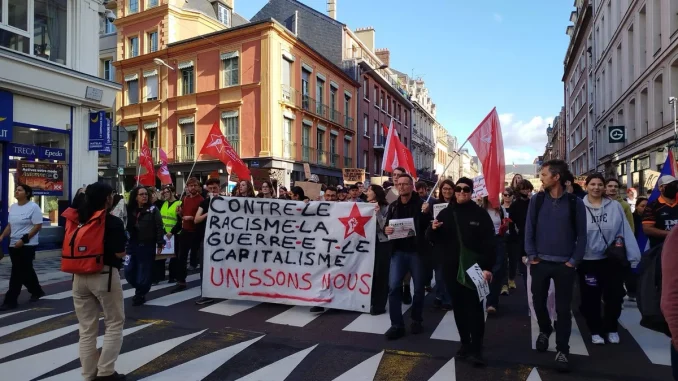
Between 600,000 and 800,000 people took to the streets! It was massive. And, really, that’s not surprising. The price of fuel is around €2.40 a litre, and it’s not going any lower. The government is not taking any decisive action against this, and is making it easier for Total, among others, to line its pockets and enrich itself on our backs. Most of the working class is suffering every day from the high price of petrol and transport in general, but also from the unbearable rise in food prices, at the same time as wages have been stagnating for the vast majority of workers.
October 17 had been announced as a day of action on a Saturday, like the ‘Yellow Vests’ had been able to achieve and organise eight years ago. The date was in the minds of a large number of workers and had become seen as an important next step in the movement. This step then became a decisive one, because of the movement of high school students that then spread to the universities, which was gaining momentum, and which most of the working class sympathise and identify with, because of course it involves their own children, but also because they oppose the attacks on young people in general.
Faced with police and administrative violence
The police repression orchestrated by Macron-Lecornu and Nuñez is playing an important role. The level of repression is absolutely unparalleled in comparison to the history of youth movements. Before 17 October, the numbers of arrests had reached nearly 8,000. This is more than during the ‘Yellow Vest’ movement itself, which itself had faced extreme repression.
Now, after October 17, two young people have lost an eye, including a 17-year-old on Saturday in Mulhouse and another during the earlier high school actions. There are young people who have been mutilated, a second person has had his hand ripped off, and people who have suffered cardiac arrests in the demonstrations. And then there are the injured, and a lot more people who have been affected by the repression.
The repression is not limited to the police. For high school students, disciplinary councils in schools are being planned for the return to school after the half-term holidays, i.e. after 2 November. And teachers who have been taking action will certainly face disciplinary action too.
All of this is part of the repression and criminalisation of young people, trying to make them look like they are intent on destruction, when, on the contrary, they are fighting for the right and for the means to build a better future. However, this demand collides head on with the capitalist system and its inability to meet the needs of the majority of the population, since the system is based on the domination of a tiny minority of ultra-rich over the vast majority of the population.
For a new decisive step: the working class must join the action
Of course, faced with such a situation, we need to take a new decisive step, one in which the youth and workers feel not only their collective strength, not only their massive numbers – as we saw on 17 October with a mobilisation of between 600,000 and 800,000 people in the streets, a mobilisation which demonstrated the level of mass support. The determination of the young people confirms the determined character of the movement as a whole, one that could be felt in all of the 17 October demonstrations, where, despite the repression and the denial of the right to demonstrate in many big cities, because the orders of the local Departmental Leaders and the Ministry of the Interior were to prevent the development of marches and demonstrations worthy of the name. This happened in Paris, but also in other big cities, such as Marseille, where access to the highways and the city centre was blocked, but left room for groups to come and loot. There were different kinds of looting that took place, theft from shops of things that are going to be resold but also looting of supermarkets where some of the food, especially in Paris, was distributed to the homeless and to people who were sleeping on the street. We even saw young people filling a bag or two with food shopping – simply to eat.
Vandalism, looting, and an element of rioting have taken place because the social conditions have degenerated so far, but they offer no kind of a solution at all. For the movement as a whole, this violence is counterproductive and deters some workers and youth from coming to demonstrations for fear of repression.
There is also a section of youth and workers that does not want to be associated with this kind of chaos, because what they want to build is a society of solidarity, a collective society, a society that responds to the needs of all. It is this central concern that must be heard and addressed by the organised labour movement. For it is only the conscious and organised intervention of the working class, acting as a class, that will decisively reverse the balance of forces – and nothing else. And the unions and political parties that claim to be for the working class must seize the opportunity opened up by the youth revolt: the central role of the working class in action must be demonstrated.
Make 5 November a 24-hour general strike!
Workers, those who produce the wealth of a country, have been present in the demonstrations whenever they were able to do so. They came out in massive numbers on Saturday, 17 October, but in the absence of an absolutely determined call for a joint, public-private sector strike, many do not yet recognise the central role that they have to play.
The experience of previous movements that have succeeded in stopping government attacks has always been ones where the workers have mobilised, taken strike action, and organised that strike action in a determined manner.
The union leaderships, in the wake of 29 September, which had been a day of strikes in public services, and in a number of other sectors that also took part, then made a call for a public and private sector one-day strike, against budget cuts and redundancies, on 5 November. That date is now barely a fortnight away, and has now taken on a much greater significance than when it was announced at the end of September, when the action still seemed a little far off in the future.
Make 5 November a decisive day in the fight against Macron and his pro-capitalist policies
Now, with the movement of the youth, and the revolt felt by young people that it has demonstrated, 5 November becomes a key stage for the working class to take its rightful place in the movement, introducing its demands for wage increases, a freeze and a lowering of prices, but also, obviously, the struggle against the planned redundancies, and for taking the money required from the profits of the capitalists and the big multinationals who are making dividends and record profits once again this year.
Of course, that will mean going head on against government policy, since they are announcing an absolutely massive austerity budget at the same time – this is why the date of 5 November was chosen, to fight the government’s policy of austerity and budget cuts.
In this situation, the action planned for 5 November must take on a much bigger and more determined form. The union leaderships must respond to the situation. Violence and destruction must not be used as a pretext to pull back and minimise the importance of the November 5 strike. In fact, the exact opposite is required!
In the two weeks that remain, a mobilisation in the workplaces, the general assemblies, and in workplace union meetings must be organised far and wide, so that workers in their workplaces seize hold of this date, and make it a decisive day of action against Macron’s policies, against the capitalists, and against a society that destroys the future of our youth, and undermines the working conditions of those in work.
For three consecutive days of strike action!
November 5, called as a united co-ordinated strike across the public and private sectors, must become a ‘total strike’ day, a 24-hour general strike, a day of militant action, where striking workers go from workplace to workplace to discuss with other workers, organise themselves in a general assembly, and also plan assemblies in their workplaces, the same evening or the next morning, to discuss the next steps. We need to know immediately – or better yet, before – what the next date will be after the big day of strikes and demonstrations on 5November!
It is up to the workers and young people to decide together what are the next steps for the movement, and on 5 November, workers and youth must find ways to decide and put demands on the union leaderships for two or even three days of successive strike action, so that the pressure can be increased against this government, in order to make them back down on their austerity budget.
Of course, it is essential that the day will also be a day where huge demonstrations are held, organised and stewarded safely for all those who want to march, but also as a day of determined action. This means that this day must include workplace assemblies, and pickets at all workplaces, where we can talk with passers-by and with colleagues who are in the same industrial zone, in order to be able to engage in a battle that must be a decisive battle against Macron, but also against all the policies being imposed in the interests of the capitalists.
This is what Gauche Révolutionnaire stands for, through building via its determined activity, in the workplaces, schools and colleges, for a massive strike day on 5 November in both the public and private sectors, a day of ‘total strike’, with pickets on the gates of all companies, of all places of study, of all workplaces, of all high schools and education establishments, but also through general assemblies during the day and in the evening, or even the next morning, to discuss the consequences of the strike, and to call for three consecutive days of strike to bring down the policies of this government, and Macron and the politicians at the service of the capitalists.
A political perspective for workers and youth
Politically, workers and youth want to confront Macron. He is hated, hated by a majority of the population, but what is missing is a perspective of what to put in Macron’s place, of what is to replace Macron. Therefore, the question of workers and youth organising politically is key. One thing is clear: as soon as a political force speaks up with determination against the government, it is targeted.
La France Insoumise and the next steps to take
La France Insoumise is playing a significant part of this today. It is under permanent attack from the bourgeois parties and the media, blamed as being as responsible for the vandalism and social unrest. But the real culprits are Macron and the capitalists. La France Insoumise plays an important role in the movement, for example with its demands for the freezing of prices and the increase of wages. It is also the only political force with a high level of mass support amongst the most active militants, amongst the high school students and in the universities, and amongst those demonstrating, and it is also calling for an escalation of the movement and the building of the strike on 5 November.
Support is growing for Jean-Luc Mélenchon’s candidacy in the presidential elections of 18 April and 2 May, 2027. A large part of the youth, but also a growing part of the workers, are showing an interested in La France Insoumise and see the importance of a political movement that translates the aspirations of young people and workers into a coherent and combative program.
It is clear that a mass strike movement against Macron, six months before the presidential election, is creating an extremely favourable situation for workers and youth to finally have a political voice independent of the parties of the bourgeoisie, of course independent of the right, the RN and the Macronists, but also independent of the Parti Socialiste of Hollande and Glucksmann, which is a party that also clearly exists to serve the interests of the bourgeoisie.
Challenging the capitalists by building the movement
La France Insoumise should respond to the current situation beyond simply calling for a vote for Mélenchon in 2027. He must call on everyone to join the ranks of LFI to organise themselves in the movement both now and in the weeks to come, and to build a movement and the mass strike action necessary to defeat Macron’s policies.
La France Insoumise is holding its national convention on 7 November. It needs to be the moment when the movement creates the structures that allow young people and workers to organise themselves politically around a combative anti-capitalist program: for nationalisation under democratic workers’ control and management of all companies that are laying off workers, and in particular the key sectors of the economy such as energy, but also that of pharmaceuticals and medicine, and of course industry as well. After all, we saw the announcement in the week before the 17 October of the Brittany Foundry being put into receivership, as well as the ‘Forges de Tarbes’ being snapped up by a hedge fund, Europlasma, which will also face closure if the workers do not seize hold of the situation.
Join Gauche Révolutionnaire
- For a freeze and cut in prices.
- For increases in wages and student grants and for them to be Inflation-Proofed by linking them to the Price Index
- No to job losses, no to redundancies! Let’s get organised!
- Public ownership, under workers’ control and management, of all the companies that announce closures or lay off workers!
- Reduction of working hours with no loss in pay until there is no more unemployment!
- An end to discriminatory measures such as the increase in tuition fees and the abolition of APL housing grants [Aide Personnalisée au Logement] for non-EU students
- Construction and renovation of decent and inexpensive housing in sufficient numbers and expropriation of empty housing!
- For high-quality public services that meet needs, with increased staffing particularly in education, health and transport
- For a socialist and therefore a democratic society where we will collectively decide what and how to produce in order to meet the needs of all in addition to getting rid of war, discrimination, unemployment, poverty…