
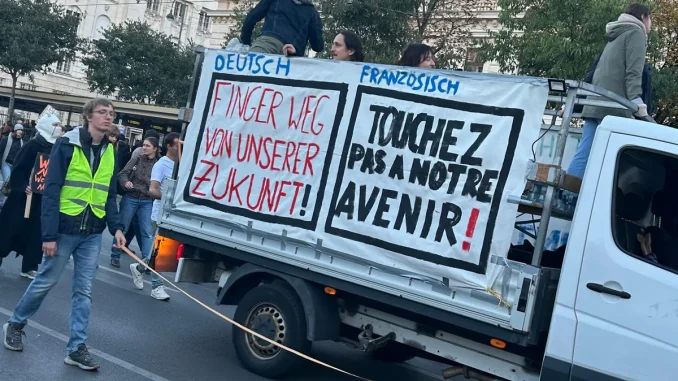
For the third time in the space of a few months, there has been a massive mobilisation in Vienna by university students and staff against the budget cuts planned by the government.
The government is a coalition of the conservatives, the Social Democrats and the liberals, originally formed in 2024 with the aim of keeping out the far-right Freedom Party. The government is increasingly unpopular due to the cuts it is implementing. The Social Democrats like to present those as “soft cuts”, but they are not soft in their effects.
In spring 2026 30,000 students and university staff had demonstrated, when the budget cuts for 2028-2030 were first announced. The budget had ever so slightly been increased since thanks to the pressure but is still insufficient in covering the present costs. The existence of entire study branches is in danger, especially the more “exotic” ones, and so are the jobs of the lower grade staff, who often have casual contracts.
On October 13 we saw a first protest this autumn and now the massive 50,000 strong demonstration on October 22, marching from the technical university to the University of Vienna. Uni-staff from other university cities such as Graz, Innsbruck and Salzburg had been mobilised via busses to attend the demonstration by their shop stewards.
The mobilisation shows that young people are not simply going to let their future be taken away from them. Many placards clearly expressed this discontent, linking the cuts, for example, to the issue of military spending. The call to join forces with other sections of the population, such as workers, was also clearly evident. Time and again, references were made in a spirit of solidarity to the protests in France and other European countries.
Sozialistische Offensive (CWI in Austria) was part of these demonstrations, and we took part with various slogans, such as “Universities, schools, IT, retail, ÖBB – fight together – November 20: Youth Strike” or “Demonstration today – strike tomorrow”, which were well received.
We also highlighted the international youth strike on 20 November and emphasised the link between the protests against cuts at universities and the protests against militarisation and wage negotiations.
The demonstrations were a good first step, but there is no plan for organisation given by the leadership and no clear direction for the next stages of the struggle. We propose setting up action committees at universities, where the programme, demands and next steps can be discussed within democratic structures and decided upon democratically.
There have already been meetings of junior and mid-level university staff to discuss possible industrial action. Staff on short-term contracts are particularly at risk from the budget cuts. Unfortunately, short-term contracts are widespread at universities.
It is unacceptable that only the heads of the universities or the leadership of the students union and the union leadership – which are all trying to slow down the protests – should dominate where the movement is going next. The fact that the well-paid heads of the universities share only limited common ground with students and university staff was evident in the speeches at the demonstration, in which tuition fees were not directly presented as an option, but were not ruled out either.
20 November could mark a step towards further mobilisation. However, a plan setting out the next steps is needed. A Plan that also addresses the issue of strikes amongst junior and mid-level academic staff, as well as solidarity with other workers currently engaged in struggles – whether in the public sector against cuts imposed by the government and the City of Vienna, or in the context of wage negotiations. There are areas within the university that can exert economic pressure. This applies for example to areas where research is carried out on projects for the private sector. In the retail sector, the IT collective agreement, the ÖBB and other sectors, conflicts over wage negotiations and possibly protests over pay are on the horizon. If these struggles are linked, it will not be so easy to isolate the students and divide the movement, which the bourgeois media and the right wing populists are currently attempting.
The international protests – the protests by school students and students in France or the strikes in Ireland – show that students and university staff in Austria are not alone – capitalism offers us no future! We won’t pay for the capitalists’ crisis – join us in taking action and become part of the struggle for a better, socialist future!