
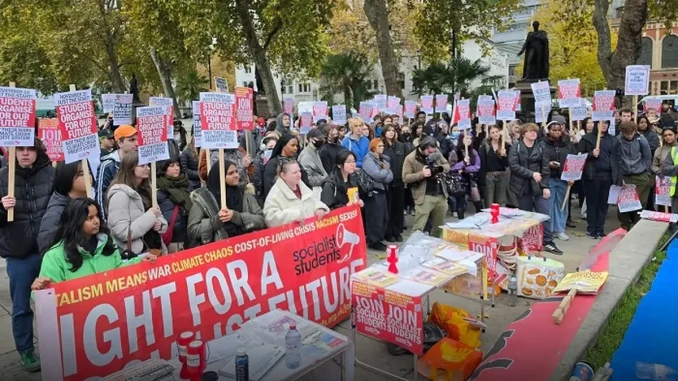
“A new wind is blowing across the earth.” These were the words of a student in Paris, who was among the one million-plus young people who took part in the international youth strike to ‘fight for our future, not their wars’ on 20 November 2026.
A full picture of the scale of the movement in different countries is not yet clear, but the International Youth Strike network which initiated the strike, estimates that it involved 27+ countries, 500+ cities and 5,000+ schools, colleges and universities. In a number of Italian cities, the student protests were many tens of thousands strong, and took place on the same day as a 24-hour general strike by the biggest trade union federation, the CGIL. In total, around 100,000 marched through the streets of Milan. Meanwhile, fifteen thousand were protesting in Berlin. Students in Vienna and Bologna withstood brutal police repression. Most impressive was the sheer spread of the strike. The list of cities, towns and even villages where hundreds or thousands of students marched is huge and spread across the map of Europe, from Finland in the north, to Serbia and Albania in the east, to Portugal in the west, where a public sector general strike took place on the same day.
The students and young people from some countries, above all France, have already taken part in inspiring mass movements this year. For students in Britain, however, this was just the beginning. But what a beginning! Many hundreds rallied in numerous city centres, including Liverpool, Manchester, Brighton, Bristol, Birmingham, Sheffield, Cardiff and London. But even more impressive than the cities were the 150+ places where group of students went on strike and held local marches.
See the Socialist Students live feed from the day for an overview of protests in Britain.
The history books will not remember 20 November because of yet another COP conference proving incapable of decisive action on climate change, nor because Andy Burnham, on behalf of British capitalism, chose that day to meet representatives of capitalist governments in the European Union. Instead, N20 will be remembered for the solidarity and internationalism of a new generation: many taking their first steps into the struggle for a different, socialist, world.
How N20 developed
It was a meeting in June of this year, involving 12 youth organisations from eight different European countries, which launched the call for N20 primarily around opposition to war and militarisation. Socialist Students, in which the Socialist Party’s student members participate, was the only organisation from Britain at that meeting, primarily as a result of its role in organising the walkouts against Trump when he visited Britain last year.
At that first meeting, Socialist Students representatives put forward that the slogan for the proposed strike should be, ‘fight for our future, not their wars’, successfully arguing that the struggle against war should be connected to the wider fight against the profit-driven capitalist system, which robs young people of a future in all ways – whether through war, climate change, or attacking education and living standards.
As enthusiasm for N20 grew more organisations came onboard, including the National Union of Students and the Young Greens in Britain. The University and College Union (UCU), along with other higher and further education unions, also declared N20 a day of action. Most importantly, the strike slogan chimed with a generation of young people, as did the demands around which Socialist Students mobilised – for free, fully funded education; fund our services, not their wars; a £15-an-hour minimum wage for everyone; arms companies off our campuses; student unions in every school and college to give us a voice; make the super-rich pay; and for a socialist future, run for the needs of all without war, poverty or climate chaos.
Socialist Students has won many new university students over the last month, but it is students from school and colleges that have flocked to it in the biggest numbers. Some, especially school students, faced threats of disciplinary action from school managements for exercising their democratic right to protest. World Children’s Day falls on 20 November, which is the anniversary of the UN Convention on the Rights of the Child. Article 12 gives young people the right to express their views on matters that affect them and article 15 recognises their right to freedom of association and peaceful assembly, but that didn’t stop some school managements from threatening detentions or suspensions, plus in some cases calling the police or hiring private security in their desperation to stop students protesting.
As a result, there were certainly many students who wanted to strike, but instead had to show their support in other ways, including petitions and in school sit-downs. Others, however, showed huge determination, including scaling fences and gates and dodging security guards in order to join the action. Many of these were brand new to protesting. On TikTok, wherever groups of school students have posted footage of their own strike, there are countless comments from other school students about how they too walked out.
Some students were able to strike without threats of reprisals because they successfully approached school staff in the National Education Union (NEU) beforehand to intercede with management on their behalf. At the instigation of Socialist Party members on the NEU executive, the union agreed “support for the right of young people” to take “part in the N20 day of action”, and to “oppose disciplinary action against students participating in peaceful protest activity, including detentions or other sanctions, and to support campaigns defending students’ rights where required”. Daniel Kebede, NEU general secretary, spoke at the Socialist Students rally in London in solidarity with the protests, as did the general secretary of the UCU.
Many other trade unionists came to show their support to protests around the country, including the Unite Birmingham bin strikers who joined their local demo. The enthusiasm which all the trade union speakers were greeted with showed an understanding of the need for a common struggle of workers and youth, particularly having seen how that is developing over the channel in France.
If school or college students face disciplinary action in the aftermath of the strike, NEU members and other trade unionists will have an important role to play in acting to oppose those threats.
We’ve only just begun
On N20, students showed huge determination and organisational skills. That is now a springboard for qualitatively increasing the level of fighting student organisation in Britain. Over the last decade or more the National Union of Students (NUS) has been hollowed out, having repeatedly failed to lead national struggles on the issues that matter to students – not least in the battle for free education. However, the NUS came onboard to support N20, and members of its current leadership, including the National President spoke at the Socialist Students protest in London. The NUS leadership now has an opportunity to wage a campaign to build fighting student unions in every university, college and sixth form – where they already have the legal right organise – and to support secondary school students also building their own union, with the same statutory rights that exist in colleges.
The first step in getting organised, however, will be for students to set up Socialist Students groups, and to attend the Socialist Students conference taking place in Manchester on 5 December 2026, which will bring together students from every sector. There, Socialist Students will be democratically debating what the next steps should be to take the fight for a future forward. That will include the question of how to continue to develop the International Youth Network that was initiated to build for N20.
N20 showed beyond doubt that young people understand that the struggle against war, climate change and capitalism – the fight for a future – cannot be fought in one country alone but has to be conducted internationally. The International Youth Network has already discussed holding an in-person conference in Italy in February to work out next steps, and Socialist Students representatives have raised that conference should look at launching an international socialist youth and student network, building on the manifesto for N20 to explain why fighting against capitalism means fighting for a re-organisation of society based on need, not profit. But whether that is agreed or not, it is clear that the network should continue coordinating concrete international youth actions.
The Socialist Party supported the N20 initiative from day one, including by building support for it in the trade union movement. We will now do all we can to aid students in building on its success. For almost a decade, opinion polls in Britain have shown that at least half of young people consider themselves socialist; N20 was an important step to getting organised to fight for a different system.
The far-right and trade union stewarding
On a very few of the N20 protests individuals or small groups from the far-right turned up to intimidate or harass the young people – many in their teens – who had come to protest. In one or two cases, individuals who had initially come to oppose the protests listened to the speeches and decided the students ‘had a point’. However, in London there was a national mobilisation of a few dozen, overwhelming male and in their 40s or 50s, who were determined to try and hamper and intimidate the young demonstrators. They didn’t achieve their aims, and the Socialist Students rally was successful. Nonetheless, this again raises the need for the trade union movement to begin organising serious stewarding in order to defend our movement from potential far-right attacks.