
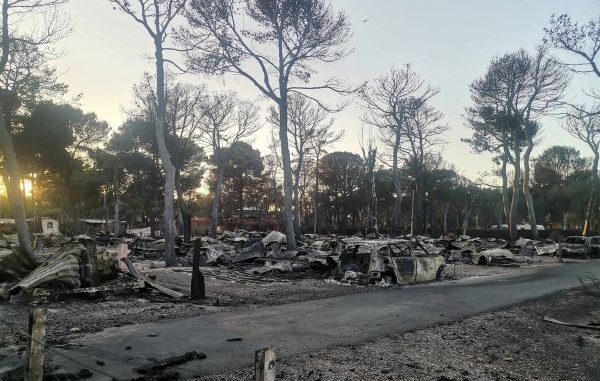
Huge wildfires have meant that 100,000s of people have been evacuated in France, and tens of thousands more in Spain. Britain khas enter its fourth heatwave of the year; extreme heat earlier in the year meant over 1,000 people died who would not have otherwise. Capitalist climate catastrophe is upon us, and we need socialist change to fight it.
El Niño Southern Oscillation, a recurring climate phenomenon caused by changes in the surface temperature of the Pacific Ocean in the tropics, has begun.
These conditions can last for months, potentially disturbing weather patterns across the globe. For example, the El Niño of 2023 hit production of maize by up to 70% in parts of eastern and southern Africa. El Niño periods can cause heatwaves, hurricanes, and both drought and heavy rain in different areas. The scientific consensus is that the increasing severity of El Niño events is being driven by worsening climate change. Within the last 50 years, there have been three ‘super’ El Niños, in 1982, 1997, and 2015, that have caused deaths and damage from freak weather events, and broken temperature records.
Disruption to agriculture caused by the El Niño is set to drive global inflation in food prices, compounding the effects of Trump’s war on Iran, and the closure of the Strait of Hormuz – which has already pushed up the price of fertiliser. Analysis by the European Central Bank in 2023 indicated that a severe El Niño could result in 9% food inflation over a period of 16 months. For small economies in Africa, the effects of this could be catastrophic.
In Britain too, already-stretched family budgets will be pushed to breaking point. In response to severe food inflation, we need emergency price caps on food and essential household goods, as well as immediate mitigation measures – such as flood defences – against the worst effects of climate change.
We need socialist change
However, to break the cycle of climate degradation and food shortages, a socialist plan of production is desperately needed. Huge investment into renewable energy, alongside research and development into technologies for electricity storage and transfer, could eliminate the need for fossil fuels.
For example, concentrated solar power – using mirrors or lenses to focus a large amount of sunlight on a small area – could supply the entire world’s electricity requirements with just 2% coverage of the Sahara Desert. However, such a project would be almost impossible on the basis of capitalism, such are the geopolitical complications and the economic power of the fossil fuel industry.
Socialist planning could also allow for the production and distribution of food based on need rather than profits for big agribusiness. This will require taking the huge monopolies in the major economies into public ownership, run under a system of democratic workers’ control. This way, it would be possible to achieve food security worldwide, alongside managing and minimising the worst effects of climate change.
A workers’ transition
In the debates about ‘net zero’, the Socialist Party argues that it is essential that there is a transition away from fossil fuels, but that must be on the basis of a plan that saves jobs, livelihoods, skills and the life of communities.
That means we need nationalisation of the energy industry, under democratic workers’ control and management, and with no compensation to the energy bosses whose already exorbitant profits have gone even further through the roof. They have enriched themselves while bills have soared and the planet burns, meaning working-class and poor people pay several times over. Compensation should only be on the basis of proven need.
That would ensure a transition that protects the lives and livelihoods both of people today and of future generations.