
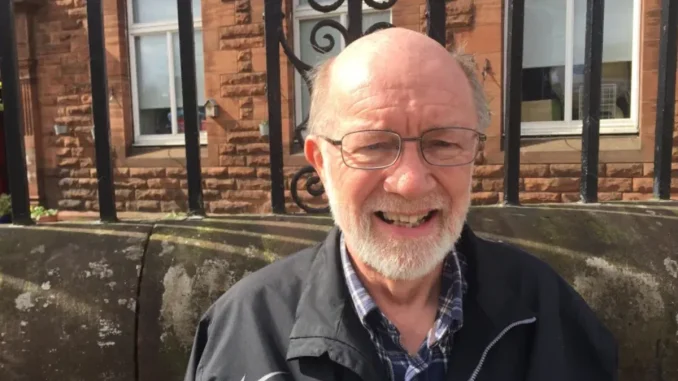
The death of Ronnie Stevenson, aged 81, is a huge loss to so many – first and foremost among them are his family to whom we send our love and condolences. For his comrades in Socialist Party Scotland, we remember a dedicated trade union and socialist fighter who left an indelible mark on the working-class movement in Scotland and beyond.
Ronnie’s contribution to the development of Militant – the Marxist tendency in the Labour and trade union movement – and its successor organisation, Socialist Party Scotland, was immense. For more than 50 years, Ronnie Stevenson was an ever-present participant in the struggle to rid the world of the horrors of capitalism and the horrific brutality it brings in its wake.
Formative years
Ronnie’s politics were moulded by his upbringing. Born in the working-class community of Bridgeton, Glasgow, in 1945, his first political activity was at the age of five, when his mother brought him to Bridgeton Main Street, where she was campaigning for funding and more teachers for the massively under-resourced primary schools in the east end of Glasgow.
As a teenager, Ronnie described himself as a “Christian socialist”, but within a few years he would embrace the ideas of Marxism. He attended Glasgow University and graduated with a degree in Chemistry. He travelled to Northern Ireland in 1968 to complete his PhD at the University of Ulster in Coleraine. Then it was on to California, where he enrolled in Cal Tech for post-doctoral studies.
His time studying away from Scotland took place amid the eruption of mass civil rights struggles in both the North of Ireland and the US, which left an indelible mark on him. Ronnie spoke about the horrific violence and state-sanctioned murder meted out by the police and security services against the Black Panthers in the US during his time there. It also embedded a profound sense of socialist internationalism in him that lasted throughout the rest of his life.
On returning to Britain in the early 1970s, his life took a different course. Increasingly, he became motivated by social equality. Ronnie trained to be a social worker in Leicester and also, while there, attended classes on Marxism.
Trade unionism and Militant
Ronnie returned to Glasgow in 1974, where he began his career as a social worker. He was an active member of Nalgo, the local government trade union, and soon became a shop steward. In those days, Nalgo was seen as a staff association rather than a trade union, where managers were often the trade union reps. Ronnie went about changing that.
By the end of 1974, the Nalgo shop stewards committee was founded – with Ronnie the main driving force. That body played a vital role in not only transforming the union in the social work department, but indeed the work of the Nalgo branch as a whole in what became, in 1975, Strathclyde regional council. It was during that year that he met Clare, his future partner, who was also a shop steward.
He was also incredibly well regarded as a social worker, for his kindness, patience and passion for changing the conditions of life for working-class communities.
Ronnie told the story about how he joined with Militant: “One of the shop stewards sold me a copy of the Militant newspaper and explained how he had come across Bolsheviks in the Labour Party, and you should be part of it.” And he did, throwing himself into the work of helping to transform the work of Militant in the west of Scotland.
In 1976, Ronnie attended the second world congress of the Committee for a Workers’ International in Germany – of which Militant was the British section – and was hugely inspired by the comrades that he met. He formed a particularly close bond of friendship and comradeship with Jim Cameron – who was also a Nalgo shop steward and later the branch chair for Strathclyde region Nalgo – and Bob Wylie, both leading figures in the development of Militant at the time. Peter Taaffe – who was the editor of Militant and later general secretary of the Socialist Party – was also one of Ronnie’s firmest friends and comrades.
As the influence of Militant grew in the Labour Party and the trade unions in Glasgow, Ronnie twice stood to become a prospective parliamentary candidate for Labour – only narrowly losing out.
The rise of Marxism in the Labour Party was a mortal threat to the right wing leaders who had long ago thrown their lot in with capitalism. The witch-hunt against Militant began in earnest in 1983, when the Militant newspaper’s editorial board was expelled. But they couldn’t stop the rise of support for our ideas.
It was in 1983 that Ronnie started work as the west of Scotland industrial correspondent for the Militant newspaper. He threw himself into the work, and when the miners’ strike began in March 1984, Ronnie spent a year in the coalfields, helping to build support and solidarity and working with those miners who were joining Militant .
He played a critical role in developing the trade union work and the caucuses of Militant supporters in the various unions we were active in. Ronnie was, during this time, elected onto the national leadership body of Militant in Britain, which he served on for a decade.
Poll Tax battle
The poll tax battle was, for Militant, one of the greatest tests and, alongside the struggle of Liverpool City Council between 1983-87, one of our greatest victories. The mass non-payment strategy was put forward by Militant as the best tactic to defeat Thatcher’s poll tax, which was being introduced in Scotland a year before England and Wales.
Ronnie was the secretary of Mount Florida anti-poll tax union. As he explained in an article he wrote to commemorate the 20th anniversary of the introduction of the poll tax in 2009: “Chic Stevenson moved that we begin to organise for total defiance of the Poll Tax. The strategy involved arguing for all councillors to refuse to implement the tax and for the building of support for a mass non-payment campaign should it be implemented.”
Chic was a Labour councillor in the east end of Glasgow and a Militant supporter who moved the motion at the special conference of Militant in Scotland in 1987.
Within four years of that conference taking place, the poll tax was gone, and Thatcher was ousted from power. Both the Liverpool council struggle and the poll tax enraged the capitalist class and their agents inside the Labour Party. The witch-hunt was stepped up, and by the late 1980s/early 1990s hundreds of socialists had been expelled – including Ronnie Stevenson.
However, that did not mean Militant was defeated. On the contrary, our support continued to grow. Scottish Militant Labour, in which Ronnie played a leading role, was launched in late 1991. The run-up to the general election of 1992 saw Tommy Sheridan – a leader of the anti-poll tax campaign and SML member – jailed. Yet, SML won over 6,000 votes, coming second in the Pollok constituency, despite the candidate being in prison.
The council elections a few weeks later saw SML end up with four councillors – and Ronnie played a key role in helping to organise this new council group.
Return to social work
Ronnie finished his full-time political work in 1995 and returned to social work in Glasgow. Before long, he returned as a shop steward for the successor union of Nalgo – UNISON – becoming the convener for social work in 2000 until he retired from work in 2013.
Over that time, he led various disputes and negotiations, including the three-week-long successful strike of 600 Glasgow fieldwork social care workers in 2007, as well as organising Glasgow workers during several national strikes on pay and pensions.
As Glasgow City UNISON social work shop stewards convenor, he helped pioneer the influence of Marxism in the branch – and that influence continues today, in no small measure thanks to Ronnie.
Every Glasgow City UNISON AGM, he would ensure a motion committing the branch to support socialism and the nationalisation of the banks and major industries was moved. It was always passed – and still is. It became known among union activists as the Ronnie motion.
On his retiral from social work, Peter Taaffe wrote: “Ronnie also symbolises to me a part of the history – a very important part – of Marxism and socialism, both in Scotland and throughout Britain in the last four decades.”
Marxism
Ronnie was nothing if not a Marxist to his core. When the debate opened up in SML in 1998 over the launching of the Scottish Socialist Party – with a proposal by a majority of the SML leadership to dissolve itself into the SSP – Ronnie and his brother Eric understood immediately what was at stake.
The very existence of the revolutionary party that Ronnie has himself dedicated his life to building was threatened. He did a great service to Marxism by taking the stand he did, thereby contributing to ensuring the ideas and programme of Militant and the CWI continued in Scotland.
Ronnie, like the comrades who went on to form Socialist Party Scotland, participated fully in the SSP, but sought to maintain a revolutionary Marxist core. Ronnie also continued to stand in elections, first for the SSP and then the Scottish Trade Unionist and Socialist Coalition.
Family
While continuing with his weekly attendance at Socialist Party Scotland branch meetings, conferences and national events, Ronnie turned to another love of his – athletics. He was a volunteer, welfare officer and a coach for Giffnock North Athletics Club, as is Clare, and encouraged and mentored hundreds of young people in the sport. He even took on, for 20 years, the role of convener of the Glasgow Athletics Association.
Dedication towards his own physical fitness was legendary. He became a viral sensation when, on his 77th birthday, a video was posted by his local gym of him training, which has millions of views, with tens of thousands of happy birthday wishes posted. Ronnie tried to reply to every one of them.
Above all, Ronnie was a loving and caring human being. His family meant everything to him. He delighted in seeing the arrival of his grandchildren, who he doted on. Nobody gave a cuddle like Ronnie Stevenson.
Socialist Party Scotland and the Committee for a Workers’ International salutes the contribution of our comrade.
Our loss is great, but it pales compared to that weighing on his family. Our condolences and love go to his partner, Clare; his daughters, Sara and Helen; his son, David and their partners; Ronnie’s brothers, Eric and Alistair; as well as Ronnie’s grandchildren and all family, comrades and friends of Ronnie Stevenson.
A dedicated fighter for the working class and for socialism is gone. But he has left us with an inspiring legacy – which we will use to carry on the struggle in his memory.
- A celebration of the life of Ronnie Stevenson will take place on Thursday 26 November, 12 o’clock in the Linn Crematorium, Glasgow.