
Report from a participant
On November 11, the first general strike since 2012 took place in the Spanish state. The two largest unions in the country, UGT and CCOO, together with tenants’ organizations and smaller unions, supported the strike call. About four million people participated. At the center were demands for affordable housing, higher wages, shorter working hours, combating precarious employment and rising living costs, as well as stopping evictions.
Anger has built up over years due to rapidly rising rents, the spread of short-term tourist accommodations, inflation, and so-called “vulture funds” – speculative financial investors and real estate funds. Maricarmen, the sadly deceased tenant in Madrid whose eviction triggered a mass movement, was also naturally a topic.
The CWI intervened in the city of Murcia. We distributed 500 leaflets, which received a lot of positive response, spread our demands, and started conversations with participants in the demonstrations.
According to the unions, strike participation in the Murcia region averaged about 50 percent but varied by industry. It was highest where unions are strongly entrenched. For less unionized sectors, it was only 10 to 20 percent. It was particularly high in education and among students and young people.
The situation in Murcia
Murcia is one of the lowest-income regions in Spain. The average gross monthly salary is around 2,121 euros, placing it second to last among the autonomous communities. With a rate of 44.6 percent, this region in south-east Spain also has the highest rates of child poverty and social exclusion in the country. This background also shaped the demands on the streets.
Migrants are particularly affected. Many have newly arrived in the country in recent years. Because the cost of living eats up wages, many of them live in precarious conditions, for example in small apartments with too many people. That was also a topic of the strike.
Morning: pickets and blockades
The day began with actions to block access to buses and trains and with information pickets at the bus station. There were more pickets at the university, in certain streets, and in front of shops.
Around noon, for example, about 250 young people, students, trade unionists, and employees marched in front of the department store “El Corte Inglés” with the slogan “Neither rentiers nor bosses!”. The picket was led by the unions CCOO and the Plataforma de Afectados por la Hipoteca (PAH) and monitored by the Policía Nacional. The demonstrators pushed for the closure of the store and were at least temporarily successful. There were whistles, chants, and shouts, including: “I would be ashamed to be a policeman” and “The police defend capital.” The atmosphere was loud and combative.
Flashing apartment keys became a symbol of this historic day. One demonstrator explained to us that the keys symbolize that with high rents and low wages, not everyone can afford an apartment. Many live with their parents, in shared apartments, or in precarious living situations.
But in parts of the city, it felt like a completely normal day. A few streets away, cafés served breakfast, shops served customers, offices and hotels were open as usual.
Evening: Large demonstration
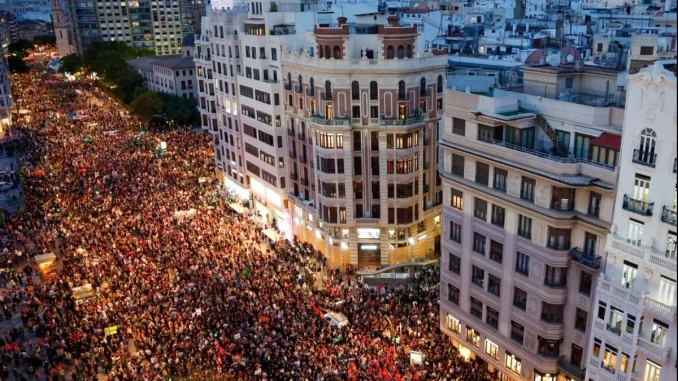
Around 7 p.m., the large demonstration started at Plaza Circular. Despite rain, more than 70,000 people took to the streets of this city of nearly 500,000 inhabitants in another step against the social crisis and also the policies of the “left-progressive” PSOE/Summer government. It marks one of the largest demonstrations in the history of Murcia.
The trade unions were present, including UGT, CCOO, and STERM. STERM is a trade union in the Murcia region that organizes employees from the public sector, education, and the railway. In its closing speech, STERM emphasized the social character of the protests and spoke out against electoral political takeover by UGT and CCOO. In addition, the tenants’ union Sindicato de Vivienda and the PAH were represented. They see the general strike as the start of a wave of protests and demand an end to forced evictions for vulnerable people, more public housing, and a limitation of investment funds in the real estate market. Also represented was the Coordinadora Juvenil Socialista – a left-wing youth organization that partly emerged from a split in the communist youth association – with a large bloc consisting mainly of students and pupils.
Criticism of UGT and CCOO
From this bloc, chants repeatedly came sharply criticizing the UGT and CCOO. A banner that drew much applause read: “The progressive government is responsible for our misery. CCOO and UGT are accomplices.” Another popular demonstration chant was: “We will not reconcile again – this is our class struggle!”
The UGT and CCOO leaderships, who co-called the general strike, certainly want to use the protests to support the ruling social-democratic PSOE in view of the new elections, to relativize the social partnership with it, and to gain support for Prime Minister Sánchez and his policies. Reforms under Sánchez, who governs with the left-wing Sumar (Unite) alliance, such as on the minimum wage, have helped some people but have not eliminated the social crisis. Their policies are responsible for the suffering and thus also for the growth of the right.
Criticism of the union leadership is therefore justified. It took tenant protests and pressure from tenant organizations, especially after Maricarmen’s eviction and death, before the general strike call took place.
But such criticism should be combined with concrete demands and proposals on how the struggle can be intensified and what a political alternative might look like. These should be addressed to the leadership of the mass organizations of the working class as well as to the many activists in trade unions and the rental movement.
The closing speeches did contain combative content. It was demanded that the general strike not remain isolated but be a step in the consistent fight for fair wages and rents, investments in health, education, and social welfare. But this should be made concrete.
For example, we proposed setting up committees in workplaces, neighborhoods, schools, and universities to broaden the movement and democratically discuss the next steps and political demands. We also proposed a three-day general strike as the next step. Some still thought this too ambitious, but a 48-hour general strike could also increase pressure on the government as well as on the political right that could win the elections.
As we wrote in our flyer:
“The Spanish working class must not be satisfied with individual reforms. Yes, the danger is great that after the elections a right-wing government of PP and Vox will gain a majority. But building a democratically organized mass movement of workers and youth is the best way to prevent that. Or, if that fails, to show these parties their limits from day one and accelerate their downfall.”
“Building a socialist workers’ mass party is necessary, one that supports such steps in dialogue with the masses and develops a political perspective for the fight against capitalism. Despite some leftist rhetoric, PSOE is a party that has made its peace with capitalism. The experiences with Podemos and Sumar also show: leftists who become co-administrators of capitalism and govern with parties of capital disappoint the hopes placed in them.”
“It is necessary to throw the system that brought about this suffering onto the stake of history. Capitalism produces housing shortages, precarious work, social cutbacks, war, and racist agitation. Against these policies, we do not need better management of capitalism, but a movement that organizes the power of the working class. The CWI fights for every improvement in the here and now, but also for a fundamentally different society. True socialism is a society in which banks and corporations are publicly owned and democratically controlled and managed. In which the economy is democratically planned, according to our needs and not according to their profits.”
One reader was so enthusiastic about these ideas that he helped distribute the flyers.
The entire leaflet that was distributed during the strike:
Bring capitalist vulture funds to their knees! Solidarity from Germany and internationally!
Prepare for three days of general strike!
Committees in companies, districts, schools, and universities!
For a socialist alternative to Vox, PP, and PSOE!
Dear comrades,
I am a socialist from Germany and bring the solidarity greetings of the Socialist Organization Solidarity (Sol) and the Committee for a Workers’ International (CWI), a Marxist organization with supporters in 23 countries. Workers and young people worldwide today look to your general strike with hope. You are part of mass movements and protests across Europe, whether Albania, France, Germany, Portugal, or the Spanish state. You show the enormous power of the working class and youth, whom the rulers have forgotten to fear. All wheels stand still if our arm wills it!
The causes of our protests are similar: decades of neoliberal policies have driven social cutbacks, privatizations, and the dismantling of public infrastructure. At the same time, prices are rising, precarious work is growing, and housing is becoming a speculative object. They have billions for armament and wars, but not for us.
The forced eviction of the 87-year-old Maricarmen shows where the logic of capital leads: after 71 years in her apartment, she was evicted because she could no longer pay the 275 percent increase in rent with her small pension. Her fate is not an isolated case. In Spain, under the supervision of the supposedly “leftist” PSOE/Sumar government, over 24,000 people were forcibly evicted in 2025 alone.
So-called vulture funds buy up rental houses, drive rents up, and profit from people’s right to exist. The reforms under Sanchez, such as the minimum wage, have certainly helped some people but have not eliminated the social crisis.
A truly left-wing government would have pushed resistance for improvements and against the power of capitalists on the streets and in factories much earlier. But now people are defending themselves. After the evacuation of Maricarmen, 500,000 people took to the streets in Madrid and 120,000 in Barcelona.
However, one-time symbolic demonstrations are not enough. The movement must grow, network, and organize the struggle – in workplaces, schools and universities, neighborhoods, and internationally. The next step could be a three-day general strike. Such a step could also be used to discuss what the movement’s goals are and how it can fight for it without risking being pushed back by small concessions, repression, and disappointment.
The Spanish working class must not be satisfied with individual reforms. Yes, there is a great danger that after the elections a right-wing government of PP and Vox will gain a majority. But building a democratically organized mass movement of workers and youth is the best way to prevent this. Or, if that fails, to show these parties their limits from day one and accelerate their downfall. It must be prevented that the union leaderships channel the current protests behind the PSOE and merely use the general strike to gain support for the social democratic-led government, which is responsible for the suffering and thus also the growth of the right.
For a successful movement, the organization of our resistance must be improved. The call for international youth strikes for November 20-22 is important, but the trade unions must also use their apparatuses and resources to organize coordinated strikes of employees across Europe, starting with a Europe-wide 24-hour general strike.
Organizing from below must be taken to the next level: with strike committees, workplace, district, school, and university assemblies, as well as networking of workplaces, schools, and universities down to the national level. Internationally, struggling colleagues should also network.
These networks could not only organize the struggle but also propose further escalation of protests – to multi-day and, depending on the state of the movement, even indefinite general strikes and the building of a massively democratically organized movement as an alternative to pro-capitalist governments.
Building a socialist workers’ mass party is necessary, one that supports such steps in dialogue with the masses and develops a political perspective for the fight against capitalism. Despite some leftist rhetoric, PSOE is a party that has made its peace with capitalism. The experiences with Podemos and Sumar also show: leftists who become co-administrators of capitalism and govern with parties of capital disappoint the hopes placed in them.
It is necessary to throw the system that brought about this suffering onto the stake of history. Capitalism produces housing shortages, precarious work, social cutbacks, war, and racist agitation. Against this policy, we do not need better management of capitalism, but a movement that organizes the power of the working class. The CWI fights for every improvement in the here and now, but also for a fundamentally different society. True socialism is a society in which banks and corporations are publicly owned and democratically controlled and managed. In which the economy is democratically planned, according to our needs and not according to their profits.
We invite everyone to organize themselves with us. The CWI, Committee for a Workers’ International, fights for the goal of building revolutionary parties in every country by applying the scientific methods of Marx, Engels, Lenin, and Trotsky. Our sections are united by the CWI, which we are building as the core of a mass party of socialist revolution, built from world-historical events and the conscious participation of Marxists.