
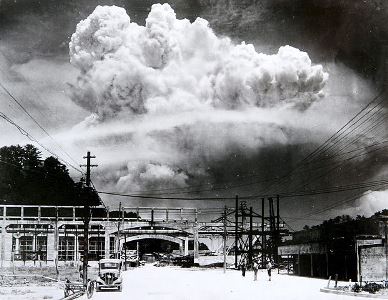
Hiroshima, 6 August 1945, 8:00 am. The ‘all clear’ sounded, signalling the end of an air raid by US bombers. Workers and school children left their homes, putting out fires, clearing damage and going to work. At 8:45 am a single US bomber flew across the city, dropping an atomic bomb that exploded above the city. The bomb killed over 100,000 people and injured another 80,000.
The allied powers had already inflicted mass death and destruction on German and Japanese cities, but the atomic bomb was qualitatively different – a single weapon killed as many people as wave after wave of conventional bombers.
On 9 August, a second atomic bomb was dropped on Nagasaki, killing over 70,000 and injuring a similar number or more. The atomic bombs also left a terrible legacy of traumatic social damage and genetic deformations.
US imperialism, with the support of Britain and other capitalist powers, had ushered in a new era of weapons of mass destruction. Fascist regimes – Germany, Italy and Japan – that came into conflict with the Western powers, and the Soviet Union perpetrated the most barbarous crimes against humanity, including genocide. Nevertheless, the strategy of mass terror against civilian populations carried out by the Western powers, particularly in the closing stages of the second world war (1939-45), were also monstrous crimes against humanity.
Hiroshima and Nagasaki will forever stand out as symbols of barbaric mass warfare. The nuclear attacks opened a new dimension of destruction. But they were the culmination of ruthless measures already deployed against innocent civilians in Germany and Japan.
Carpet-bombing German cities
In the closing stages of the war against Germany, the western powers’ (the allies’) adopted a policy of ‘strategic’ or ‘area’ or ‘morale’ bombing. The strategy was aimed not so much at backing up military operations or destroying Hitler’s military machine, as at the blanket destruction of cities and terrorisation of the civilian population.
The Nazi regime’s bombers had undoubtedly unleashed massive destruction on the people of Warsaw, Rotterdam, Coventry and other cities. The “Blitz” on London, using heavy bombers and later rockets, was a brutal strategy of terror. But in the last two years of the war, the US and Britain took the strategy much further.
Allied carpet-bombing during 1943-45 engulfed cities like Hamburg, Bremen, Dresden and Berlin in ferocious firestorms, incinerating or gassing 600,000 people – overwhelmingly civilians. The heaviest bombing was in the last few months of the war, when most of Germany was already in ruins and Hitler’s military machine was cracking.
‘Strategic bombing’ was the brainchild of Churchill’s air-force commanders, notably Trenchard, Portal and the notorious ‘Bomber’ Harris. All four of them had been involved in attempts to put down uprisings of Arabs and Kurds in Iraq (1920) and Aden (1934) through bombing and gas attacks.
Churchill and his commanders brushed aside advice from scientific advisors like Lord Zuckerman that the targeted bombing of transport infrastructure would be more effective in defeating Nazi Germany. These servants of the ruling class wanted savage revenge on Germany. They made no distinction between between the Nazi regime and the German people, who were the first victims of Hitler’s fascist dictatorship.
In the strategy of US-British imperialism, Germany’s civilian casualties were not ‘collateral damage’ – they were the actual targets of the allied offensive. And it was the same in Japan. The urban population, overwhelmingly working class, paid a terrible price for the military aggression of their ruling class.
Why did US nuke Japan?
The US president Truman and his top officials and military commanders argued that the use of nuclear weapons was essential to bring the war against Japan to a speedy conclusion. They claimed it could save the lives of a million US troops. With the high US casualties from the US capture of the Japanese islands of Iwo Jima and Okinawa, this not surprisingly struck a powerful chord with most Americans.
They did not reveal, however, intelligence assessments predicting that the Japanese regime would soon surrender. The official US Strategic Bombing Survey later concluded, “It is the Survey’s opinion that certainly prior to 31 December 1945, and in all probability prior to 1 November 1945, Japan would have surrendered even if the atomic bombs had not been dropped, even if Russia had not entered the war, and even if no invasion had been planned or contemplated.”
The Japanese military machine was cracking. In March 1945, the US Air Force firebombed Tokyo, killing 80,000 people.
Sections of the Japanese fascist regime were exploring terms of surrender with the Western allies, particularly through talks with the Soviet government. The US was demanding unconditional surrender. The Japanese ruling class wanted an assurance that the emperor, Hirohito, would not be tried as a war criminal and would be allowed to remain as emperor under US occupation. (They were not so concerned about safeguarding the rights and conditions of the Japanese people!) Truman rejected this condition, though later the US readily accepted it—after dropping two nuclear bombs.
Why was US imperialism so determined to use nuclear weapons? The historian Herbert Feis sums it up. The rush to use the bombs, only a month after the first test in the New Mexico desert, was driven by “the impetus of the combat effort and plans, the impulse to punish, the inclination to demonstrate how supreme was [US] power…” This ruthless policy of ‘shock and awe’ cost hundreds of thousands of lives.
The demonstration of US power was particularly aimed at the Soviet Union. In accordance with earlier agreements between the allies at Yalta in February 1945, Stalin was committed to launching a military offensive against Japan on 8 August.
By mid-1945, however, the underlying antagonisms between the ‘allies’ had come to the surface. Threatened by deadly fascist enemies, Germany, Italy and Japan, US-British imperialism was forced to rely on the Soviet Union for military support. At the end of the European war, however, the Stalinist regime – a bureaucratic dictatorship ruling over a centrally planned economy – occupied Central and Eastern Europe, forming a massive counterweight to the power and influence of Western capitalism.
The last thing Truman and Churchill wanted was the occupation of Japan by Soviet military forces. They were determined to pre-empt Stalin’s military offensive, dropping the first atomic bomb on 6 August and a second on the 16th. This enabled US forces under General MacArthur to occupy Japan.
A former scientific adviser to the British government, PMS Blackett, later commented: “… the dropping of the atomic bombs was not so much the last military act of the second world war, as the first act of the cold diplomatic war with Russia now in progress.” For this diplomatic demonstration of nuclear power, two large cities were wiped out.
Capitalist leaders continue to justify the use of nuclear weapons against Japan in 1945. But the historical record is clear. Hiroshima and Nagasaki were not necessary for US imperialism to bring about a rapid defeat of Japanese fascism. Atomic bombs, weapons of mass destruction on an entirely new scale, were used purely to demonstrate US power.
An unlimited nuclear arms race
Most of the top scientists (124 out of 150) working on the ‘Manhattan Project’, the massive US scientific-industrial effort to build nuclear weapons, came out against the use of an atomic bomb against Japan. Many favoured a public, demonstration explosion, giving the Japanese government time to surrender. While it was believed that Hitler could be preparing nuclear weapons, the scientists felt it was justified to work on a US bomb.
After the defeat of Germany, however, when it became clear that the Nazi regime had not been able to develop nuclear capacity, they considered nuclear weapons no longer had any moral justification. The political representatives of the US ruling class brushed aside these scruples.
In a letter to Truman, a group of scientists including James Franck and Leo Szilard warned that the use of the atomic bomb would trigger an unlimited race for nuclear armaments. Their warning was amply borne out. In response to the US development of the even more destructive hydrogen bomb and intercontinental ballistic missiles with nuclear warheads, the Soviet Union developed its own massive nuclear armoury.
Smaller powers, like Britain, France and China followed suit. The powers accumulated enough nuclear warheads to wipe out the planet many times over. This weaponry absorbed a huge share of available resources for science and technology, which could have been directed to socially useful projects.
Trying to justify nuclear weapons, Western leaders argued that the balance of nuclear power, with mutually assured destruction, ruled out war. But while nuclear weapons ruled out a world war between the superpowers, which would have resulted in mutual destruction, they did not prevent an endless series of ‘small’ wars, which were often manipulated by the powers for their own ends. Between 1950 and 1989, these wars claimed the lives of between 20-30 million people.
After the collapse of the Soviet Union after 1989, Western leaders claimed there would be a ‘peace dividend’, with the reduction of nuclear stockpiles and armament spending generally. True, the number of nuclear warheads has been reduced. But there are still around 27,600 warheads (2,500 on ‘hair-trigger alert’) with a destructive power of 5,000 megatons (equivalent of 5,000 million tons of TNT).
At the same time, the relatively stable relationships of the cold war, with two superpowers dominating rival blocs of regional powers and client states, there is a much more unstable, dangerous situation.
Over 40 states have nuclear weapons or the capacity to rapidly produce nuclear weapons. Superpowers may regard nuclear weapons as the absolute last resort. But can it be totally ruled out that regimes like North Korea or Pakistan, given a regional conflicts and internal upheavals, would not resort to a nuclear strike against their enemies?
The major powers claim that they are committed to arms reduction and nuclear non-proliferation. But this is completely hypocritical. Even now the US is developing a new generation of tactical nuclear weapons. In Britain, Blair is secretly preparing to replace the ageing Trident nuclear force – at an estimated cost of at least £15 billion.
In 1945, Franck, Szilard and other Manhattan Project scientists warned: “protection against the destructive use of nuclear power can come only from the political organisation of the world.” Sixty years later, the failure of the United Nations and numerous international “arms control” treaties to stop the proliferation of nuclear shows this to be a utopian dream under capitalism. The competitive drive of national capitalist states for ever-greater wealth and power makes arms accumulation and wars inevitable.
“The political organisation of the world” requires a worldwide change in the social system: Democratic economic planning instead of the anarchy of the market. Socialist democracy instead of the predatory rule of capitalists and landlords. Only the democratic control of society by the working class can provide the basis for real international cooperation and global planning.
Hiroshima and Nagasaki are perpetual reminders of the barbarous, destructive potential of capitalism. Today, because of deepening global crisis, the world has become a much more volatile and dangerous place. The alarming proliferation of nuclear weapons makes socialist change even more urgent.
Fight for a communist world or capitalism will destroy humanity!
Excerpts from the editorial of the August 1945 supplement of Socialist Appeal, the newspaper of the Revolutionary Communist Party (British Trotskyists), on the dropping of the atomic bombs on Hiroshima and Nagasaki:
“… During the war, technology has evolved faster. Labour productivity has increased enormously in the most important warring countries. Thus, the problem of exploiting the surplus produced in capitalism has reached a more acute stage than a quarter of a century ago.
The technique of destruction has progressed even faster than the technique of construction. As weapons of destruction, the V1 and the V2 are already obsolete. The lightning war of tanks, planes, and guns is another age’s product. The horrific bomb attacks on the world’s major capitals are just a child’s play compared to the destructive forces of the nuclear bomb.
The atomic bomb is the highlight of this war in the cold-blooded search of the imperialists for the best way to scientifically destroy entire populations in war. Imperialism goes far beyond the primitive looting of cities and the slaughter of her inhabitants by amateurs like Genghis Khan and Atilla the Hun. The extinction of every man, woman, and child in a city, in seconds, is a massacre that is unequal in the long cruel, and bloody history of humanity.
The Japanese reported on the effects of the nuclear bomb on the former city of Hiroshima:
“Medical aid organizations that rushed from neighbouring districts were unable to distinguish the dead from the injured, let alone identify the dead.”
“The effects of the nuclear bomb were so powerful that virtually all living beings – humans and animals – were literally burnt to death by the enormous heat and pressure generated by the explosion. All the dead and injured were burned beyond recognition.”
The hypocrisy of the Allied imperialists in their condemnation of fascists in the use of poisonous gas in Abyssinia, as well as the rockets and flying bombs against Britain, is hardly credible.
And the imperialist lackeys – the Stalinists and Labour leaders who scourged the crimes of the Nazis yesterday, are boasting today about the horrific tragedy of Hiroshima and Nagasaki. Not a word of condemnation or protest these atrocities committed by their masters. All of this is an educational lesson in the classic mechanisms of morality. There is no crime that would be too horrifying for the imperialists to commit when their class interests are threatened.
The madness of capitalism is so great that Anglo-American imperialists spent $500 million to develop the bomb. This almost corresponds to the entire pre-war budget of Great Britain, one of the richest countries in the world. But in peacetime, the money for researching scientific problems was only $100.000
Against this background, the total anachronism of the capitalist system stands out. The existence of state borders, customs barriers, state armies, navy, and air force, the delirium of production for profit seems like a horrible nightmare.
The survival of humanity requires the working class to destroy the bonds of production built by the existence of the capitalist system. The need for international socialism as a planned global economy has never been more obvious in history than it is today.
…All the traitors and renegades in the working-class ranks, the Stalinists and reformists who relied on a gradual solution to the evils of capitalism, have experienced a shocking refutation as the nuclear bomb develops. The main task for those who even want the continuation of the human species, even civilization, is to clearly explain the alternatives to the workers of all countries.
…The age of nuclear energy is a warning to the working class of all countries that it is no longer a question of communism or barbarism, as Lenin urgently warned – it is now a question of communism or nothing. The continuation of the capitalist system anticipates the complete destruction of humanity.
Workers of Great Britain and the world! The nuclear bomb is the final warning. Fight for a communist world or capitalism will destroy humanity.