
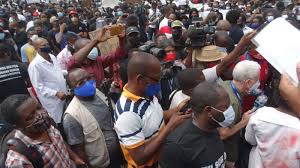
Mass protests broke out in Luanda, the capital city of Angola, on 28 July, in one of the latest popular protests in Africa against poverty and oppression. At the behest of the International Monetary Fund, the government had announced a cut in fuel subsidies, causing a 33% rise in the price of diesel. This is also having a knock-on effect on food prices, as companies attempt to pass on distribution costs to customers. There have been 22 confirmed deaths, over 200 injuries and over 1,200 arrests, resulting from violent police repression, including reports of live ammunition used against protesters.
Taxi strike
The movement started with a three-day strike called by taxi drivers’ unions against the price increases. In Luanda, minibus taxis are the only real form of public transportation, carrying around 90% of commuters. Despite the attempts of some union leaders to call off the strike, much wider layers of the working class and urban poor have been drawn into the uprising. Shops have been looted as protesters desperately search for access to food, and overflowing frustrations have resulted in damage to buildings and vehicles. Demonstrations have also broken out in other towns and cities in Angola. On 29 July, a 16-year-old protester was shot and killed by police in the second-largest city, Lubango.
Angola is an oil-rich country. Only Nigeria has larger reserves in Africa. There are also important reserves of diamonds, gold and copper. However, most of the population live in poverty. The average monthly wage is roughly 70,000 kwanzas, or £56. Inflation is running at 20%, unemployment is at 30%, and outbreaks of cholera, malaria and rabies are commonplace.
Portuguese imperialism
Angola was formerly a colony of Portugal, established gradually through colonial aggression and economic dominance, and eventually formalised at the 1884-85 Berlin Conference of European imperialist powers that carved up Africa between them. After World War Two, independence movements started to grow, as the urbanised working class started to find its feet and its voice. The rural workforce also started to organise ad-hoc illegal unions. In 1961, the war of independence started, with various militias fighting against the colonial occupiers. This process came to a head in 1974, with the overthrow of the Nato-backed Estado Novo military dictatorship in Portugal in the Carnation Revolution. As a result, the People’s Movement for the Liberation of Angola (MPLA) – supported by Soviet and Cuban military intervention that stopped the 1975-76 invasion by the army of the then South African Apartheid regime – was able to declare Angolan independence in November 1975. A civil war between the MPLA and opposition forces, however, continued until 2002.
The MPLA established a largely nationalised, planned economy, which, based on oil exports, allowed for significant economic growth and industrialisation. However, the lack of any meaningful workers’ control or democracy in the economy meant that corruption and embezzlement were rife. After the collapse of the Soviet Union in 1991, the MPLA government moved quickly to supporting capitalism and neoliberalism. For a time there was economic growth based on oil and raw materials. Corruption is still rife, alongside state repression and violence against political opponents of the regime.
New party
The MPLA government, despite its radical past, acts today in the interests of neo-colonial capital. This is recognised and understood by wide layers of those participating in the protests. The movement needs to give birth to a new working-class party, drawing in wider layers of the urban and rural poor, with the objective of bringing to power a government led by the workers and poor that carries out a socialist programme. This would include bringing the large state oil company Sonangol – which is subject to a creeping programme of privatisation under the MPLA – into democratic workers’ control and ownership, alongside the nationalisation of all foreign assets in the oil industry with compensation paid only based on proven need. Such a programme would free the huge material wealth of Angola to be used to raise living standards, invest in healthcare, education and infrastructure, and stand out as a beacon to all those fighting back against capitalism and neocolonialism in Africa.