
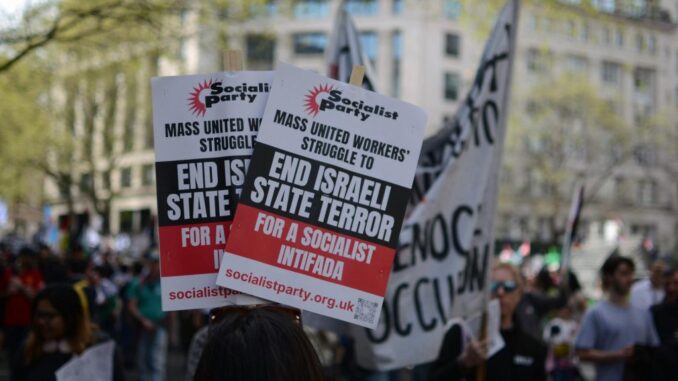
Hundreds of deaths in Gaza from malnutrition, almost half of them children. Hundreds of people slaughtered while seeking food. And now the Israeli military says it is preparing for the forcible displacement of one million people from Gaza City. The official number of those killed in Gaza has topped 61,000 but that is undoubtedly, tragically, an enormous underestimate.
Huge demonstrations have continued to take place in Britain for the last 22 months in a sustained movement that had no reason to cease after the July 2024 elections which brought in a Labour party government with Keir Starmer as prime minister. Marchers demand an end to the horror. That is not on offer from the Starmer government, which kowtows to US president Trump and the interests of the capitalist class.
A July YouGov poll found that almost two-thirds of the population sympathise a great deal or somewhat with the ‘Palestinian side’. The figure rises to 77% among those who voted Labour in the general election.
Instead of representing the views of the voters and protesters, Starmer’s Labour has sought to criminalise the anti-war movement with the proscription of campaign group Palestine Action. Two activists broke into an airforce base and damaged two planes by spraying paint in their engines. The ban makes membership or support for Palestine Action a criminal offence punishable by up to 14 years in prison.
State Repression
But in the past month, hundreds of people have been arrested under the Terrorism Act – many of them pensioners – for protesting against the proscription. The attempt to undermine sympathy for the plight of the Palestinians is backfiring. One poll even found that seven in ten Labour members believe the government was wrong to proscribe Palestine Action as a terrorist group.
The opposition to the war is widespread across society. Hundreds of thousands of workers and young people protest across the country. The most recent demonstration on 6 August was among the largest this year, showing that the movement has not been intimidated by Starmer’s threats.
Those arrested on the separate courageous Defend Our Juries protest in opposition to the Gaza slaughter and the ban on Palestine Action included a former magistrate, a retired multinational executive, an ex-army colonel and a priest from Buckinghamshire, whose congregation applauded his stand. But the movement needs to have the organised working class at its heart, with its huge potential to challenge the warmonger capitalists for power.
Starmer’s government has picked up where former Conservative party Home Secretary (interior minister) Suella Braverman left off. She sought to tar protesters as “hate marchers” in October 2023. But her threats to ban the marches also backfired, and led to the biggest demonstration to that point, and her removal as Home Secretary. Then her government was smashed in the general election because of its war and austerity agenda – and five independent anti-war MPs were elected. However, the movement has not yet succeeded in ending British government support for Israeli state terror or Trump.
But this ban, the arrest of 523 people for sitting outside Parliament with signs, not to mention the maintenance of the anti-union laws on the statute books despite commitments to remove them, are not the actions of a confident government but of one anticipating the mass opposition that will shake it as it continues to pursue its own austerity and war agenda.
Undermining their System
There is clearly concern among the defenders of capitalism that these laws will exacerbate the already declining legitimacy of the institutions they rely on such as the police and the court system.
Research last year found that only two out of five people in England said they trusted the police. However, as the general election showed, alienation from the establishment political parties is even greater as they pursue attacks on living standards as well as war. Labour won, but with the votes of only one in five of the electorate.
A former minister under Tony Blair’s Labour government, Peter Hain, has warned that the Palestine Action ban “will end in tears for the government”. Baroness Shami Chakrabarti told The Independent newspaper that the “proscription of Palestine Action is in danger of becoming a mistake of poll tax proportions.” That was a reference to former-Conservative Prime Minister Margaret Thatcher’s unpopular policy that was defeated by a mass movement – which also brought her down.
However, opposition from leading establishment figures cannot be relied on to defeat this major attack on the right to protest – the outrageous labelling of peaceful protesters as terrorists – which if left in place can lead to the government proscribing other protest and workers’ organisations. In particular, the trade union movement needs to make defending the right to organise and protest a more pressing task.
Anti-Poll Tax Campaign
Defend Our Juries has pledged to increase the number of protesters facing arrest from 500 to 1,000, and argue that the courts and prison systems being blocked up will lead to the ban being overturned and Home Secretary Yvette Cooper removed from office. This tactic has also been compared to the mass movement against the poll tax. But this is overstated.
Between April 1990 and September 1993 the number of cases of unwillingness, or inability, to pay the poll tax taken before the magistrates (in just England and Wales) totalled 25 million, involving an estimated 14 million people.
While we salute the heroism of the Defend Our Juries protesters, who have bravely faced arrest and convictions for terrorism to raise awareness of the government’s outrageous attacks on the right to organise, it is correct that the movement discusses what are the best tactics to achieve our aims, including why mass organisation is key to building the anti-war movement and why campaigning for the more than six million-strong workers’ movement to play a central role in it is vital.
Mass non-payment of the poll tax, with around a third of the entire adult population facing some form of legal action against them over a four-year period, laid the basis for an organised movement to make the poll tax unenforceable.
But it was one of many tactics that were developed during the years-long campaign, including mass coordinated court attendance with campaigners taking up the right to a ‘McKenzie Friend’ to provide vital support there and challenge the court’s ability to intimidate non-payers. The movement organised bailiff busting, and battles in workplaces against wage deductions, among other tactics.
Working-class organisation was the essential foundation on which the development and implementation of non-payment and all the other tasks of the campaign could be built. That organisation was built first locally and then connected regionally and nationally in the All-Britain Anti-Poll Tax Federation. The leadership at every level was elected and accountable.
Like Starmer and Cooper, Thatcher faced warnings too. Members of her Cabinet foretold the dangers at an early stage in the preparations for the poll tax, saying it would be uncollectable. But this outcome was not a forgone conclusion. It still had to be organised.
Thatcher claimed to be the Iron Lady. This was never true. Her confidence came from her correct assessment of the non-preparedness to struggle of the right-wing leaders of the trade unions and the Labour Party, which was more concerned with expelling socialists and transforming the party into one that defended the interests of the capitalist class.
But through the leadership of those socialists organised through Militant, now the Socialist Party (CWI England & Wales), the opposition to the poll tax was given mass organisational form involving 18 million people and won. It was our understanding of the potential for the working class, flowing from its role in capitalist production, to be the agent of socialist change that allowed us to play this role.
There is nothing even remotely iron-like about Starmer’s Labour. But, posed by the hugely popular announcement of independent MP and former Labour leader, Jeremy Corbyn, and Zarah Sultana, a suspended Labour MP who resigned from the party in July, is the potential to create a new workers’ party that could be a political voice for the anti-war movement as well as the workers in trade unions and across society, fighting for a socialist alternative to war and austerity.
The creation of such a party would terrify Starmer, enormously strengthen our movement in Britain, and give confidence to the working class and oppressed fighting Trump and Netanyahu worldwide, to build parties that struggle for the ending of this rotten capitalist system and the war and exploitation inherent to it.