
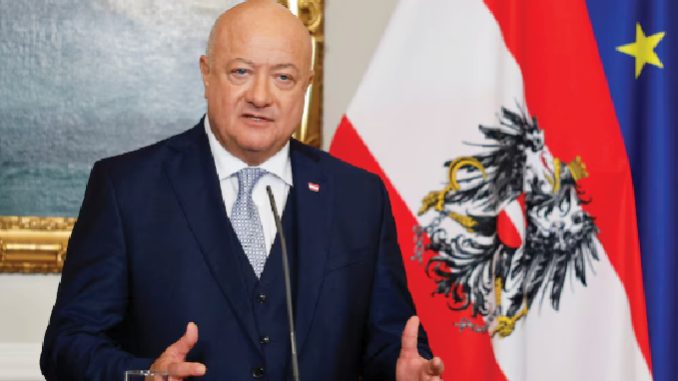
The Austrian ruling coalition of conservatives (ÖVP – People’s party), social democrats (SPÖ) and liberals (NEOS), formed in March this year six months after a general election, is implementing an austerity package totalling 15 billion euro in 2025 and 2026 (6,4 billion in 2025, 8,7 billion in 2026). Officially these are not cuts but “consolidation”. This is on the back of a deep economic crisis, The Austrian economy, especially its car industry, is closely connected to Germany’s. Austria is suffering the longest economic recession since it was reestablished as an separate state in 1945. Already Austrian companies have been laying off staff, 10,000 industrial jobs have been lost and workplaces have been closed. People fear for their jobs on top of an inflation rate that is nearly double the Eurozone’s 2.2% annual increase, in Austria the rate was 4% in September.
However, union leaders agreed in late September to a wage agreement in the metal (engineering) industry below inflation in the metal industry – 2% for two consecutive years at a time when workers are suffering from inflation. These are real wage losses. The metal industry in Austria, as seen as the ‘heavy battalions’, usually set the standards for the wage negotiations in other industries. The union leaders argued that this low settlement “should provide job and income security”, but these words are more of a hope than a certainty.
Spearheading, and paving the way for the bosses’ attack on wages, though has been the coalition government granting most pensioners a pension increase below the yearly average inflation rate. The government, with the acquiescence of the trade union leadership, also opened up a renegotiation of the public sector workers’ two year wage agreement – which originally had factored in a wage rise above inflation. The new agreement agreed in early October means no wage increase until June 2026, as well as a three year agreement which includes 1,5% wage rises on average each year. This is. at least for this year, distinctly below inflation and will mean real wage losses for years.
The government cuts also include raising the age of early retirement, pensioners having to pay more for health insurance and cuts in climate measures – while investment in military spending is being increased.
These cuts have resulted in a loss of support for the SPÖ, which is justifying the cuts with a ‘lesser evil’ argument that this is preventing the formation a government led by the far right Freedom Party (FPÖ) and even worse cuts. In fact though the coalition negotiations between the FPÖ and People’s Party at the beginning of the year had seen a cuts plan which basically amounted to the same sum of cuts that the current coalition is implementing.
The FPÖ, despite having leapt in the election from being the third biggest party to the largest one with 28.8% of the vote, eventually refused to join a government in which it would not be the dominant. After the bad experience of being a junior partner in a coalition government after 2000 the FPÖ’s strategy now is to strengthen itself while this government of what the it calls the “establishment parties” fails. And this is working, the FPÖ has seen a surge in the opinion polls to 38% currently. In contrast the SPÖ has further lost support and is down to 17% compared to 21.2% in last year’s election. 35 years ago the SPÖ was still getting over 40% of the vote. Vice chancellor Andreas Babler had been elected SPÖ chair in 2023 with a few ‘left’ demands such as a shortening of working hours to 32 hours a week and taxing the rich – but none of his original demands have been included in the government’s agenda. However the trade union leadership, the majority of whom are tightly connected to the SPÖ, is complicit in selling the cuts to the working class and refusing to organise resistance.
But not only is the federal government implementing cuts, so are regional governments – especially Vienna, which is governed by a coalition of social democrats and liberals, with the social democrats in a dominant majority within that coalition. Those cuts include a raising of public transport tickets – from 365 euros a year to 467 (a 30% increase) as well as increasing the price of cheap public transport tickets for youth and pensioners. The cuts also include reductions in social benefits which will affect families with children. Blind and deaf people in the past had free public transport, the plan was that they should now pay 300 euros a year, but the Vienna City Council withdrew from that measure once several NGOs had pointed out how it would affect people.
This retreat shows that the cuts are not set in stone and that both regional and federal governments can be put under pressure – if there is a fightback. This fightback should be organised by the unions. But this would mean that those unions which are still politically connected to the SPÖ will need to be prepared to challenge and break from this party and its policies. Likewise the GÖD public sector union which is dominated by the fraction of the conservative ÖVP, needs a fighting and combative leadership.
In Vienna, the Communist Party (KPÖ) as well as the left wing alliance LINKS have a total of over 40 district councillors – they also have a responsibility to mobilise resistance against the cuts. Like in many other countries, Austria needs a new workers’ party, given the role of the social democratic party in implementing cuts and being totally integrated into the capitalist system.
The KPÖ has been filling some of the vacuum with making gains in local and regional elections around questions such as housing and taking only a workers’ wage for its elected officials. However if it fails to consistently oppose the cuts and present a credible alternative, that potential will be wasted. To do this means the KPÖ having a programme that rejects the capitalist cuts logic and presents an alternative- a socialist programme. However in Graz, Austria’s second largest city where they lead the city council, the KPÖ only very slightly improved one part, referring to the first half of 2026, of the new three year public sector wage deal. However they accepted the austerity limits on wage rises until the end of 2028. This should not be repeated, the KPÖ should say that the working class, and less well-off middle class, should not pay for capitalism’s crisis. As part of such an approach the KPÖ should appeal to former supporters of Babler to join them in a fight against the cuts – and also have a principled stance against joining pro-capitalist governments at city, federal state or national level – which would only mean more cuts.
With the complicit role of the trade union leaders in accepting attacks on workers’ rights and living standards, anger is mounting in society – this is a gift to the far right. Combative unions and a political representation of the working class are urgently needed. Sozialistische Offensive (CWI in Austria) will fight for the demands mentioned above, defending living standards, as the only way to combat the further rise of the far right – and a socialist alternative to the never ending capitalist crisis. For example, our currently small forces are, for example, involved in organising resistance among teachers as part of the public sector workers whose wages are under attack. Through such activity we aim to help in the fight to resist austerity while building the socialist forces to end wars and the general misery of capitalism.