
What the Steady State report tells us
On 16 October the Steady State organisation published a report warning that the second Trump administration in the US, “is placing the nation on a trajectory toward competitive authoritarianism: a system in which elections, courts, and other democratic institutions persist in form but are systematically manipulated to entrench executive control.” The Steady State was founded in 2016 by more than 340 “former senior national security professionals” from the CIA, FBI, State Department, and departments of Defence and Homeland Security, alongside former ambassadors and diplomats. In other words, the Steady State represents a significant section of the senior bureaucracy of the US state from recent decades. Above all, the Steady State report confirms the serious splits in the US ruling class. The broad political consensus that existed in the post-World War Two era has collapsed. But there is no agreement about the new policies necessary to advance the interests of US capitalism in the new multipolar era of capitalist crisis (see here).
The political form of the dictatorship of capital is a crucial issue for Marxists. The CWI has pointed to the crisis of bourgeois democracy – one of the forms of the dictatorship of capital – in the advanced capitalist countries, whose political landscapes continue to be swept by major changes. Most serious capitalist commentators and ideologues agree. Support for the historic political parties of capitalism has weakened, and, in many cases, collapsed, alongside a collapse of confidence in other institutions of capitalist political rule. At this conjuncture right-populist politicians and parties are the main beneficiary and in many countries are likely to enter government in the next period. Right-populism attempts to rally a social base for capitalism with an appeal to conservative, nationalist and other reactionary ideas and the vacuum of independent working class political organisation, combined with the weakness of left politicians and parties, is giving them the opening. With Trump and the MAGAfied Republican Party a right-populist government is already in power – for the second time – in the world’s biggest economy and still dominant imperialist power.
Above all else, a Marxist analysis looks at the balance of class forces to come to a characterisation of the political form of capitalist rule. Bourgeois democracy, based on parliamentary rule, regular elections, and, in the modern era a universal franchise, is the most stable form for capitalism, most stable under conditions that allow concessions to the working class. For Marxists, what is crucial under bourgeois democracy is the status of “the institutions of proletarian democracy” as Trotsky called them. These are the trade unions, independent workers’ political organisations, such as parties, and the democratic rights needed to wield them as weapons in the class struggle, such as the right to free speech and assembly, the right to organise, bargain collectively, protest, vote and stand for political office.
Capitalist Bonapartist regimes arise when the class struggle “reaches its highest tension” and society polarises between the forces of the working class and the capitalist class which balance each other. This elevates the capitalist state – the Executive Committee of the ruling class – to a greater relative political independence from the ruling class. This does not mean however, that a Bonapartist regime acts exclusively against the working class. In periods of crisis, such as today, the tensions between the different layers, groups and factions within classes polarise too, as has happened within the US ruling class. Faced with an impasse in such a situation, a Bonapartist “arbiter” will act against different wings of the ruling class too. Bonapartist regimes include its ‘hard’ form in a police or military dictatorship, usually characterised by severe repression against “the institutions of proletarian democracy” and the curtailment of democratic rights. But ‘softer’ regimes of parliamentary or presidential Bonapartism can develop too, where repression and other authoritarian measures play a greater role. In such regimes the institutions of bourgeois democracy can be maintained, albeit increasingly sidelined, subordinated or neutralised. Likewise, democratic rights can formally remain, including the rights of the “institutions of proletarian democracy”, but increasing repression limits these rights in practise. Finally, under fascist political regimes independent workers’ organisation of any form is completely smashed and all democratic rights suppressed.
There is of course no ‘pure’ form of bourgeois democracy, Bonapartism or fascism. Every capitalist political regime has its own features. There are elements of Bonapartism under bourgeois democracy, and vice versa; and elements of fascism under Bonapartism, and vice versa. Each capitalist political form emerges from a particular balance of class forces. This balance shapes both the possibilities for the working class to challenge the dictatorship of capital and the possibilities for the ruling class to resist these challenges. By making the balance of class forces central to its analysis, Marxism avoids being distracted by secondary and superficial features. This includes the drama of bourgeois politics which has become a soap opera in the polarised situation created by the crisis of bourgeois democracy.
Provocatively, the Steady State report uses the US intelligence services’ methods for assessing foreign governments for “indicators of democratic backsliding and authoritarian trends”… and applies them to the US. It makes for very interesting reading and is a useful summary of ‘the case’ against Trump 2.0. But it goes without saying that the report does not offer a Marxist class analysis. This leaves it with fatal blind-spots, conflating different elements, phenomenon, and processes that need to be disentangled to come to a clear understanding of Trump 2.0, what it represents and how it is likely to develop in the future. So, what evidence does the Steady State report present and how do Marxists evaluate it?
Repression Under Trump 2.0
The Steady State report confirms the dramatic increase in repression under Trump 2.0, unprecedented in recent decades. This has been most decisive in the changes to the operations of the now globally infamous ICE (the Immigration and Customs Enforcement federal agency). On 14 October, POLITICO magazine interviewed John Sandweg, a former acting-ICE director during the Obama presidency. He describes the change in policy at ICE as “unprecedented” in its nearly twenty-five-year history. Sandweg describes the previous ICE policy – including under Trump 1.0 – as “worst first”, meaning the priority of the agency was to investigate, track down and deport migrants with a criminal record. This has now changed in favour of widespread raids and indiscriminate area sweeps to arrest as many undocumented migrants as possible regardless of their criminal record. The latest figures confirm that for the first time those in ICE detention with no criminal record outnumber those with one.
There are an estimated fourteen million ‘undocumented’ migrants in the US, most working in low-wage, informal jobs and living in low-income neighbourhoods. The new policy of raids on workplaces, and ‘Home Depot’ carparks where day labourers congregate, alongside traffic stops and apartment building sweeps is a dramatic increase in repression against a section of the working class. As Sandweg points out, “by and large, your really serious criminal threats don’t do shifts at the local car wash for minimum wage.” Inevitably, this repression impacts wider sections of the working class, such as documented migrants and those from a migrant-family background, especially Latinas. Racism is clearly a basic, if unofficial, criteria for ICE operations. Trump 2.0 hopes to go further through ending rights to ‘birthright citizenship’ for the children of undocumented migrants.
Agents from across the different US law enforcement agencies have been redeployed to support ICE. In his ‘Big, Beautiful Bill’, Trump increased ICE’s budget by $75 billion and announced plans to double the number of agents to 20,000. Sandweg points out that it would normally take ICE three to four years to recruit and train this many agents. On Trump’s compressed timescale, he warns, ICE will struggle to conduct background checks and interview new recruits.
The new ICE recruitment drive has, in the main, targeted existing law enforcement agencies. As an inducement to join, new recruits are being offered a signing-bonus of up to $50,000, alongside student debt repayment. However, recruits are presenting themselves from even more worrying backgrounds. In an interview with the Observer (London) newspaper, Enrique Tarrio, a figurehead of the far-right Proud Boys militia, pardoned by Trump for his role in the 2021 Capitol riots, claimed that “close to a dozen” Proud Boys had applied for jobs with ICE. The police and other law enforcement agencies have always been magnets for far-right individuals and organisations. The institutionalised racism in US police forces has driven two waves of Black Lives Matter mass protests in recent years. As political polarisation deepens this could develop further with ICE becoming a greater pole of attraction
In response to anti-ICE protests in Los Angeles, Trump deployed some 4,500 National Guards to the city, alongside 700 marines who spent a month guarding two federal facilities before being withdrawn. The LA deployments were a new challenge to the right to protest and a dramatic escalation of repression against those sections of the working class targeted by ICE.
Using the assassination of Charlie Kirk as a pretext, and amidst a concerted campaign to lay the blame for his murder on “the left”, on 25 September Trump signed an Executive Order (EO) designating so-called “Antifa” (anti-fascist) groups as “domestic terror organisations”. Days later, a Presidential Memorandum demagogically stated that “a violent assault against democratic institutions, constitutional rights, and fundamental American liberties” is underway in the US. It gives a sweeping definition of “Antifa” describing its “common threads” as, “anti-Americanism, anti-capitalism, and anti-Christianity; support for the overthrow of the US government; extremism on migration, race, and gender; and hostility towards those who hold traditional American views on family religion and morality.” This clearly lays the basis for a return of increased repression against the workers’ movement, the socialist and Marxist left, not seen in decades, and even repression against the pro-capitalist liberal ‘left’. The revocation of visas is already being used to stifle foreign anti-Gaza war and pro-Palestinian activists, leading to detentions and deportations.
Attacks on the Workers’ Organisations
Trump 2.0 is clearly a threat to the workers’ movement. Trump himself has been described as the “Union Buster-in-Chief” because of his administration’s attacks on federal government workers and their unions. Trump 2.0’s determination to cut government spending has so far seen nearly ten per cent of the federal workforce fired, some 300,000 workers. This is driven, in part, by the crisis of US capitalism and its ballooning government debt and budget deficit, and in part, by an ideological opposition to ‘big government’. Either way, the road to achieving this goal lies through cowing the federal workers’ trade unions.
In Executive Orders in March and August Trump removed union rights from more than one million federal workers. The second Executive Order was issued days before the US’s Labor Day public holiday in a deliberate provocation. To carry through the attack, some federal agencies have been redesignated as involved in “national security” work, including, rather implausibly, the National Weather Service and the National Oceanic and Atmospheric Administration. Alongside the March EO the Department of Justice filed pre-emptive lawsuits against several federal workers’ unions, with the Attorney-General declaring, “We are taking this fight directly to the public-sector unions”. In the wake of these EOs, the Department of Veterans Affairs has cancelled the collective bargaining agreement covering 400,000 workers and the Environment Protection Agency the collective bargaining agreement covering 8,000 workers.
Repression & Bourgeois Democracy
A brutal escalation in repression against sections of the working class is underway in the US. The rapid change in the situation facing migrants and those with a migrant-background, federal workers and political activists will be chilling, even terrifying. Insecurity and uncertainty about the future has been stoked for millions and arbitrary harassment and the disruption of daily life stepped-up.
An element of repression always exists under regimes of bourgeois democracy. It can never be otherwise under capitalism which is a fundamentally undemocratic system where a tiny minority exploits the vast majority. The capitalist class was forced by the working class to concede the right to vote and Trotsky explained that it remains “mortally afraid” because the working class can use the democratic rights it has won to challenge the capitalists’ rule. Therefore, the ruling classes retain a repressive apparatus at the core of the modern capitalist state even under the most democratic regimes. Where the ‘line’ is drawn between bourgeois democratic rights, the legal limits placed on them by the capitalist state, and the level of repression used to enforce these limits, is in a permanent state of ‘negotiation’ via the class struggle. The working class wins concessions at one point; the ruling class pushes back and imposes limits at others.
The “worst first” policy of ICE before 2025 did not prevent the Obama administration from deporting migrants at a rate that Trump 2.0 is in no danger of yet matching. In 2012, over 400,000 were deported, although this included a very high proportion of recent arrivals. By contrast, in its ten months in office, Trump 2.0 has deported 234,000, embarrassing for Trump 2.0, especially given many right-populists’ anti-Obama rhetoric. Across the bourgeois democracies there has been a huge increase both in anti-migrant propaganda and action against migrants and those from migrant-backgrounds regardless of the political character of the government. ‘Birthright citizenship’ is not the norm under capitalism. Only thirty countries worldwide recognise this right. The bourgeois democracies of Europe do not generally recognise it.
In the post-World War Two period the capitalist state has alternated between consciously excluding organised far-right and fascist elements from its police and military forces and leaning on them as unofficial auxiliaries depending on the demands of the class struggle. The Trump regime gave a massive boost to far-right groups and militias by pardoning over 1,500 participants of the 2021 Capitol riots, including high-profile leaders of right-wing militias. But in general, Trump maintains a distance from the far-right militias, whilst being careful not to alienate them, cultivating an ambiguity about the relationship. Nevertheless, an environment that emboldens the far-right, their militias and fascist groups is being consciously fostered. For example, groups like the Proud Boys are organising campaigns to identify left-wing activists and publicise personal details, including workplaces and home addresses.
Before Trump’s “Antifa” EO the Labour government in the UK listed Palestine Action as a “terrorist organisation” because of a protest where two activists trespassed on an airforce base and threw paint over military airplanes. The police have arrested over two-thousand supporters of Palestine Action since then – overwhelmingly on peaceful protests. In Germany, the CDU-led government, and the ‘Ampel’ coalition before that, has virtually criminalised criticism of the Israeli-state’s war on Gaza. Speeches by activists are scrutinised for any signs of “anti-semitism” – in reality criticism of the Israeli-state and the German ruling class’s foreign policy of supporting it – opening the door to prosecution. This included pre-emptively shutting-down one anti-war conference because of what the police anticipated one of the speakers might say. Literature distributed at protests is likewise scrutinised and slogans cannot be shouted except in German and English.
In the recent period bourgeois democracy after bourgeois democracy has repeatedly waged massive assaults on the public sector and public sector workers, reducing the size of public sector workforces and attacking the bargaining rights of public sector trade unions. Trump 2.0 also prioritises austerity and ‘shrinking the state’, an objective to which the federal workers’ unions are an obstacle. Whilst Trump 2.0’s layoffs will have a devastating impact on fired workers and their families, it has so far only succeeded in bringing the number of federal workers back to the level that existed in 2014.
Trump 2.0’s attacks on federal workers have used existing legal mechanisms to remove collective bargaining rights from specific groups of government workers, rather than any new legislation introducing general restrictions on trade unions or the right to organise and bargain collectively. This is little comfort for the workers affected but it gets to the heart of the criteria by which Marxists assess the character of capitalist political rule – the status of independent working class organisation and the rights that accompany them.
In all bourgeois democracies there are limits on the rights of the military, the police and the intelligence services to organise in trade unions. Though under a favourable balance of class forces far-reaching trade union rights can be won. Other categories of civil servants and even so-called “essential workers” employed by the capitalist state – sometimes including health workers, firefighters etc. – often face some combination of limits on the right to organise, to protest or to strike too. Again, where the line lies between workers’ rights and their limits is being constantly negotiated via the class struggle. The federal workers’ unions have pushed back with court cases against the Trump administration. This is possible because their legal right to exist is not being challenged by Trump 2.0. Whether they can survive in the face of a huge loss in membership is a different matter.
In defence of US capitalism, the second Trump administration is waging a struggle to redefine where the line lies between bourgeois democratic rights and repression in US society. Trump 2.0 embraces capitalism’s need for increased repression in this era with zeal and prosecutes it with boldness. However, the new wave of repression under Trump 2.0, while a significant escalation, remains within the framework of bourgeois democracy.
Elements of Bonapartism
The Steady State report argues that the “primary driver of the US’s increasing authoritarianism is the increased frequency of Executive Branch overreach” to “entrench executive control”. Here, there are elements of Bonapartism in the second Trump administration in the sense that Trump’s preference is to concentrate power in the presidency. What is the Steady State’s evidence for “entrenched executive control” and how do Marxists evaluate it?
Trump has issued 275 Executive Orders (EOs) since returning to office, and has beaten the record set by his predecessor, Joe Biden, for the highest number of EOs in an administration’s first hundred days. This number is almost unprecedented in the post-World War Two era in the US, as is the authoritarian character of many of the orders. However, even counting the 220 EOs passed in Trump’s first term, there are still nine other presidents who passed more. This includes the record-holder, Franklin Roosevelt, with 3,721 EOs, although the first half of his twelve-year presidency was during the Great Depression and the second half covered World War Two. All bourgeois democracies have a version of the US’s Executive Order, or some other mechanism to free the executive branch, the government, or the head of state to act with reduced restraints. The Steady State report laments the decline of Congress’s role in the legislative process but is forced to admit that this is a longer-term process predating Trump and right-populism.
The firing of key figures in the intelligence agencies, including the Head of Cyber Command, the Director of the Defence Intelligence Agency, and the Chair and Vice-Chair of the National Intelligence Council is criticised. Trump has also revoked the security clearances for key figures in the Biden administration, the law firms representing them in various court cases and thirty-seven other former “intelligence community” officials (likely including some Steady State members). The Steady State report lambasts Trump for firing the Inspector Generals at seventeen federal agencies. It condemns him for encouraging the prosecution of former-FBI Director James Comey and New York Attorney General Letitia James. The reintroduction of “Schedule F” in the federal bureaucracy is denounced as a measure which “undermines the neutrality” of “thousands of career officials”. So too is submitting so-called “independent” regulatory commissions, such as the Securities & Exchange Commission, the Federal Communications Commission and the Federal Trade Commission to “centralized White House review”.
Trump 2.0 has used various legal mechanisms to “federalise” the state-level National Guards – i.e. place them under regular military laws – and deploy them under presidential command. This was done in Los Angeles in response to anti-ICE protests, the first time since 1965 and the height of the civil rights movement, that such a deployment was made under presidential command, rather than that of the state governor. However, the attempts to make smaller-scale National Guard deployments to Portland and Chicago, also in response to anti-ICE protests, have been blocked by the courts. At this stage Trump has not attempted to deploy the Guards in defiance of the courts. Indeed, it is Trump who has taken the Chicago case to the Supreme Court with deliberations likely to continue for weeks and possibly longer. Elsewhere, local politicians in Washington D.C. and Memphis have cooperated with the Trump administration to deploy the National Guard to “combat crime”.
Trump’s remarks to an audience of hundreds of military officers on 30 September was another chilling indication of the direction in which his administration is looking. Trump suggested they “use some of these dangerous cities as training grounds for our military”, although he has taken no steps to make this a reality yet, nor invoked the Insurrection Act as he has repeatedly threatened, although it remains a possibility. Trump 2.0 is pushing at the limits of the bourgeois legal framework governing the control of the capitalist state’s armed forces.
Hypocrisy
What really alarms the Steady State is that Trump 2.0’s actions are shattering the carefully crafted fiction that the capitalist state and its senior staff are “neutral”. Likewise, the ruling class has used the fiction of “independence” to place sections of the capitalist state beyond even the limited reach of bourgeois democracy. In the neoliberal era this was deepened further through privatisation, quasi-privatisation and the creation of various ‘arms-length’ agencies and quangos. An ideological campaign was conducted to pose fundamental political choices, contestable by the working class under regimes of bourgeois democracy, as technical issues to be resolved by “specialists” and “technocrats”. The so-called “independence” of central banks, for example, placed fundamental parts of government economic policy, including interest rates and money supply, beyond any democratic influence, i.e. beyond the risk of working class intervention. This is the political environment that formed the world outlook of the Steady State organisation, selected and trained to manage capitalism in an era now disappearing in the rearview mirror.
Despite its so-called “independence”, the Securities and Exchange Commission, with a role in oversight of banks and financial products, failed to prevent the 2008 financial crisis. It did however succeed in allowing the capitalist class to enrich itself through waves of financialisation in the years beforehand. The Federal Communications Commission, with responsibility for the regulation of broadcast media, has not prevented its concentration firmly under the control of a handful of capitalists. And the Federal Trade Commission, responsible for so-called “anti-trust” enforcement did not prevent the emergence of ‘Big Tech’, ‘Big Pharma’ etc., nor limit the monopoly character of US capitalism in any way. This is because these agencies are not “independent” of the capitalist class, but exist to further their interests, which is easier, the further removed they are from any working class influence.
The fact that security clearances for key figures from previous administrations traditionally continues under the next, reveals the expectation of the likes of the Steady State that there will be a fundamental continuity of policy regardless of who has a majority in Congress and who sits in the White House. Likewise, it has been common practise for Inspector Generals, introduced in the late 1970s, to serve under multiple presidents, despite formally being presidential appointees. The Secretaries of State come and go with the election cycle, but the Inspector Generals, as “career civil servants”, remain in post, again revealing the expectation of fundamental continuity in policy regardless of elections.
Every one of the senior figures in the intelligence agencies dismissed by Trump worked to defend US capitalism and the US ruling class. Of course, Trump’s replacements will too. Depending on their role, some “career civil servants” should rightly be considered political deployees, which ‘Schedule F’ effectively does by redesignating some posts as “policy-related positions”. In a workers’ state key positions at all levels would be subject to election and those in the post subject to recall. For the US ruling class however, the dispute over ‘Schedule F’ is struggle between its different wings to have ‘their people’ in key posts, precisely to ensure a continuity in policy regardless of which wing controls the presidency. The working class did not have any greater democratic control over the capitalist state before Trump’s changes. It is completely false for the Steady State report to pose the status quo they presided over as somehow ‘more’ democratic.
The fact is that almost everything Trump 2.0 is doing is within the bourgeois legal framework built and presided over by the very wing of the ruling class that the Steady State organisation represents. Trump did not invent Executive Orders, the Insurrection Act, federalisation powers over the National Guards etc. The Steady State did not have a problem with any of these Bonapartist powers when they had exclusive access to them. Making this point is the Steady State’s objection to Trump 2.0’s use of the National Guard, which is from the point of view of jurisdiction, not in defence of the right to protest. The organisation’s complaints against Trump are dripping in hypocrisy and displays the arrogance of an established elite habituated by decades of power to thinking of itself as “the good guys” and everything it does as automatically “democratic”. The defence of democratic rights is crucial in this period. But the Steady State’s hypocrisy underlines that it is only the working class that is capable of being consistently democratic. This demands the defence of democratic rights to be conducted on the basis of class independence from all wings of the ruling class.
Ruling Class Splits
The US ruling class is searching for a new way forward, searching for a new policy. The Steady State report bemoans Trump’s “broader efforts to ensure loyalty and ideological conformity across the federal bureaucracy”. But what is really being objected to is the weakening of conformity around their ideological outlook. The MAGA ideologues gathered around Trump 2.0 think they have a new policy for US capitalism in this era, which, in key areas is a break with the post-World War Two policies of the ruling class. They are also conscious that to affect a major, and they hope irreversible, change in the policy of the US ruling class its old senior staff in the state needs to be displaced. The CWI has pointed to the elements of civil war in the US. A key battleground is the capitalist state itself, with the executive committee of the ruling class contested in a way not seen in generations.
The depth of the splits in the US ruling class is further indicated in the ‘lawfare’, elements of a judicial Bonapartism, deepening under Trump 2.0, including the use of “shadow dockets” to override lower courts and force through policy implementation. But the inter-ruling class struggle is not limited to the capitalist state. Without any consensus on the way forward, it spills over into those institutions, like the universities and the capitalist media, which play a central role in establishing, propagating and defending the dominant ruling class ideas of the era.
The inter-ruling class struggle is a product of the crisis of capitalism and the crisis of bourgeois democracy this has given rise to. The ruling class senses the ground disappearing from beneath its feet as support for its traditional political representatives collapses. But the working class does not yet pose a “mortal” threat to capitalism in the form of a revolutionary governmental alternative – with no party of its own, in the US or across the bourgeois democracies – which could give the class struggle a clear expression and a clear goal in the overthrow of the capitalist system itself.
Trotsky, commenting in the 1930s on the political crisis in Germany that preceded Hitler’s fascist regime, said, that from the point of view of the ruling class, “The parliament without a majority, with irreconcilable wings, offers an irrefutable argument in favour of dictatorship.” But Trotsky had in mind here a parliament split between the representatives of two hostile social classes – labour and capital. Congress is firmly in the hands of capitalist political representatives. The class struggle, while sharpening, is a long way from forcing the ruling class, or a section of it, to try and fundamentally shift its form of political rule in a ‘classic’ Bonapartist direction, not to mention the balance of class forces which would provoke a huge reaction. The elements of Bonapartism under Trump 2.0 emerge primarily from the inter-ruling class struggle for primacy in the capitalist state. This shapes how and in what direction these elements are likely to develop in the future.
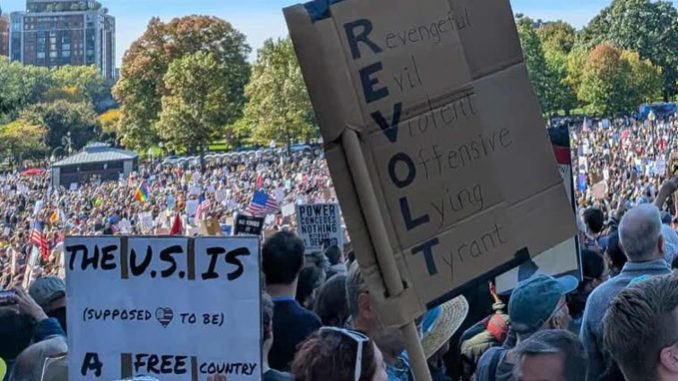
Changes in the political form of capitalist rule are extremely risky for the ruling class. The social upheaval involved can provoke a revolutionary intervention from the working class. It is usually resorted to only because the ruling class faces a “mortal” threat and the alternative is its overthrow. We are not yet at this point. Trump 2.0’s attempt to redefine the line in the US, between bourgeois democratic rights, repression and other authoritarian measures has already been sufficient to provoke mass protests. This indicates the massive struggles that would be unleased if the ruling class, or a section of it, pushed for a fundamental change in the form of capitalist political rule in the US. It is not necessary for it to take such a risk at this stage.
Class Independence
The US ruling class is at a dangerous conjuncture. Serious splits in the ruling class are one of the conditions for social revolution. Right-populism in power solves nothing for capitalism. It may have new policies, but these are incapable of fundamentally resolving the root cause of the crisis of bourgeois democracy, which is the inability of capitalism to deliver for the vast majority. Trump 2.0’s ten months in power has now deepened the crisis. It has polarised the ruling class further and poured gallons of fuel on the fires of the class struggle with its increased repression against sections of the working class.
Currently, the different wings of the US ruling class lean on sections of the working class and middle class to land blows against each other. This is deepening the polarisation in US society more broadly and deepening the crisis of bourgeois democracy yet further. A period of increasingly unstable bourgeois democratic rule and a constitutional crisis lies in the future of US capitalism. Championing the ideological, political and organisational independence of the working class is crucial – independence from all wings of the ruling class, as well as the middle classes, on the left and on the right, whipped into a frenzy by them. Conquering this independence is a prerequisite for the working class preparing itself for its own political rule in a socialist society. A sober assessment of right-wing populism in power and of Trump 2.0 is an essential defence against tail-ending different wings of the US ruling class.