
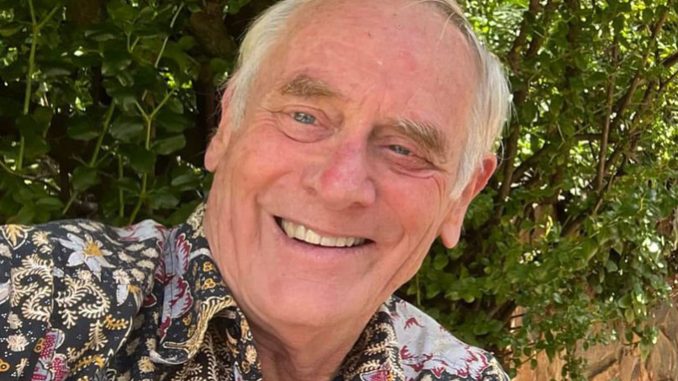
Trade unionist and soldier of the working class with a lifelong commitment to socialism
We express our deepest condolences to his wife, Suzanne, his former wife Trish, his children, his family as a whole, including his brothers Crispin and Jonathan. Suzanne and his stepdaughter Soraya supported him with unstinting dedication on his last journey after his illness compelled him to return from the US.
The flood of tributes from across the world are eloquent testimony to the mark he has made on activists in the working class struggle at home and in every country he set foot in – Zimbabwe, Tanzania, Israel/Palestine, India, Britain and the US amongst others. As so many tributes testify, he became part of the trade union and workers struggles everywhere he found himself.
Dave cut his political teeth in the struggle of the working class against cheap labour, exploitation and oppression in Natal (today’s KwaZulu-Natal) in the late 1960s and early 1970s. Before that he was involved in student politics and the National Union of South African Students. At the then University of Natal, he served on the Students’ Representative Council and edited the student newspaper, Dome. He thereafter “graduated” into the workers struggle, exposing the exploitative conditions British companies subjected workers to in SA, going onto be part of establishing the Wages Commission in 1971. His activism connected him with others who made a significant contribution to the struggle of the black working class like Rick Turner and Steve Biko. Both were subsequently murdered by the SA police, the latter after prolonged torture revealing in full the barbarism of the apartheid regime.
Arguably his most important contribution then was his role in the re-building of the trade unions in that period in the face of state repression. That “kragdadigheid” (brute force repression) had endured since the apartheid regime’s declaration of a state of emergency in 1960 to end the struggles of the 1950s including the Defiance Campaign. It led to the banning of the African National Congress (ANC), Pan-Africanist Congress (PAC), and the life and death sentences imposed on political and trade union leaders.
Dave thrust himself into the midst of the stormy events that marked the reawakening of the workers’ movement and broke the regime’s aura of omnipotence. It not only restored the self-confidence of the working class but boosted that of the entire black population in their struggle for national liberation. In the slipstream of the winds of the 1973 strikes, the working class student revolt followed in 1976. Beginning in Soweto it became a nationwide uprising. The leap in consciousness turned the struggle onto the political plane. The United Democratic Front (UDF) was launched in 1983. The confluence of the workers and youth movement sparked the 1984-86 uprising. Most decisively, the Congress of SA Trade Unions (Cosatu) was born in 1985 amidst the intensified repression of the partial state of emergency imposed in May 1985. On the banner of Cosatu’s 1987 congress were inscribed the words: “Socialism means Freedom”. Less than ten years later the apartheid regime was defeated in the first democratic elections.
There is no better account of the Durban 1973 strikes than the one written by Dave himself in an article published by Congress Militant, the paper of the Marxist Tendency of the ANC (CWI South Africa) in 1990. The 1973 Strike Wave: How We Rebuilt the Unions. He described not only the mountainous challenges they faced and how these were overcome. It is an incomparable account of a participant, armed with a mature understanding of the power of the analysis of Marxism to which that struggle had drawn him. He describes the leading role of the working class in process of the breaking down of the racist barriers the apartheid regime had erected, the lesser known role of women, including the highly repressed Indian women, as class unity was forged. He also reveals the role of Gatsha Buthelezi in an early dress rehearsal of the barbaric counter-revolutionary role he was to play and in the 1980s and 1990s.
In this tribute we believe it necessary to give Dave his voice that death has deprived us of. Let it reverberate for the present generation to learn its rich lessons. About 1973 he wrote:
“There were tremendous difficulties in building the unions: a complete lack of experience, few organising skills among the workers, the implacable hostility of the bosses, and the police watching like hawks. There was a desperate urgency to train shop stewards and union leaders. There were no dormant Sactu cadres who could be called on to play a key role. Most union leaders then were victimised activists who often had only two to three years education. The factory activists were not recognised shop stewards as in British unions, for example – they had to work secretly. There were no handbooks on how this should be done!”
He recounts the savage attack on an Indian women activist disfigured by acid thrown in her face.
Slapped with a banning order, constant surveillance and persecution he went into exile in March 1974. Armed with the experience and above all the conclusions he had drawn from the struggle he was to join with other comrades from the workers struggle in SA, the struggles of the 1950s and 1960s, and Trotskyists from the African Peoples Democratic Union of SA and the Black Consciousness Movement to form the Marxist Workers Tendency of the ANC.
The MWT of the ANC immersed itself in the struggle of the British working class collaborating with Militant, the British CWI affiliate and today the Socialist Party of England & Wales. The MWT campaigned against apartheid and for solidarity by the British and international workers movement for the emerging independent trade unions under the banner “Direct Links.” The exiled SA Congress of Trade Unions (Sactu) denounced this under the front page headline of its organ Workers Unity: “Direct Links Stink”. At that time, Sactu, unlike the MWT, held that only stooge fake trade unions could be built in Apartheid SA, a position which the 1980s growth of unions and Cosatu’s formation in 1985 utterly disproved.
The most shocking disdain for the working class was then Irish Anti-Apartheid Movement leader Kader Asmal’s pressure on the heroic Dunnes Stores strike in Ireland after refusing management’s demand to handle SA goods, to call off the strike. As recounted by strike leader Mary Manning in her memoir: Striking Back: The Untold Story of an Anti-Apartheid Striker, Kader Asmal denounced the workers’ nearly three-year strike – an act of strike breaking. They were supported throughout by MWT member Nimrod Sejake, who had shared a cell with Nelson Mandela and who appears on the cover of Sactu’s official history: “Organise … or Starve”. The strike led to the Irish government being the first in Western Europe to impose sanctions on apartheid SA.
Dave contributed to the production of campaigning material like the video: “We Live Like Dogs” on the exploitation of mineworkers; the bringing over of activists from SA and Zimbabwe to the UK through the Southern African Labour Education Project and the production of a political education pack for mineworkers by agreement with the National Union of Mineworkers: “Sifuna Konke”.
Under the CWI’s guidance, the MWT oriented towards the ANC based on the perspective that the masses would look to it for unity in the struggle to overthrow apartheid. This would entail a struggle against the ANC leadership’s capitalist policies and those of the SA Communist Party. The SACP played the role of a Stalinist tendency that provided the ideological cover for the ANC leadership’s capitalist policies in the form of its two-stage theory – (bourgeois) democracy now and socialism in the indefinite future, the results of which we see in South Africa today.
Alongside Paula Ensor, Martin Legassick and Robert Petersen, David had been deployed to the ANC where they served on the editorial board of Workers Unity, the organ of the exiled SA Congress of Trade Unions (Sactu). For putting forward Marxist ideas, and for criticising the secret talks between the ANC leadership and Gatsha Buthelezi, the ANC unconstitutionally suspended them followed by expulsion in 1985 without a hearing at a special congress in Zambia. Ironically, at the same congress O.R. Tambo admitted the ANC leadership had colluded with Buthelezi – as the blood of the pro-ANC activists, UDF, trade unionists and youth had begun to flow in Natal at the hands of Inkatha death squads armed and protected by the apartheid regime’s army and police that was to claim up to 14,000 lives by the mid-1990s.
After this Dave was to locate to Zimbabwe where he put his socialist internationalism into practice together with fellow MWT members, D’Arcy Du Toit, and their respective partners, his then wife Trish, whom he had met and married there, and Annecke Poppe. Tasked with building a section of the CWI, comrade Dave played a leading role in campaigning for socialism in Zimbabwe and establishing the Campaign for Democratic Gemwu, the metal and engineering union, that led to his arrest without charge and imprisonment and later deportation along with his fellow comrades and their families to the UK.
In a draft of an article forwarded to the MWP for comment in 2019, Dave wrote of this experience in Zimbabwe:
“He (Mugabe) was no friend of the left. He displaced trade unions from negotiations to set minimum wages. Then in February 1985 he ordered the arrest of (14) ZANU(PF) and trade union leaders in Harare and the Midlands who were campaigning for uncompromised union leadership and a radical program of democratic socialism on land, jobs and wages. These comrades were tortured and their children excluded from schools. When the British miners’ strike came to an end early in March 1985 the interrogators crowed: “Your friends have been defeated and you’re on your own”. They threatened to deport detained South Africans to Pretoria prisons. Only after Militant Labour Party MP David Nellist spearheaded an international campaign, were all these comrades released from police cells and Chikurubi Maximum Security on Independence Day, 18 April 1985.”
Dave produced a brilliant analysis of the political situation in Zimbabwe published in a special issue of the MWT of the ANC quarterly journal Inqaba Ya Basebenzi on whose editorial board he served: “Zimbabwe Perspectives” (No. 8 – 22nd December 1986). Regrettably, Dave and other comrades broke from the MWT and the CWI in 1999 during the period of a discussion over a need for a reorientation from the ANC following its imposition in 1996 of the neo-liberal Growth Employment and Redistribution policy. We believe this was a mistake resulting from the ideological disorientation of the left worldwide following the collapse of Stalinism, and the questioning of the Bolshevik methods of building a revolutionary Marxist cadre party.
His faith in the working class and socialism, steeled by his personal experience first at home before exile, and reinforced from international activism afterwards, remained undimmed, however. The same question he said had evaded the activists he had struggled with in SA in the 70s: how to build the instrument for workers unity and socialism, temporarily disoriented him.
But only those who do nothing do not make mistakes. He continued to organise solidarity for the striking workers as in the Clover strike and engaged the leadership of the General Industries Workers of SA (Giwusa). He organised a delegation of dock workers to participate in the commemoration of the 1973 Durban strikes.
From his close observation of events in SA, he recognised in time that the analysis of those who remained in the CWI’s SA section, first as the Democratic Socialist Movement, then the Workers and Socialist Party, and from 2019 the MWP, were confirmed by events. By the late 2000s Dave, for whom political differences never degenerated into personal acrimony, began to seek out comrades in the MWP with the generosity and modesty that has marked his personal and political character. This led to regular telephonic discussions whilst he was in the US, exchanges of documents and collaboration in defending the original ideas of the MWT of the ANC from assault from our detractors and the class enemy. He responded with indignation over the MWT’s despicable political assassination comparing it the ANC’s corrupt Radical Economic Transformation faction in the pages of the now defunct City Press with a letter to the editor. His denunciations of the eulogies by the ANC and EFF leadership towards Mugabe and Buthelezi were full throated. He was deeply disappointed by those who had betrayed the working class and socialist cause, crossing the class barricades. This only strengthened his commitment.
In Dave’s own words:
“Listening to some of the tributes to the belatedly dead former president of Zimbabwe, Robert Mugabe, over the past fortnight, one could have sworn that Pope Francis’ recent visit to southern Africa was organised to check on the man’s credentials for beatification. In South Africa, we had everyone from Julius Malema to President Cyril Ramaphosa turning history and reality upside down as they tried to portray Mugabe as an unblemished champion of the rights of African people. But it was former president Thabo Mbeki who took the cake when he spoke in Durban last week.
To Mbeki, Mugabe “was a great patriot, a defender of Africa’s independence, a defender of Africa’s interests. To Mbeki, the man who oversaw the slaughter of more than 20,000 people in Matabeleland in the 1980s and visited misery on the Zimbabwean population during the last 20 years of his rule “was very brave”.
As these engagements, including in-person meetings during his visits to SA, progressed, Dave came to recognise that the MWP’s strategic goal of building a mass workers party on a socialist programme was a continuation of what he had fought for in the MWT days. He made an appreciable financial contribution to the MWP fighting fund. In his last email from the US on 7th May, 2025 Dave confirmed that he was going to arrange for the MWP to address an online meeting of International Workers International Network and SA comrades on socialism and the struggle for a mass worker party. Unfortunately his illness meant this did not materialise.
The MWP recognises this contribution by a stalwart of the working class struggle for socialism as worthy example to follow. As he would expect us to, we rededicate ourselves to the struggle he devoted his life to. Though cowards flinch and traitors sneer, we’ll keep the red flag flying here.”(The Red Flag)