
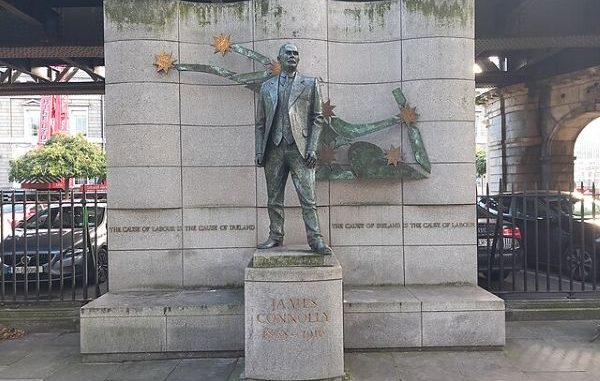
James Connolly, the socialist revolutionary and workers’ leader executed after the 1916 Easter Rising, is widely commemorated across the Republic of Ireland with statues, a major railway station, a military barracks, and streets and other public buildings bearing his name. This public honouring of a Marxist, internationalist, and advocate of workers’ rule by a capitalist state—the very class order he sought to overthrow—is a remarkable phenomenon in the West. These commemorations highlight the lasting influence of Connolly’s ideas on the Irish working class, even if ‘official’ Ireland has diluted and gutted their revolutionary meaning.
Funded by Irish trade unions (such as, SIPTU, Fórsa, and Unite), We Only Want the Earth: The Life & Ideas of James Connolly corrects nationalist and Establishment portrayals, focusing on Connolly’s role as a mass workers’ leader in late 19th and early 20th-century industrial, militant trade unionism and socialist movements across Ireland, Scotland, and the US.
The film’s emphasis on Connolly’s working-class leadership and socialist ideas is valuable and a good starting point for exploring his entire legacy.
James Connolly is reframed as a socialist revolutionary and workers’ leader, not just an Easter 1916 martyr, connecting his ideas to modern Irish issues. The documentary uses archival footage and worker testimonies to depict the Dublin slums, strikes, and Dublin lockout. The film features Nora Connolly’s moving account of visiting her father before his execution, and his great-great-granddaughter, Tamsin Iona Connolly Heron, singing a workers’ ballad about him.
All this highlights Connolly’s bravery, steadfastness, and internationalist and implacable opposition to capitalism and empire, emphasizing his belief that “the cause of labour is the cause of Ireland, and the cause of Ireland is the cause of labour.”
However, the documentary dilutes the Marxist essence of his politics and avoids some of the pertinent political questions his life still raises in contemporary capitalist society. The documentary’s title, We Only Want the Earth, taken from one of Connolly’s poems, encapsulates his revolutionary vision. Connolly was unequivocally aligned with the revolutionary wing of the labour movement, both in Ireland and globally, stating, “The day has passed for patching up the capitalist system; it must go!”
Despite referencing Connolly’s written works, the film’s political analysis lacks depth in this respect. Connolly’s masterpiece, Labour in Irish History, for example, offers a Marxist analysis of Ireland’s colonial subjugation, revolts, and the working class’s role in national and social liberation. He saw class struggle as history’s driving force, without which Irish history would be “a hopeless chaos.”
Though under two hours, We Only Want the Earth alludes to Connolly’s ideas and modern capitalist crisis, vaguely suggesting his ideas offer a path forward. Focus could have been placed on Connolly’s efforts to build various revolutionary socialist organisations to fundamentally change society – a struggle still relevant today.
Born into poverty and struggle
The documentary guides us through Connolly’s life. Born in Edinburgh in 1868 to Irish immigrants, Connolly’s impoverished youth led him to join the British army. He was stationed in Ireland, where he deepened an anti-colonial stance. Returning to Scotland, he engaged in socialist politics and trade unionism in Dundee. Later, in Dublin, Connolly co-founded the Irish Socialist Republican Party. Financial instability prompted a move to the USA, where he significantly influenced socialists and worker-activists through his work with the Industrial Workers of the World (IWW).
The film gives the impression that Connolly believed in the Wobblies’s aim of building ‘one big union’, the idea of industrial unionism that sought workers’ control of production as the basis of socialist society. It is true that Connolly was influenced by the Wobblies’ ideas but he was critical of the IWW’s rejection of political action. The IWW emphasized direct industrial action and general strikes, often dismissing electoral politics and socialist parties.
Connolly believed that political struggle was essential alongside industrial action. He argued that workers needed both revolutionary unions and a socialist political party to challenge capitalism effectively.
Along with Jim Larkin and other union leaders, Connolly was pivotal in establishing the Irish Labour Party in 1912, which surprisingly is not mentioned in the documentary. This in no way diminished Connolly’s understanding of the limits of parliamentarism and his insistence on working-class self-organisation and struggle for power. He saw the Labour Party as a vehicle for socialist transformation, not just for gaining reforms for the working class.
Connolly, described in the film as an early feminist in the workers’ movement, led a 1911 Belfast linen mill strike, uniting Catholic and Protestant female workers. He aimed to unite all workers against bosses, bigots, and imperialism, understanding sectarian division as a ruling-class tool.
Interviewees suggest some working-class Protestants now dismiss Connolly as a “Provo.” While revered by generations of workers, his legacy has been distorted, out of recognition in some cases, by the consequences of the “Troubles”, in general, and by armed republican groups efforts to make an association of their military actions with him. The Provisional IRA presented their struggle as anti-imperialist, but most Protestants saw it as a sectarian campaign against them.
Yet Connolly’s real legacy is that of a workers’ leader who fought sectarianism to build a movement based on socialist principles and class solidarity. He saw sectarian divisions in the north as serving the ruling class and worked to challenge them, advocating for mass struggles uniting all workers. For Connolly, mass struggles, uniting the working class, Catholic and Protestant, were the weapons by which to change society, not the methods of individual terror. The armed campaign of the Provos and other paramilitaries, ran at right angles to mass activity, with secret armies carrying out bombings, assassinations and shootings that helped deepen sectarian divisions and tended to strengthen the state’s repressive apparatus, and demobilise the working class.
Notwithstanding the misunderstandings, distortions and falsifications from various sources, Connolly’s legacy can be revitalised through growing anti-sectarian socialist forces and a renewed, unified workers’ movement.
A central figure in Ireland’s revolutionary history
In 1913, in his leadership in the Irish Transport and General Workers’ Union (ITGWU) with Jim Larkin, Connolly led Dublin workers in a major lockout struggle and helped establish the Irish Citizens Army, a workers’ defence militia, after brutal police attacks.
The documentary effectively portrays Connolly as a central figure in Ireland’s revolutionary history, emphasizing his leadership of the Irish Citizen Army during the 1916 Easter Rising. And the film accurately notes that Connolly allied himself with radical nationalists after the European social democratic parties’ leaderships betrayed their principles by supporting their respective ruling classes’ war objectives in 1914.
“What of the fine resolutions against war passed at the Socialist Congresses? What of the declarations that the workers would refuse to shoot each other down at the bidding of their rulers? What of the noble sentiments expressed in the speeches of the leaders? All gone to the winds. The bugles of war blew them all away,” Connolly lamented in the Workers Republic newspaper, in 1915. He saw this betrayal as a sign that revolutionary action, not mere resolutions, was needed to challenge imperialism and capitalism.
The film overlooks Connolly’s political compromises with the Irish Republican Brotherhood and other radical nationalists before the rising, driven by his urgency to combat British colonialism and imperialist war. These compromises, especially regarding the political programme, did not diminish his Marxist views but have historically obscured his ideas and allowed adversaries to misrepresent his motives.
The documentary also tends to understate the inherent tensions between nationalism and socialism. A few days before Easter week, Connolly told the Irish Citizen Army: “The odds are a thousand to one. But if we should win, hold onto your rifles because the Volunteers may have a different goal. Remember, we are not only for political liberty, but for economic liberty as well”.
Connolly’s 1916 execution by British forces, cheered on by Irish Catholic bosses, among other reactionary forces, deprived the 1918-1921 revolutionary period—marked by workers’ soviets and militant unionism—of a vital Marxist leader. Sinn Féin and the IRA, representing conservative bourgeois interests, deliberately suppressed this class struggle. They prioritised “national unity” for an independent capitalist state, fearing a social revolution from below, and thus subordinated socialist demands to protect private property.
The central failure lay with the Labour leadership, which committed a historic betrayal by refusing to provide an independent class alternative. None of this is dealt with by the documentary. By abstaining from the 1918 general election, the labour movement, under a weakened leadership (with Connolly dead and Larkin in the US) handed political leadership to Sinn Féin and failed to mobilise its own powerful base.
Connolly’s conviction that “If you remove the English army to-morrow and hoist the green flag over Dublin Castle, unless you set about the organisation of the Socialist Republic your efforts would be in vain,” was validated by subsequent historical events. The impoverished and oppressive Irish Free State, established after his death, mirrored the capitalist and clerical dominated society he had so vehemently warned against.
The film missed a vital chance to discuss Connolly’s prophetic warning about the partition of Ireland by British imperialism. In 1914, Connolly cautioned that partition “would mean a carnival of reaction both North and South, would set back the wheels of progress, would destroy the oncoming unity of the Irish labour movement and paralyse all advanced movements while it lasted.”
Partition in 1921, a deliberate act of British imperialism, divided the working class to safeguard capitalist and imperialist interests, creating the impoverished and oppressive states of the Irish Free State and Northern Ireland. For decades, the six northern counties functioned as a Unionist-dominated, semi-police statelet, marked by rampant institutional anti-Catholic discrimination.
The Irish Civil War (1922–23) saw pro-Treaty forces (accepting British dominion) defeat anti-Treaty republicans, including pro-socialist figures and trends inspired by Connolly. The anti-Treaty leadership failed due to a lack of a social and economic programme to mobilise the masses, fighting primarily on military terms for a 32 country capitalist republic.
Without Connolly, the labour leadership’s ‘neutrality’ allowed partition, religious sectarianism, and capitalist rule to prevail unchecked by a mass working-class alternative. Only a united, independent working-class movement, combining national liberation and Connolly’s Marxist principles, could have overcome division and defeated imperialism.
The Communist International, established in 1919 after the successful 1917 Bolshevik revolution, issued statements broadly taking this line in regards to Ireland. James Connolly’s son, Roderick Connolly, worked with the Communist International to build a communist movement in Ireland, but internal divisions—especially with Jim Larkin after his return from the US —fractured the effort, preventing a unified communist party from taking root at this stage.
Unfortunately the decision by the film makers to only deal with events up to Connolly’s death and then to jump forward to today’s situation in Ireland – a modern economy that is officially ‘rich’ but with big inequalities, a severe housing crisis, stagnant wages etc – misses out on the full richness and impact of Connolly’s ideas and actions over generations.
The film commendably connects Connolly’s politics to modern movements like housing campaigns, trade unions, and feminist and environmental struggles, with interviewees often seeing him as a moral guide for the Irish Left. Despite societal changes since Connolly’s era, a class-based society persists, making his Marxist ideas—rooted in the workplace, communities, unions, and the struggle for socialist transformation—essential today. To honour his legacy, it is crucial to strengthen trade unions and working-class organisations as democratic, accountable, combative bodies, and build a mass socialist alternative. Connolly would advocate for militant action over mere remembrance.
We Only Want the Earth successfully reintroduces Connolly’s voice and potentially to a wider and new audience. However, socialists should view it as a starting point. Our task is to finish his work: the struggle for a world where workers globally own the earth.
We Only Want the Earth: The Life & Ideas of James Connolly
A film by Alan Gilsenan, produced by Yellow Asylum Films for the James Connolly Foundation, released in 2025.
(Note: As of now, the film is being shown at curated events and festivals. Dates for a wide theatrical or digital release will be forthcoming).
For more analysis of Connolly’s life and ideas:
Peter Hadden: The real ideas of James Connolly (April 2006)
Socialism Today – Labour in Irish History revisited