
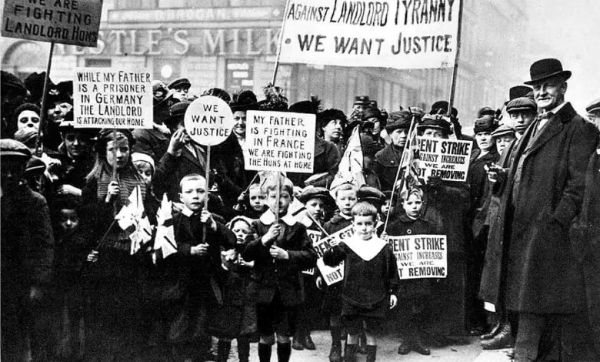
One hundred years ago, in November 1915, the rent strike battle in Glasgow was in full swing. This was an historic event that saw up to 20,000 tenants refusing to pay the increased rent imposed on them during the first world war. A mass movement led by working class women and joined by working class men from the workplaces around Glasgow inflicted a famous defeat on the government, which was forced to introduce a rent restriction act on November 25, 2015.
Below is an extract from the Socialist Party Scotland (CWI) pamphlet Red Flag Over the Clyde, by Jim Cameron, that explains the significance of this movement, just one of a number of struggles that made up what became known as ‘Red Clydeside’. The tactic of a mass rent strike has important relevance for today during a housing crisis and when rents take up a huge part of the wages of workers.
socialistworld.net
Following the outbreak of the war in 1914 tens of thousands of working-class men throughout Britain left their homes to join the armed forces. They went to fight in a war which their leaders confidently told them would be “over by Christmas”. In Glasgow, as in other cities, their wives and mothers were left behind to continue the daily grind of feeding and clothing their children and paying the bills, including rents to the private landlords who owned the only sources of accommodation for working class families.
At the same time, thousands of other men and their families were drawn into the city to provide the workforce for the munitions industry, which was expanding at a furious rate to meet the demands for arms and ammunition. This increase in the population, particularly around the major workplaces, put further pressure on a housing market already under pressure. The demand for rented accommodation outstripped supply and provided an opportunity for the landlords to increase rents and make even greater profits for themselves.
Thousands of families, particularly those where the main, and in most cases the only wage earner was away fighting “For King and Country”, canon fodder in the capitalist, were not able to pay the increased rents, and were threatened with eviction. In theory, the Emergency Powers Act protected those who could prove that their inability to pay was caused by war conditions. In practice thousands of families were unable to satisfy the Sheriffs that they fell into that category. Soon eviction orders were being granted.
Even those who escaped the Sheriffs’ warrants were not safe. Thousands of soldiers’ families, as well as elderly people, were subject to a campaign of intimidation designed to drive them out of their homes. The landlords’ aim was to then let these houses to families with working men, who could just about afford to pay the rents, which would of course be jacked up. Not only would this further swell their coffers, but they would also benefit from the new tenants having no protection were under the Emergency Powers Act.
It is important to note again here that the housing in question was far from luxurious. Most working-class families lived in one room flats in densely packed tenements, with several families sharing one stairhead toilet and often sharing this accommodation with a lodger, taken in to supplement the family income so that they were able to pay the exorbitant rents. Those who now talk about “the good old days” in single ends clearly did not have to live in those conditions.
In Glasgow housing has always been a major issue for working class families. From the slums of the 18thand 19th centuries to the damp infested schemes of the mid to late 20th century, the city’s working- class families have been subjected by private landlords, and central and local governments, to some of the poorest and not fit for purpose housing imaginable.
In 1915 the stage was set for a social explosion against the rent increases and threatened evictions. The public villains of the piece were not the property owners themselves, who kept well away from the firing line, but the lackeys they employed to do the dirty work for them. These were the factors, generally solicitors, charged with looking after the landlords’ property and maximising profit through exorbitant rents. When a tenant fell into arrears the factor was able to go to the Sheriff Court and obtain a warrant which gave him authority to evict the family from their home.
Initially some families were evicted but, as local people became better organised, a hugely successful campaign of defiance was mounted. This campaign not only organised to resist evictions, but to refuse to pay the rent increases the factors were attempting to impose. Rent strikes started in the Govan area and spread out from there.
Several figures came to the fore as organisers and leaders. One such figure was Andrew McBride, and Independent Labour Party councillor, who was secretary of the Glasgow Labour Housing Committee (GLHC). Others included John Maclean, Willie Gallacher, and John Wheatley, who later became an ILP MP in the east end of Glasgow. But it was a Govan woman, Mrs Mary Barbour, [herself a member of the ILP] whose name was to become synonymous with rent strikes and working-class resistance. A statue of Mary Barbour has now been erected in Govan following a lengthy campaign by local people.
In May 1915 a joint meeting of the GLHC and the Women’s Housing Association (WHA) called the first rent strike. The aim was not to withhold the entire amount of rent but only the increase. Marvellous agitational work and organisation took place, initially in the Govan area, and then spreading to other areas of the city. Meetings were held in back courts, in the streets, and wherever a group of people could be brought together. Alongside local meetings, city-wide demonstrations took place including one in George Square where an estimated 25,000 people gathered to support the cause of the rent strikers.
John Maclean and others did a power of work drumming up support within the organised labour movement. However, it was the women in the working-class areas who bore the brunt of the work and became the shock troops of the rent strike movement.
Working class women, because they are more often than not landed with responsibility for feeding, clothing, and looking after the children, and balancing the family budget, generally have little time to become involved in trade unions, political parties, and campaigns. However, because of the very fact that they are so close to the daily grind of working-class existence and have little time to escape from it, once they become involved in struggle they do so, not as a hobby, but as a vocation. When the women of Clydeside decided there would be no rent increases and no evictions, the battle was as good as won.
Very quickly women organised themselves in the working-class areas. Whenever factors and sheriff officers came into an area to carry out an eviction, word would quickly spread that they were about. Pots and pans were banged together, flour bombs, bricks, and anything else that came to hand, were mobilised and the invaders were soon driven back. One factor who was driven out of Partick covered in flour was described as “a grain store in disorder”. No quarter was given and the factors very quickly realised that their days of using evictions for non- payment of rent were over.
These tactics of local and mass rallies, and physical resistance, were to be adopted later in the century in the successful campaign spearheaded by Militant against the Thatcher government’s Poll Tax.
Appeals were made to Glasgow City Council to intervene on behalf of the families faced with unaffordable rent increases and evictions. However, as most of the councillors were themselves involved in the property business, the Council was hardly likely to be on the side of the tenants. And so it proved.
The government set up a Committee of Enquiry, but John Maclean quickly pointed out that this would not solve the problem. All that would happen, he said, would be that the landlords would demand a rent increase of £3, and the Committee would reduce that to 30 shillings (£1.50), exactly what the factors had planned in the first place. Against that background MacLean raised the call for a complete rent strike – “The people ought now to refuse to pay any rent at all”. This call was quickly taken up and soon wall and windows were plastered with posters and slogans proclaiming – “We are not paying increased rent”.
Unable to collect rent or to evict non-payers, the landlords and factors changed tack. They decided to pursue those in work through the courts, not to seek eviction warrants, but to carry out wage arrestments. They thought this would break the back of the rent strike. How wrong they were.
John Maclean was a great Marxist teacher and often spoke about the idea of the “dialectic”. For the Marxists, the dialectic means that nothing is ever as simple and straightforward as it looks. What appears as one thing can often very quickly be turned into something else, indeed its opposite. Hate often goes along with love, fear with courage, joy with sorrow, strength with apparent weakness, and victory with defeat.
So it was with the factors’ attempt to break the rent strike. Their ruse of going down the road of wage arrestments served only to fuel the anger and determination of those they sought to intimidate. What they thought would be an easy victory turned into a humiliating defeat.
A turning point
Up to this point the organised labour movement, though hugely supportive of the rent strike, had not been centrally involved. This was to change dramatically when, on 18th November 1918, eighteen working men were summoned to appear at the Small Debt Court to have a Wage Arrestment Order made against them. It was decided that a huge demonstration would be organised for that day and preparations were made.
Mary Barbour and the other leaders of the Women’s Housing Association mobilised the women in all the working-class areas for a grand march to the Sheriff Court, where the case was to be heard. One of the men summoned, James Reid, worked at Dalmuir shipyard. On the day of the court appearance workers from Dalmuir, Fairfields, Stephens, and other shipyards, engineering works, and factories, downed tools and joined the march on the Court House. There they linked up with the women marchers and with workers from Albion, Yarrows, Meechans, and all the other workplaces who had made their own way to the demonstration.
One set of marchers stopped at Lorne Street School in Kinning Park and picked up John Maclean who, two days earlier, had been given notice of his dismissal by the School Board. Maclean was a conscientious and popular teacher, but his political views and activities put him at odds with his Headmaster and the School Board. This was to be the last time John Maclean set foot in Lorne Street School.
The streets around the Court House became jammed and all traffic stopped as upwards of ten thousand working class people gathered to protest at the actions of the factors and the court. Makeshift platforms were erected from whatever was at hand and John Maclean and others addressed the crowd. The mood was electric and it was agreed that Maclean would demand of the Prime Minister, Asquith, that legislation be immediately introduced preventing any increase in rents for the duration of the war. To give weight to this demand it was also agreed that if the government failed to comply, then a General Strike would be called for Monday 22nd November.
A deputation asked to meet with Sheriff Lee, who was hearing the cases. He had little choice but to agree. Faced with the wrath of the crowd outside his Court House, Sheriff Lee got through by phone to the Minister of Munitions, David Lloyd George. He explained the background to the cases before him and the demands of the demonstrators. The seriousness of the situation was impressed upon Lloyd George. This was no token demonstration; this was the beginning of an uprising.
Lloyd George was many things, and certainly no friend of the working class. However, he was not a fool and realised he was in a corner. He instructed the Sheriff to abandon the court proceedings and to inform the demonstrators that their demands would be met.
A Rent Restriction Act was to be immediately introduced. This was a complete victory for the workers and a total vindication of the position taken by John Maclean, Mary Barbour, Andrew McBride, and the other leaders of the rent strike.
When the news of the victory was passed to the demonstrators there were jubilant celebrations which carried on throughout the night. There is no record of how the factors spent that evening.
With the victory of the rent strike movement, and the defeat of the landlords and factors, this was an historic day on Clydeside.
Red Flag Over the Clyde – pamphlet from Socialist Party Scotland £4 – email [email protected]