
US Forces out of Latin America
For workers’ unity and socialism
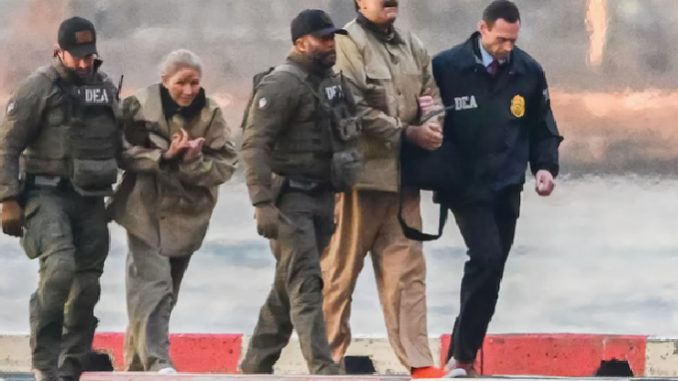
The kidnaping of Venezuelan President, Nicolás Maduro, and his wife, Celia Flores, through the military assault by US imperialism has, in a dramatic fashion, ushered in 2026. This naked colonial attack by the Trump regime will have profound consequences in Venezuela, throughout Latin America and in global geopolitical relations. The repercussions are being felt around the world. This modern version of “gun boat” diplomacy starkly illustrates the nature of the era we are now in.
The intervention in Venezuela by US forces was carried out with clinical precision. 150 aircraft carried out ‘shock and awe’ bombing raids. Having succeeded in cutting power supplies and blacking out Caracas, this was followed by drone and helicopter incursions and the invasion by the elite Delta Force after. Vindictively they bombed the mausoleum where Hugo Chávez’s remains were entombed.
This, however, was not the peaceful operation claimed by Trump and much of the Western media. Venezuelan forces claim most of Maduros’ bodyguards were killed as they fought back during the operation. In addition, thirty-two Cuban fighters were also killed. The Venezuelan regime reports that over one-hundred were killed in the fighting. The crucial question is what follows now in Venezuela.
Trumps actions, seizing Nicolás Maduro and his wife and dragging them handcuffed for a show trial in New York represents a brazen act of naked colonialism. It was preceded by imperial piracy with Venezuelan oil seized at sea and the amassing of a US armada with 15,000 troops in the Caribbean Sea.
The stench of hypocrisy coming from Trump and US imperialism in the charges they level against Maduro is overpowering. The former right-wing President of Honduras, Juan Orlando Hernández, was backed by Trump in the 2017 presidential election. Obama at the same time referred to him as an “excellent partner”. He was later put on trial in the US for heading a drug cartel and being involved in shipping 400 tonnes of cocaine to the US. He was sentenced to over forty years imprisonment. Trump pardoned him and set him free on 1st December 2025 –– a month before he kidnapped Maduro!
Maduro in his first court appearance stated he regards himself as “a prisoner of war” which in many respects he is. The charges against him border on the ludicrous. The drug cartel he is accused of heading, Cartel de los Soles, branded a narco-terrorist organisation by the US does not exist as an organisation. In Venezuela it is an acronym for officials taking bribes! Maduro may or may not be corrupt or involved with drug cartels. However, that is a matter for the Venezuelan working class to judge and decide upon. Not US imperialism desperate to get its hands on Venezuelan oil.
Trump gloatingly proclaimed the US will now “run” Venezuela and boasted US oil companies will seize Venezuela’s oil which he calls “our oil”. He went on to threaten that the US was not afraid of a further invasion, or “boots on the ground” should the Venezuelan regime not comply with the dictates of US imperialism.
Trump’s claim that this is about “democracy”, echoed by other western capitalist leaders like UK prime minister Starmer, is farcical. Brazenly, Trump and US Secretary of State Rubio have dismissed the idea of new elections in Venezuela until the US “has sorted it out”. The previously lauded leaders of the Venezuelan right-wing opposition, like María Machado and Edmundo González, (recognised by Washington and others as the supposed winners of the 2024 Venezuelan presidential election), have been unceremoniously ditched because they are “lacking support”.
Trump openly and shamelessly laid claim to Venezuelan oil on behalf of US companies. Now he claims that he will seize fifty million barrels of Venezuelan crude and sell it on the open market. The revenue will be under his control and the funds raised can only be used to purchase US produced goods! He blurts out the real intentions of US imperialism and brushes aside the sham hypocrisy of bourgeois diplomacy which is hated by sections of the US and other ruling classes globally. Western capitalist denunciations of Maduro as a dictator are echoed by a deafening silence about their “allies” heading brutal dictatorships like in Saudi Arabia.
A Modern “Monroe Doctrine”
This intervention, as Trump boasted, marks a return to the “Monroe Doctrine” in a modern form. Declared by US president James Monroe in 1823 it asserted the right of US imperialism to intervene throughout Latin America in any way necessary to advance and protect its interests. Then, it was motivated to extend US influence throughout the Americas against continued European intervention in the Western Hemisphere. Today, the “Monroe Doctrine”, an act of naked colonialism, is aimed at warning both China and Russia to keep out of what the US still regards as its “backyard” despite the weakened position of US imperialism throughout the continent and globally.
Significantly, Maduro was meeting a Chinese trade delegation only hours before he was kidnapped. China is the largest purchaser of Venezuelan crude oil. The White House’s National Security Strategy, released in December 2025, asserts the unilateral right of the US to deny rival powers the ability to own or control “strategically vital assets” in the Americas and declares that the US should “make every effort to push out foreign companies that build infrastructure in the region”. Something that China has done rapidly in Latin America. Chinese goods trade with Latin America has grown forty times since the turn of the century to reach US$518 billion in 2024. Increasingly, Latin Americans are driving BYD cars, using Xiaomi smartphones and order taxis and food from Didi rather than Uber.
New World Geopolitical Order
The assertion of US imperial might has decisive implications beyond Venezuela and Latin America. It has repercussions in the new world geopolitical order. This has been reflected in the seizure of an oil tanker flying a Russian flag in the Atlantic by US and UK forces. In the UK Starmer is paying a price for his collusion with Trump and refusal to condemn the kidnapping of Maduro with further divisions opening up in the ruling Labour Party as a result.
The former so-called “rules based” international order of “international law” presided over by capitalist bodies such as the United Nations, which supposedly existed following the Second World War, has been shredded. Now, no rules apply even formally. Yet even in the past the “rules” were largely meaningless. They were frequently “broken” by all the imperialist powers. Witness the interventions in Vietnam, Iraq, Iran and elsewhere. US imperialism has invaded or instigated military coups in almost every country in Latin and Central America. By the mid-1970s most of Latin America was turned into a giant concentration camp through a series of US-inspired military coups. Bill Clinton authorised over 20,000 troops to invade Haiti in 1994 to overthrow a military regime there which resulted in a disaster. In 1989 Geroge H. W. Bush authorised 27,000 troops to invade Panama. In 1983 Reagan did not even bother to inform his “friend”, the then British Prime Minister, Margaret Thatcher, that Grenada was going to be invaded despite its head of state being the British monarch.
However, in the new geopolitical situation, with weakened US and European imperialisms, mirrored by the rise of China and some other powers like India, greater consequences will flow from the new “Monroe Doctrine”. After all, if the US can intervene to defend its interests in its “backyard” why can’t other powers like China, Russia, or India do the same? The scene is now set for further military conflicts globally and greater polarization.
Some of those in Trump’s circle refer to the desired goal of the contending powers holding spheres of influence – in effect carving up the world between the US, China, Russia and others, and with ‘agreement’, tacit or openly, of no interference in each other’s spheres. In a globalised economy and multipolar, fractured world, this is wishful thinking. The redivision of the world between imperialist powers will only bring more tensions, shifting alliances, conflicts and new wars.
Wider Repercussions
The Trump regime now proclaims that it only wants “friendly” regimes on its borders. As a result, Trump rages against the Cuban regime, and the Colombian and Mexican Presidents threatening that they could face regime change if they fail to comply with the agenda determined by the White House and Pentagon. Yet his ambitions go beyond Latin America. Further afield he has repeatedly laid claim to Greenland in the interests of “national security”. Of course, the increasing accessibility of rare minerals there due to global warming is not also a factor in their calculations!
The White House now brazenly states it is seriously looking at how it can take Greenland. It has done this historically. In 1946 it offered to buy Greenland from Denmark for US$ 100 million. An offer turned down by Denmark. Military occupation is apparently not being considered – at this stage. An attack on Greenland, currently a Danish self-governing autonomous territory, would constitute the US attacking another member of the NATO alliance, threatening its existence which Trump would not be concerned about. Trump will probably try to “buy” Greenland, or back a campaign to bribe the population into agreeing to US investment and exploitation of its natural resources, but this could change.
Trump’s demand for Greenland is and will further split and increase the growing conflict between the EU and US. This is reflected in the official US policy outlined in the National Security Strategy document. These developments are also accumulating divisions and splits within the EU.
The attack on Venezuela also has implications for the Iranian regime. It was not an accident that Trump threatened intervention should the regime continue repressing the significant mass protests that have erupted there in recent weeks. A further military attack on Iran cannot now be excluded.
If US imperialism is able to realise all of these objectives remains to be seen. US imperial might, and Trumps regime, is not unlimited and has been weakened. However, it is likely that at least in some of these cases some type of US intervention is likely to be attempted. This reflects the character of the era global capitalism is now in.
Crises in the US
Domestically, Trump is running into increasing problems, difficulties and crises. The mass “No Kings Day” protests in 2025 illustrate the growing opposition and disenchantment he faces domestically. The sizable protests against the intervention in Venezuela in the US are a further illustration of this. The execution by Federal ICE paramilitaries in Minneapolis of Renee Nicole Good, and the protests that erupted as a result, illustrate the polarisation and conflicts taking place in the US. Trump faces the prospect of suffering serious setbacks in the upcoming midterm elections in November 2026.
One factor driving his turn to the “Monroe Doctrine” internationally at this conjuncture is precisely the domestic opposition and crisis that is unfolding. Like a military dictatorship, which Trump is not, nationalist right-wing populist regimes like his can strike out in desperation and be at their most dangerous when they face domestic crisis, opposition and a threat to their position.
Maduro’s Regime
Despite the deep economic and social crisis which exists, reflected in the mass migration out of the country by eight million Venezuelans, the Maduro regime still retains a base of support. This flows from the legacy of the revolutionary process in Venezuela, especially under the leadership of Hugo Chávez following his election in 1999, and especially since the defeat of the attempted coup to oust him from power in 2002 which was backed by US imperialism. Since Chávez’s death in 2013, Maduro has retreated from the radical reforms which encroached on capitalist interests. The reforms implemented by Chavez were widespread in health, education and other gains for the poor and the working class. Poverty was reduced and literacy rates dramatically rose especially between 2003-07. Chavez relied on the boost in oil revenue following a rise in the price of oil. However, despite increased state intervention in the economy capitalism was not overthrown.
At the same time a new elite emerged – the so-called “Boli-bourgeoisie” – from within the Bolivarian movement. This developed under Chávez but strengthened its position under Maduro. It is riddled with corruption and constitutes a part of Venezuelan capitalism. This arose as capitalism was not snuffed out and replaced with a democratic socialist planned economy. Reforms implemented by Chávez encroached on the interests of capitalism and imperialism. Yet they were implemented with a bureaucratic method by a top-down apparatus. Under Maduro, the socialist rhetoric of the Chávez-era was largely put to one side. He headed what increasingly became a corrupt and repressive regime. The sanctions imposed by imperialism served to worsen the situation and the economy went into free fall with hyperinflation and a desperate situation for millions.
Despite this, it maintained a base of support. This is due to the legacy of the revolutionary period and the reforms that were introduced alongside a fear of what the right-wing opposition would unleash, including reprisals, should it come to power. It is reflected in support for Maduro, even though this is often begrudging and with reservation. Western media, full of “fake news”, has not reported on the large widespread protests throughout Venezuela against the US intervention and demanding Maduro’s return.
What next in Venezuela?
The right-wing political opposition, lauded by western capitalism, led by Maria Machado, awarded the Nobel Peace Prize only a few weeks ago, has been unceremoniously caste aside by Trump. Despite previously claiming that her stand-in candidate, Edmundo González, won the Venezuelan presidential election in 2024, Trump now simply dismisses them as “lacking support” in Venezuela!
Behind this is what appears to be the current strategy of the Trump regime. Had it attempted to simply install her and the right-wing opposition in power and remove the entire Bolivarian regime, rather than just its figurehead, it would have deeply polarized Venezuela. The prospects of armed clashes and the eruption of a form of civil war was very real. Large sections of the population in Venezuela are armed. Drug gangs and criminal armed groups are also part of the equation.
US imperialism under Trump is drawing lessons from what happened after the overthrow of Saddam Hussein in Iraq and Muammar Gaddafi in Libya. In both cases, when Western imperialist intervention was undertaken the old state machine was destroyed. Yet there was nothing to replace it. In Iraq, the former Ba’athist state machine, including the army, was destroyed. With no alternative in place a power vacuum existed which resulted in a disaster of religious sectarianism and ongoing battles with the opposing forces. A similar threat would have existed in Venezuela had US imperialism attempted to destroy the entire Bolivarian state machine, which, unlike Hussain and Gaddafi, still has a significant base of support.
They are therefore adopting a policy of trying to “rule” through a section of the Bolivarian state machine. In particular, they have courted the Vice-President, Delcy Rodríguez, who has been sworn in as acting-President. The Trump regime seems to be aiming to coax her and sections of the existing regime into playing a compliant role, serving the interests of US imperialism. Reportedly, Rodríguez has good relations with US oil companies, established through her role as the government minister responsible for negotiating oil contracts with them. She has called for “cooperation” with the US.
However, such a policy is fraught with dangers and contradictions. There are various wings within the Bolivarian/Chavista movement. Should Rodríguez adopt a totally conciliatory approach, and comply with Trump’s demands, it will pose the need to purge the more hardline Chavista-wing and the de facto surrender control of Venezuelan oil reserves. In effect she would become a puppet of Trump’s regime, including selling Venezuela’s vast oil reserves to US imperialist interests. Such a capitulation would in all likelihood provoke splits and divisions within Chavista movement. The Minister of Defence, Vladimir Padrino and Diosdado Cabello who runs the colectivos – armed paramilitary forces initiated during the period of the revolutionary movement but not controlled by democratic organisations of the working class and masses – are likely to come into conflict with such a capitulation by Rodríguez. They are both under sanction by the US and a bounty of US$10 million has been placed on their heads. Will she go so far? This remains to be seen. Elliot Abrams, former US special envoy to Venezuela under the first Trump administration thinks not, saying, “She is not going to reform anything because reforms hurt Padrino and Cabello”. It remains to be seen if he is right. However, at this stage it appears Rodríguez will attempt some form of appeasement which means surrender to Trump. This will not be an easy or peaceful road to take.
Despite the corruption which exists large sections of the Bolivarian movement are ideologically driven and regard themselves as committed “Chavistas” bitterly opposed to US imperialism. The crucial factor is the reaction of the mass of the poor, large sections of which appear to broadly be with the Chavista camp. The large protests and rallies opposing US intervention and demanding the return of Maduro indicate this. Should the Trump regime go too far, or a rupture take place within the leadership of the Bolivarian movement between the “hardliners” and the “appeasers”, it is possible the Venezuelan revolution could open a new chapter of conflict in the rotting phase of retreat that the Venezuelan revolution had entered, deepening a highly polarised and charged situation. Sections of society looking to confront imperialism and challenge capitalism could begin to search for a revolutionary alternative and socialist programme which is necessary to do this. An appeal to the US working class and masses for support would be an important part of this. One important factor in the defeat of US imperialism in Vietnam was the growing opposition to the war in the US itself.
It quite possible that some form of armed opposition could develop in Venezuela attacking US targets. This could provoke a further military intervention by the US and further polarise and destabilise the situation.
There is a deep sentiment in Latin America for ownership and control of the abundant natural resources of the continent. In the past, sections of the ruling class, for their own interests, and reflecting the pressures of the masses, nationalised crucial natural resources. The oil industries of Mexico and Brazil were nationalised at one point on a capitalist basis. Even Trump’s friends, the feudal rulers of Saudi Arabia, completed the nationalisation of their oil industry in 1988. In Venezuela oil was nationalised in 1976, long before Chávez came onto the scene. Handing Venezuelan oil over to the US can provoke a big backlash.
There is also a deep anti-US imperialism consciousness in Latin American society. By raising the “Monroe doctrine” Trump threatens unwittingly to unleash this sentiment amongst swathes of the Latin American masses.
At the same time the threat of Machado returning to Venezuela can further polarise and destabilise the situation. The right-wing opposition leaders will be dismayed at what Trump is attempting. They not only wanted Maduro removed but the end of the entire Bolivarian regime. It is striking that no protests or rallies have thus far been called by the right-wing opposition in Venezuela. They will also not be happy to be sidelined and dismissed having played their part.
How the struggle in Venezuela develops is uncertain. However, the kidnapping of Maduro opens a new chapter of upheaval and turmoil. Trumps claim that it will lead to peace, prosperity and democracy for the Venezuelan population will turn to ashes as polarisation, conflict and greater upheavals are certain.
What next across Latin America?
In Latin America large protests against the US intervention have taken place in most countries. The continent and each country on it is extremely polarised, socially and politically. The governments of Colombia, Brazil, Mexico, Cuba and Chile (the outgoing government) have all condemned US intervention and demanded Maduro’s return.
On the other side Milei in Argentina, the new Chilean president Kast, and others have enthusiastically supported Trump. They, along with the ruling classes internationally are using the situation in Venezuela to try and discredit the idea of “socialism”. This will be attempted in the US, particularly following the election victory of Zohan Mamdani as Mayor of New York. He presented himself as a “democratic socialist” despite wrongly remaining in the bourgeois pro-imperialist Democratic Party. Despite the limitations of his programme his election has put the idea of socialism back on the agenda for debate in the US.
The explosive events following US intervention in Venezuela are a reflection of the polarised geopolitical arena that global capitalism has fostered. The multipolar world and the existence of the highly erratic Trump regime together with right-wing nationalist Bonapartist regimes like Putin’s in Russia and Netanyahu’s in Israel is an explosive cocktail. The struggle for economic and political spheres of influence on all continents means that this is an era of national, ethnic and regional wars and conflicts. The Middle East, Ukraine, Sudan and other conflicts illustrate this. The clash between the UAE and Saudi Arabia in Yemen in December 2025 narrowly averted, for now, a major war erupting between these two powers rather than the proxy war that is being fought. The US bombing of Islamic bases in Nigeria has intensified the division and clashes within the country. Crucially, the prospect of a major clash involving China and Taiwan is ever-present in the situation. More serious conflicts than those already seen are likely in this era. As we already see other aspects of conflict are also a feature of this. Cyber-attacks on infrastructure are already taking place involving Russia, China and others. Drone incursions into Poland and other provocative steps illustrate the tensions and conflicts that are present in the situation.
It is not excluded that out of desperation in one major conflict a regime of the character of Putin’s Bonapartist gangster-capitalism could resort to the use of a tactical nuclear weapon or other weapon of mass destruction. His deployment of nuclear missiles to Belarus underlines this possibility. Putin has reacted in a measured tone following the seizure of the tanker flying a Russian flag. Through this he hopes to strengthen his position in any Ukraine negotiations. However, this can change.
This does not mean the prospect of an all-out nuclear Armageddon is posed at this stage. Such a development would obliterate not only the working class and mass of the population. It would also destroy capitalism. Such a development would necessitate the bloody defeat of the working class and the coming to power of a series of rogue military dictatorships in the main imperialist powers which is not posed at this stage.
Capitalism means war in this era. But not only military wars and conflict. Important features of the class war also emerged during 2025. In December 2025, millions took to the streets in Portugal in the biggest general strike for decades. General strikes have also rocked Italy, Belgium, Greece and India. The mass protests that have shaken Iran in the last few days are also an indication of the struggles that lie ahead. The general strikes that have taken place at the moment have assumed the character of protest strikes rather than a struggle for power. Yet they have put the issue of the general strike back on the agenda of social and class struggle.
The prospect of a global economic recession or crash in 2026 is a serious possibility. This will have a decisive impact socially and politically. Combined with the geopolitical crisis and conflicts, the worsening climatic and environmental catastrophe that is unfolding, the development and introduction of AI, it can polarise the situation and consciousness still further. A layer can be drawn to right-wing populist forces for a period. Yet it will also have a radicalising effect to the left on millions searching for an alternative social system.
The crucial challenge for the working class and revolutionary socialists is the need to build support for an alternative social system, socialism, and the programme and organisation necessary to achieve it. The struggle to build new mass socialist parties of the working class and all those oppressed by capitalism together with the need for a revolutionary socialist programme is now more urgent than ever. This era is to become a struggle between revolution and counter revolution – between a socialist future or barbarism.