
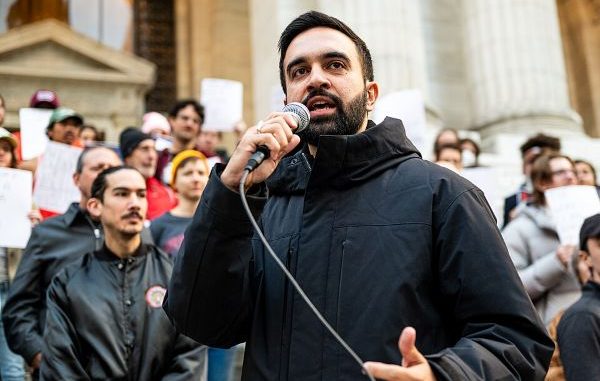
On January 1, 2026, Zohran Mamdani took office as mayor of New York City amid continued interest and anticipation for his “New Era” of affordability for working class New Yorkers.
According to his transition website, 50,000 in the city applied to be part of the team. At the time of writing, 29,000 New Yorkers have donated over $3 million dollars to the transition, the average donation being $77. The transition team statement then highlights “in contrast, during Mayor Eric Adams’ [a corporate Democrat who ran against Mamdani], transition, he had just 884 individual donors, with an average donation of more than $1,000, another former Mayor Bill de Blasio had 820 individual donors, with an average donation of $2,392”. Most of the donations have come from working and middle-class people but it is worth noting Mamdani fundraisers have been organised by Cryptocurrency billionaires and wealthy liberals.
According to various press reports, 40,000 attended a Mamdani block party to mark the inauguration. Mamdani’s approval rating among voters has risen to 61% from 51% during the election (Observer (London) December 31, 2025).
Since his election, running as the Democratic party candidate in November, Mamdani continues to be seen as a reference point for the left internationally, there is more justified scepticism on the US left.
Elif Eralp, the candidate for Die Linke in the Berlin mayoral race, said on Instagram “from New York to Berlin the left is rising, your campaign is an inspiration”.
Mamdani’s campaign, associated by many on the left with the Democratic Socialists of America (DSA), was also put forward as a model for election campaigns and building a “insurgent” political force, by a variety of speakers at the Your Party founding conference involving Corbyn and Sultana, in Britain in November.
However, there is an important question to be asked, namely is Mamdani using the transition period before he enters city hall to clearly prepare and rally to fight for the working class and youth in New York? Will he show leadership to the millions who have been inspired by the prospect of a self-described “socialist” seen as fighting back on the generational cost of living nightmare in capitalism’s most important city?
Mamdani meets Trump
A section of Mamdani’s victory speech went viral when he directly addressed US President Trump. Mamdani said “turn the volume up…to get to one of us you will have to get through all of us”.
This was in the context of the terror in urban areas that continues to be inflicted by Trump and his “ICE army” against the immigrant population from Chicago to Portland to Los Angeles. There have been significant protests against ICE in New York in the past few months in working class neighbourhoods. The recent brutal shooting by ICE of an unarmed driver in Minneapolis is likely to provoke more anger.
This onslaught has begun to be heroically resisted by young and working-class activists defending their colleagues and neighbours, through collective organised resistance, such as in the youth school walkouts and protests in North Carolina. Also, Mamdani’s speech was seen as standing up to the threats to New York’s federal funding from Trump.
Mamdani’s team reaching out to Trump for a White House meeting on November 21st therefore would have surprised layers of Mamdani’s support base. Others clearly saw it as a clever ploy to try and diplomatically deal with the threat of Trump.
Mamdani stated he was making his “case clear” in the meeting and he will work “with anyone on “affordability”.
For socialists and the wider working class, leaders’ meetings and negotiations with the representatives of capitalism, including the bosses and their politicians, can be and often are a necessary part of waging a struggle for working class interests, which must be taken seriously.
The socialist leaders of the fighting Liverpool city council struggle in Britain in the 1980s met with Thatcher’s cabinet ministers, including the minister responsible for local government, Patrick Jenkin. This struggle, outlined in the book, ‘Liverpool a City that dared to fight’ by Peter Taaffe and Tony Mulhearn, showed how Militant supporters at the time, Derek Hatton and Tony Mulhearn and the socialist-led Labour Party council group built a mass movement that pressured Jenkin, the minister responsible for local government, and the Thatcher government into winning, for a time, Liverpool’s demands around funding. Meetings with the national government were the smallest part of this and often the Tories and the right wing press distorted their content. At one point, Jenkin was put under pressure to have to visit slum areas in the city. But the biggest pressure of all was how the council utilised its support in the 1984 day of action; a one-day local general strike and mass protest, followed by the local election victories for Labour in the city when it was associated with socialism and struggle.
( https://www.liverpoolecho.co.uk/news/gallery/day-liverpool-came-halt-50000-28756530)
But Mamdani’s meeting and press conference with Trump did not in any way live up to this example or even that of a routine trade union negotiation. The DSA’s public social media statement following the meeting that a “Showdown with Socialism” had taken place and “Socialism” had won, was totally illusory, while miseducating activists and those looking towards socialist ideas and methods.
Understandably layers of Mamdani’s supporters, including some youth in DSA, wrongly hoped that the cordial atmosphere in the press conference might mean Trump temporarily holds off on attacks on New York and specifically its immigrants. This was expressed in the press by NYC DSA co-chair Grace Mauser.
Socialists must soberly and strongly warn against the conclusions of groups like Occupy Democrats who said, “This was a masterclass on Mamdani’s part. He walked into the MAGA White House, conducted negotiations for the betterment of New Yorkers, and came out looking strong and respected. Meanwhile, Trump looked spineless and weak”.
The idea Mamdani’s “masterclass” approach or charismatic personality, can by itself, undermine Trump in negotiations without resting on the power of a mobilised real mass movement is as false as it is dangerous.
It has echoes of the “game theory” around which the then leaders of Syriza (Coalition of the Left party in Greece), including the then prime minister, Tsipras, betrayed the working class and youth in Greece in negotiations with the Troika around the sovereign debt crisis, over a decade ago. At that time, the Greek working class and youth had a higher level of class and socialist consciousness, organisation and experience of struggle than those who support Mamdani currently in the US.
Trump, mired in the crisis of divisions in the MAGA movement and falling approval ratings over the cost of living and affordability crisis, effectively used Mamdani in front of the press to try and regain support with his own base.
Trump was able, unchallenged, to make pronouncements, saying he agreed with Mamdani on lowering prices, reining in Con Edison (the energy company that serves New York) and that they both shared a love of the city.
While this is likely to be well received among Trump voters who also voted for or are attracted by Mamdani’s policies, Mamdani made no attempt in front of the press to win over this important layer from Trumpism or expose Trump.
Trump made the point, while millions were watching, that many of those attracted to Bernie Sanders also supported him, thus attempting to deflect his current responsibility for soaring healthcare costs and the plight of working and middle-class Americans.
If Mamdani really believes Trump has a shared “love” of the city and making it affordable for the working class, why campaign at all on affordability and taxing the rich? It is the Trump administration, as Mamdani stated in his own campaign, that is fuelling the cost-of-living crisis and facilitating tax breaks for the wealthy and corporations.
The press fixated on Trump intervening on behalf of Mamdani when he was asked whether the President was a “fascist”. Mamdani on NBC news days later confirmed he still believes this. While the CWI would not term Trump a fascist, Trump is a dangerous right-wing authoritarian that Mamdani does not appear to have a serious strategy for defending the working class in New York from, let alone taking on. Mamdani failed in the press conference to put Trump under any kind of pressure on the ICE raids or the genocide in Gaza.
In the meeting with Trump and the fallout from it, Mamdani continued with the limitations of his campaign message on dealing with Trump He relied, as he said in a New Yorker video interview, the week before the mayoral election, on “boosting up the legal power of New York” against a hostile White House.
All this reflected the fact that, fundamentally, Mamdani, his team and the DSA leadership, do not have the perspective of ending capitalism, for them socialism is either reforms under capitalism or some kind of “never-never” land mentioned at conferences or on 1st May. In this sense, the DSA’s history illustrates this as it was formed by those who had given up working to build a socialist party in the US and instead joined the Democrats, a corporate party through and through. But in recent years, the DSA has been transformed. On Trump’s first election victory in 2016, the DSA had 8,500 members, soon 10,000s joined, and it reached a peak of 94,000 before dropping back to 70,000 today. But still, most of its leaders, including Mamdani, stick to the idea of being Democrats and refuse to take this opportunity to begin to build a new party, that fights for the working class. This is despite the fact that the very structures of the US are being questioned by many and that, amongst a significant layer of the population, there is an interest in socialism.
This refusal to build an independent, anti-corporate workers’ party is why Mamdani continues to attempt to court potential opponents to his agenda, an effort that now extends from the corporate Democrats to Trump. Mamdani and his team may have illusions that they can change Trump’s course without confrontation, but Trump was also clear he will drive Mamdani to “change”. Fundamentally Trump will only be stopped by mass opposition or its imminent threat.
After the White House meeting, Mamdani reverted to attacking Trump showing again how he moves between attempts at courting opposition and playing to his base in early December he released a popular video advising immigrants how to individually deal with ICE raids and questioning. The video did not raise the clear need to collectively resist ICE.
There is no doubt that Trump’s love-in with Mamdani, useful to him in the conflicts within MAGA and the Republicans, can be rapidly reversed now that Mamdani has taken office and can become a “communist nutjob” to Trump, once again. Trump will have no qualms about continuing to attack Mamdani’s base. Trump officials have indicated attacks on New Yorks immigrants will be stepped up.
Dangers in transition
Already within the Democratic party establishment there is organising against Mamdani’s affordability agenda in New York and in City Hall. The right-wing press have attacked DSA activists’ previous radical statements on housing provision.
A key Mamdani policy is his pledge to appoint a Rent Guidelines Board to freeze the rent in rent-controlled apartments. But the outgoing mayor, Eric Adams, attempted, before he left office, to pack the board with those who oppose this policy, although importantly tenants’ groups mobilised against this.
Other potential key battlegrounds around a Mamdani administration will be around the 51-member city council. With the Republicans only holding five seats, the battles will be amongst the 46 Democratic councillors.
The candidate looking likely to lead the city council in 2026, Julie Menin, is a corporate Democrat, who is seen as a possible check on Mamdani’s progressive agenda, and possibly can disrupt his plans for the city’s budget.
Mamdani’s appointed transition team is made up of seventeen “committees” each dealing with a policy area. DSA activists and leaders are involved, as are reps from labour and campaigning not for profit organisation. But so are property developers and figures from big business. Mamdani’s spokespeople claim all these elements have a shared interest in delivering “efficiency”.
Mamdani and DSA
Already tensions in the DSA and Mamdani’s wider support base have developed over how the administration will operate and Mamdani’s relationship with DSA. While Mamdani is a member of DSA, the national organisation did not endorse his campaign. The DSA’s lack of real accountability of its representatives elected to positions, and even lack of clarity over why this is politically necessary, is now being exposed in a dramatic fashion.
Days after Mamdani’s election, a debate broke out in NYC DSA over a resolution around how the organisation will work with the new mayor. Eighty per cent of those involved in the debate eventually voted for a text that said: “We must grow the size of our movement across every borough and every neighbourhood, such that we have the numbers and power to serve as an effective outside ally to a potential Zohran Mamdani administration, not primarily to elect a target for ourselves.” While it is not clear what this means it seems to be an attempt to say there should be no criticism of Mamdani. In other words, give him a blank check by abandoning any attempt to democratically hold leaders accountable for their actions.
But there was substantial opposition from the left to an earlier draft from local DSA leaders that said, “If we succeed in electing Zohran Mamdani, our priority will not be policing the mayor’s lapses and demanding accountability — orientations the left has adopted in moments of decline and marginality,”. Although these DSA leaders could not get this agreed, it is an indication of their political position regarding a Mamdani administration.
A conflict then broke out in DSA over whether to endorse city council member Chi Ossé’s Democratic primary challenge on a similar programme to Mamdani’s to Corporate Democrat House minority leader, Hakim Jeffries. Hakim Jeffries is a major national power-broker in the Democratic Partys.
Jeffries only endorsed Mamdani’s campaign late after Mamdani committed to retain the NYPD Police Commissioner Jessica Tisch, against the wishes of many DSA activists. Mamdani has a record of tweeting attacks on Jeffries, including over Gaza, saying in 2022: “If Jeffries is considered a progressive, the term has lost all meaning.”
That Mamdani and his supporters intervened against Ossé and succeeded in blocking DSA from endorsing any challenge to Jeffries shows his team is trying to build a coalition with elements of the Corporate Democrats and shy away from directly challenging them.
Mamdani spoke at a DSA meeting saying “The choice is not whether to vote for Chi or Hakeem at the ballot box, the choice is how to spend the next year. Do we want to spend it defending caricatures of our movement, or do we want to spend it fulfilling the agenda at the heart of that very same movement?” In other words, Mamdani, who is on the right wing of the DSA, was defending, in the name of reforms in New York, a leading pro-capitalist politician retaining his position, not understanding that such people can sabotage reforms. Ossé eventually withdrew.
Mamdani’s team have pointed to Jeffries having significant support in his district. If that is the case, why not then find a more suitable candidate instead of giving up challenging Jeffries and what he stands for? This shows that Mamdani wrongly believes the best way to push forward his affordability agenda is to not challenge key Corporate Democrats, hoping incorrectly, that Jeffries himself, if left unchallenged by DSA, would not mobilise against real attempts at taking on the wealthy in the city.
This aligns with the position of Alexandra Oscario Cortez, the well-known DSA House member, who said that the recent victories of Corporate Democrats in the November election show there is space for all views in the Democrats. Mamdani is endorsing other candidates, like the current city comptroller (finance officer) in upcoming races. But he has stepped back from promises implied in his victory speech to fight to transform the Democrats and immediately directly challenging the national leadership.
Despite these concessions, Mamdani and elements of DSA locally could end up in conflict, quickly, over his coalition-based approach to the Corporate Democrats. Even with Mamdani’s intervention, the vote in NYC DSA’s “electoral working group” was roughly only 52% against endorsing Ossé’s congressional campaign.
The opponents of Ossé also used the argument that the focus should be on increasing the “socialist bloc” of representatives in Albany (the state legislature) to pressure State Governor Hochul to allow some taxation on the rich, by which they mean running as Democrats for the assembly. Generally, Mamdani’s election has seen more “progressive” Democrat challengers in upcoming elections which DSA leaders hope they can influence. They hope to increase the number of representatives they have influence over without risking confrontation with the corporate leadership of the party.
How can Mamdani be accountable?
It is clear the DSA, even its left wing currently, do not have a clear programme or strategy for holding Mamdani to account or using his mayoralty to resist attacks from the Trump administration. They have no strategy to push him to advance real gains for working class people or taking on the Corporate Democrat establishment that rests on and defends capitalism.
The left of DSA, while mounting campaigns in the last few years to censor the likes of AOC and other Democrats they previously endorsed, over issues like limiting criticism of the Israeli government, are not clearly calling for a break with the completely pro-capitalist Democratic party. Thus, they do not argue that it is necessary to break from the capitalist Democratic Party and begin to fight for a mass party for the working class.
This is shown in the Jacobin journal’s latest articles, which reflects discussions and views in DSA.
The DSA held a discussion conference on ‘Socialism in the City’ after Mamdani won. And Bhaskar Sunkara, one of Jacobin’s founders, wrote a piece, “The goal of Socialism is everything Jacobin”(November 24, 2025), in which he makes some valid points about the difference between social democracy (as seen in the early twentieth century) and socialism, and the lower level of class and socialist consciousness today compared to the past. However, there was no clarity on how socialists could run and utilise a city administration to conduct a class struggle against capitalist forces thereby raising the need to fight for socialist transformation, lifting consciousness and working class organisation, as Militant did in Liverpool in the 1980’s.
Sunkara gives the impression that making demands on Mamdani’s administration is unrealistic until the socialist and workers’ movement has national strength and a higher level of consciousness.
In Jacobin and elsewhere, comparisons between the potential of a Mamdani administration and that of the La Guardia/New Deal era in the 1930s are also consistently made.
Socialists must point out that a real socialist administration is not merely a more “efficient” way of using the public sector and local state apparatus to run a city like New York.
La Guardia, the Republican mayor of New York, and Roosevelt, the Democratic President, are both historical figures Mamdani has said he wishes to emulate. In that era, reforms were implemented in New York and nationally around housing, parks, transport and infrastructure. To suit their interests and that of the overall capitalist system, the “New Dealers” made sections of the ruling class pay up, to a certain extent. This was to avoid wider social conflict and attempt to find a capitalist way out of the ‘Great Depression’.
It shouldn’t be forgotten that significant pressure from the working class also existed that forced reforms under La Guardia, who became Mayor in 1934. Then there was still a strong socialist tradition in the city. In the 1932 NYC Mayoral election, the Socialist Party candidate won over 250,000 votes (12.6%). But at that time a right-wing section of the SP and trade union leaders began to move even further to the right, as the SP itself began to move leftwards under the impact of the Great Depression. Feared the radicalisation of workers, these right-wing leaders split from the SP, eventually forming the American Labor Party which started to deal with capitalist politicians and supported La Guardia in New York and Roosevelt nationally. La Guardia worked to try to maintain this support while also being prepared to use strike breakers against the city’s own employees in transport and other sectors.
Mamdani and his supporters will find that even practical, on the ground, examples of “efficiency” let alone charismatic arguments to move Corporate Democrats in the state, the Trump White House and the US ruling class, behind them to make major concessions for reforms. Real change can only be forced by mass working class mobilisation.
A non-profit organisation of Mamdani supporters has emerged that claims to be independent of his office and official team, “Our Time for an affordable NY”. They are organising canvassing and mass letter writing around “childcare and tax the rich” across the city. They are asking for donations to maintain the “volunteer army” and buy the database of 100,000 that was mobilised by Mamdani’s campaign. DSA activists are playing a leading role in this organisation’s founding. Canvassing, lobbying and letters will need to be tools in building urgent mass action, including demonstrations to force effective pressure.
Mamdani and his transition team, linked as they are to the Democrats, cannot be relied upon to struggle to organise the potential of enthusiasm and hunger for a real fight back against capitalism’s affordability crisis reflected in the vote and campaign. A mobilised movement and mass organisation of the working class and youth in New York is the most effective way to hold Mamdani to delivering his programme and fighting for a wider socialist programme, independently.
We raise these ideas for consideration for all those who want to fight, including those in Our Time and DSA, about the way forward.
Independent working-class coalition
Mass meetings or assemblies, as well as canvassing efforts, should be organised in every element of Mamdani’s support base, labour unions, tenant organisations, anti ICE campaigns, student organisations, and all who want to fight for a real “new era”. These should agree demands around an emergency socialist budget, utilising all the city’s fiscal powers, meeting the needs of the city, and a strategy for mobilising against hostile forces in Albany, the White House, ICE and the state machine. The struggle behind such a socialist budget should appeal for support across the US from workers, the youth and the poor.
Demands should be placed on Mamdani and his administration, including around control of the Rent Guidelines Board, and ensuring the rent freeze takes place. There must be plans for mass demonstrations, including at Albany, for taxing the rich and the funding that is needed for rent freezes, childcare, municipal grocery stores and union labour-built public housing. A public works programme should be implemented, including a city department to build public housing .
Such a working-class coalition must be prepared to act independently, if Mamdani and his administration do not lead a fight. Mass struggle needs to be organised around wages and conditions by the labour unions. Actions such as rent strikes and occupations by tenants who are rent stabilised and those who are not, and the anti ICE activists, need to step up coordination and activity and demand protection from the administration against Trump’s forces.
Despite Mamdani’s repeated appeasement of the Corporate Democrats over the issue of the NYPD, it can still be an area of conflict around which opposition not just to Mamdani but his programme can coalesce. The first example of this may be around the question of whether Netanyahu would be arrested if he came to the city. Israel has already attacked Mamdani for reversing Adams’ order on the IHRA definition of antisemitism. Mamdani’s strategy of investment in “community support” around mental health to save on police resources has a certain validity but will not end police brutality and violence or the social crisis. There needs to be a discussion about how working class democratic community control and oversight of the police can be fought for in New York.
The threat of the growth of mass political organisation of the working class independent of the Democrats and Republicans was also a major factor in driving La Guardia and Roosevelt’s reforms and still has a faint legacy today in the history of workers and labour based organizations that were then absorbed into the Democrats. If the lessons of that period are to be learned, a new independent mass working class party needs to be built. Steps towards this must be taken by those who really want to fight for public housing, decent wages and to confront the Trump administration; organising independent electoral challenges to the Democrat machine, appealing to labour and the wider working class for support in the city and the state. Socialist public representatives in whatever legislature need to be made accountable to collective working-class organisations. This includes a policy of taking the average wage of a skilled worker and being subject to recall.
Mamdani has understandably stirred up the latent anger in New York and across the US at all of capitalism’s inequalities and cruelties, but socialism is more than just Mamdani’s statement that for him it is about “dignity”. It means real working-class power, full democratic control and management of the major parts of the economy and planning of society to meet people’s needs across the US and internationally. We appeal to those mobilised and inspired by Mamdani to discuss the way forward and fight for this.