
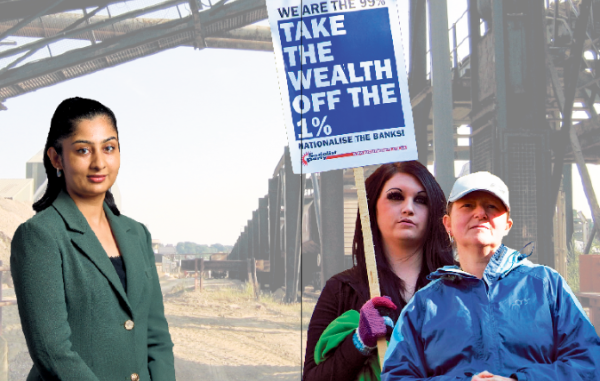
Capitalism is a failed system. That’s becoming increasingly clear to anyone paying through the nose for privatised housing, utilities and transport, seeing the real value of their pay packet shrink yearly, or watching the rapid pace of climate breakdown or the descent into further conflicts internationally.
No wonder then that a range of opinion polls show an increasingly favourable view of socialism among people in Britain. Or that there is such enthusiasm for a left-wing political alternative to Keir Starmer’s Labour government in Britain – shown by the initial 800,000 who signed up to support MPs Jeremy Corbyn and Zarah Sultana’s ‘Your Party’, last year.
At recent rallies of Your Party supporters, Zarah spoke to this layer of people when she has said: “We’re done begging for crumbs off the table. We’re taking the lot… nationalising a few industries isn’t enough. We need democratic control of the economy by workers”. And “we need to nationalise the entire economy.”
We agree with much of this. Over the years, the Socialist Party has consistently raised the need for a fundamental transfer of economic power away from the super-rich capitalist class to the working class – the ones who work to produce the wealth in the first place. But what would this look like, and how can we make it happen?
When given the chance to expand on what having “the entire economy under the control of workers” would mean in practice, Zarah has been less clear.
In an interview on the BBC, she elaborated: “When I talk about nationalising our economy, I’m talking about the commanding heights of our economy. I’m talking about the utilities, energy, rail, buses, telecoms, mail… We also have to look at other forms of democratic ownership in our economy. That means workers’ cooperatives, that means community land trusts, that means public banking, that means a national welfare – or a wealth fund that workers and our communities control.”
Alternate models?
While on an LBC phone-in, she briefly referenced as models to copy: the Asian Tigers (where a large amount of state intervention in the economies in South East Asia led to a capitalist boom in the 1990s); Germany (where worker representatives are invited to sit on company boards alongside their bosses); and Latin America (where a series of leftist ‘pink tide’ governments in the 2000s and 2010s carried through an expansion of welfare states, notably among them Hugo Chavez in Venezuela).
What unites these vastly different examples is that, in each of them, capitalism has remained intact. Major industries, banking, land and natural resources have largely remained in the hands of wealthy shareholders. They have been subject to the vagaries and storms of the global and national capitalist markets, and when economic crisis has hit, it is the working class which has been forced to suffer in the form of falling living standards.
Capitalist nationalisation
Within living memory, in Britain there was public ownership of the steel, coal and shipbuilding industries at different points in the decades following WWII, alongside utilities, mail and railways. However, they were run along much the same lines as the private companies that came before them, with highly paid bosses looking to extract the maximum amount of work for the minimum level of wages.
Because the workforce themselves didn’t have day-to-day control and oversight of the running of these industries, they were subject to a tug of war over pay, jobs and working conditions. This led to struggles and strikes in the nationalised industries, most notably in the miners’ strikes for fair pay in 1972, and against pit closures in 1984-85.
In Britain today, partial renationalisation of the railways through Great British Railways is under way. It’s welcome that private train operating companies will no longer have their profits subsidised by sky-high passenger fares. However, bosses and shareholders of contracted-out cleaning and rolling stock companies will carry on laughing all the way to the bank. And, given the Starmer government’s record so far in starving other public services of funds, there’s no guarantee that publicly owned railways will have the necessary investment to become more affordable or reliable.
Removing the profit motive could stop the short termism, and driving down of wages and driving up of prices, that we see all the time under capitalism today. But allowing nationalised industries to be run simply as businesses that happen to be publicly owned wouldn’t realise the full benefits of state ownership.
Co-ops
Some, including Zarah, have also raised the idea of worker-owned cooperatives as a way of organising the economy alternative to either private or state ownership. Doubtless a lot of workers would be more motivated to find ways to improve their output by the prospect of increasing their take-home pay or reducing the working day, rather than simply enriching their boss or shareholders further!
But in the medium-to-long term, a workers’ co-op that found itself in competition with other businesses in its sector could see itself squeezed out of the market due to large privately owned companies having greater ability to sustain short-term losses while undercutting the competition on price – as happened to the Co-op Group of food stores in the UK in the second half of the 20th century.
Socialist planning
Rather, socialists advocate for a system where planning predominates. This would allow for investment in people and technology where it’s needed, not just where capitalists can see easy returns. It would also eliminate a lot of the inefficiencies created by the free market – such as the wasted effort of engineers in competing companies developing essentially identical TVs, jeans, or any number of consumer products, and workers to produce and distribute more than is likely to ever be sold before getting replaced by next year’s model.
But without the ‘supply and demand’ of the free market, how will the planners know what people need and want, and the best way to go about giving them it?
Rather than people just following orders from on high while they are at work, workers in each workplace could collectively decide how best to organise the working day, people and resources, to both improve their own conditions and productivity and to benefit wider society, not just the bottom line. In itself, this could unlock a lot of efficiencies that are currently ignored when workers suggest ways of improving things to their boss!
Workforces, their trade unions, the wider community and government could then elect and delegate committees to oversee and plan publicly owned industries for the benefit of all, rather than vested interests.
Small businesses
Socialists, including Zarah Sultana, often get asked if this means that we should nationalise every last corner shop, food kiosk or pub?
As it is, many small businesses, from tied pubs to franchised corner shops and takeaways, to family farms, already find themselves beholden to large suppliers or buyers who can name their price. Meanwhile complete independents get squeezed out by corporate competitors who can use economy of scale and financial reserves to undercut them on price and placement.
A socialist government could offer these small businesses access to the preferential credit, research and other advantages enjoyed by their larger competitors, while allowing them to keep their individual character and family ownership.
In return, the main thing that would be asked is that workers would be paid a fair wage with trade union representation, and that these businesses participate in the general plan for the sector, that includes them taking proper care of their workers, the community around them and the environment.
Compensation
As Zarah has said, nationalising just a few industries isn’t enough. The Socialist Party calls for at a minimum the top 150 large companies and the banking system that dominate the economy in Britain to be taken into public ownership.
But wouldn’t it cost too much to buy out all the shareholders of the large monopolies?
That’s why socialists call for compensation of shareholders only on the basis of proven need – for instance pension funds or working- and middle-class people who have parked their savings in stocks and shares. Although, as of 2022, pension funds held only 1.2% and individuals (including likely some much less in need) held 10.8% of publicly listed shares in UK companies.
An act of parliament could establish public ownership of these companies in law, but it would be another thing to establish it in reality. Large investors in the newly nationalised industries would seek compensation or their companies back, including by attempting to use the courts, as happened when Northern Rock was nationalised in 2008, for example.
Workers’ action
The working class is the overwhelming majority in Britain; on the basis of mobilising its full power, any attempts by the capitalist class to undermine a socialist programme of nationalisation would not be able to succeed. The working class would play an active role in taking over the running of industry, and to replace the current machinery of government, and the UK’s legal system based on property rights established by medieval barons, with one which recognises the working class’s rights to own and control the collective fruits of its labour.
This process was carried through to its most successful conclusion in the October revolution in Russia in 1917, which established workers’ control over production at the coalface and through the first workers’ government. In living memory, the revolutionary processes in France in 1968 and Portugal in 1974 saw workers take over the running of their factories on their own initiative.
If the UK assets of Amazon’s retail arm were taken into public ownership tomorrow, the workers in the fulfilment centres could continue to pack and dispatch orders with the sales collected through a clone of the website under the democratic management of the workforce. Bezos could then stamp his feet and demand his property rights all he wanted, but the real assets – the warehouses, track, trucks and inventory – would be in the hands of the people.
But surely a socialist Britain couldn’t survive on its own? It’s true that the offshoring of manufacturing from Britain and many other Western nations over recent decades would mean that a planned economy on socialist lines would at least initially involve importing many essential goods from abroad. But this is all the more reason to build links with socialists in other countries, and to make appeals for the working class internationally to struggle against their own ruling capitalist classes.
Working-class party
What is key to fundamentally changing the world we live in for the better is the involvement of the working class on a mass scale. If the economy should be run by the working class, then it needs its own party. That’s why it’s a mistake that Zarah and others have dismissed the idea of trade unions, organisations bringing together six million workers, being able to affiliate and have a direct democratic role in shaping the programme and campaigning approach of Your Party.
Socialist Party members raise the idea of a new workers’ party encompassing the trade unions as the main organisations of the working class, not just because this could provide the boots on the ground and a mass base along with the kind of democratic oversight that Your Party has so far lacked. But also because this kind of mass party would provide a space where ideas on how society and the economy should be run can be developed and debated.
Alongside this, working-class people struggling together to win improvements to their lives under capitalism as it exists today can help them develop confidence that more fundamental change is possible. Even on a basic level this can be seen on nearly any picket line, when, taking time out from the normal routine of work and away from bosses’ prying ears, workers end up discussing ways in which their workplace and the world in general could be run better!
Many others developing an interest in socialist and revolutionary ideas will be grappling with the same questions Zarah has raised. To discuss further about how socialism would work in practice, and help build a force that can make it happen, get in touch to find out how you can join the Socialist Party.