
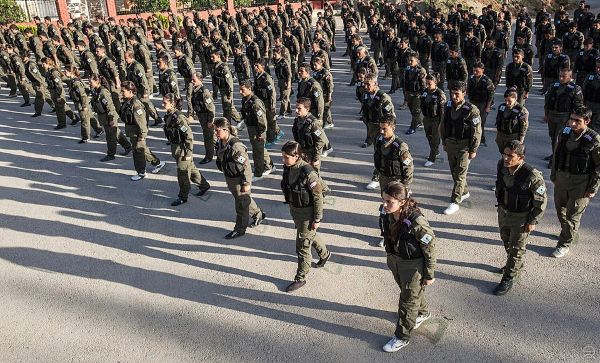
Rojava is under threat. The SDF (Syrian Democratic Forces), dominated by the Kurdish YPG (People’s Defence Units), have retreated behind the Euphrates. They have lost much of the territory they previously controlled, including important oil fields, to Syrian troops led by the new right-wing Islamist rulers. Some Arab militias in the SDF have changed sides.
A ceasefire agreement reached on 19 January represents a defeat for the SDF. Its troops are to be integrated into the Syrian army. The the region’s airspace and natural resources are to come under the control of the Syrian government,. The Kurdish police unit intended for the city of Kobanê is also to be placed under the authority of the Syrian Ministry of the Interior.
An earlier agreement reached in March 2025 between the SDF and al-Sharaa, which also aimed to integrate Kurdish self-government into the Syrian state, took some of the Kurds’ demands into account but left their exact implementation open. The advance of Damascus is now creating facts on the ground. Kobanê is (as of 26 January 2026) surrounded by the Syrian and Turkish armies. There are reports of bombings and massacres. A humanitarian catastrophe is looming.
Solidarity
Tens of thousands demonstrated in January internationally in solidarity with Rojava, which many leftists regard as a symbol of a social, anti-patriarchal and self-governing model of society. Sol (CWI Germany) also stands in solidarity with the people of Rojava, whose existence and rights are threatened by the new right-wing Islamist rulers around former Al-Qaeda member, Ahmed al-Sharaa. We call on trade unions and the Left Party in Germany, in particular, to organise solidarity actions and to put pressure on the German government to end its de facto complicity with al-Sharaa. The fate of the Kurds must be determined by themselves; not only in the Syrian areas of Kurdistan, but also in the areas of Turkey, Iraq and Iran (where thousands of Kurds were killed by the regime during the suppression of mass protests a few weeks ago).
Learn from history
However, current developments and the impending defeat of Kurdish self-government must be taken as an opportunity to critically assess the political programme and strategy of the Rojava project. In 2018, in response to the Turkish military offensive at the time, we wrote: “Now the leadership of the Kurdish self-defence forces YPG has reached a military agreement with Syria’s dictator Bashar al-Assad. It is understandable that the YPG leadership is looking for ways and means to stop the advance of the Turkish army and is seeking military support. But what price will the Kurds have to pay for this? What does it mean to switch from an alliance with one capitalist power – the USA – to an alliance with another – Syria, backed by Russia? Just as the US was no friend to the Kurds, neither are Assad and Putin. The illusion that the Kurdish people could have common interests with imperialist powers, or that they could be relied upon, is one factor that has contributed to the current situation (…) Now what socialists have been pointing out for years is being confirmed: the US cannot be relied upon – and the YPG leadership is entering into the next deal with Assad. He will hardly be willing to accept Kurdish self-government in Rojava. (…) We will be told that this is now a matter of life and death, that the Turkish invasion must be repelled and that this is not the time for fundamental political considerations. However, the time and political and military strength that the Kurdish movement in Rojava had gained was not used to advance an independent, multi-ethnic and socialist workers’ movement in the region. When, if not now, must we begin to learn the lessons from this?
“Military agreements and temporary compromises are possible even with the devil’s grandmother, if this were part of a strategy based on political independence and a socialist perspective. Based on shifting illusions in imperialist powers, such agreements will not show a way out.
“This can only be achieved if the Kurdish movement adopts a socialist course that seeks to use the political authority that has grown out of the progressive aspects of the Rojava project to call on the working classes in the Middle East to join forces in the struggle against their common enemies in the region – whether they are called Erdoğan, al-Assad, Trump, Putin or Barzani!”
Even if some of the actors are different today, the logic of our 2018 argument applies to the current situation.
No trust in imperialism
For the US, the Kurds were pawns that they used for a while in the fight against the so-called Islamic State (IS). It was never about supporting the goals of the Kurdish movement. Now the situation has changed, and the US is backing the new rulers in Damascus. This proves that it was never about fighting right-wing political Islam and promoting democracy, but always about US imperialism’s strategic and economic interests. Anyone who trusts imperialists, no matter which ones, will sooner or later be lost!
Socialist strategy needed:
The much-vaunted revolution in Rojava was able to take advantage of the conditions during the Syrian civil war to temporarily shake off foreign rule. It left the fundamental capitalist conditions untouched and had the illusion that it could pursue common ‘democratic’ goals with Western imperialism. This is now coming back to haunt them. Lessons must be learned from this, and a revolutionary, socialist force must be built that can show a different way forward.
Sol calls for:
- Solidarity actions by trade unions and left-wing parties internationally – Turkish and Syrian troops out of Rojava!
- German armed forces out of the Middle East and all foreign missions
- Immediate halt to all arms exports to Turkey
- Immediate lifting of the ban on the PKK and other Kurdish associations in the Federal Republic of Germany
- No to all deportations and equal rights for all those living here
- For the establishment of democratically structured, multi-ethnic self-defence militias in Rojava and all Kurdish areas
- No trust in imperialist and capitalist powers
- For the establishment of a multi-ethnic and cross confessional workers’ movement in Rojava, Syria, Turkey, and the entire region, to link the struggle of the Kurds with the struggle of the workers in Syria, Turkey, Iran, and Iraq
- For full democratic and cultural rights for the Kurds and all national groups – for the right to national self-determination, including the right to form their own state
- For a socialist Kurdistan as part of a voluntary socialist federation of the countries of the Middle East! Only on this basis are peace and social and economic development possible!