
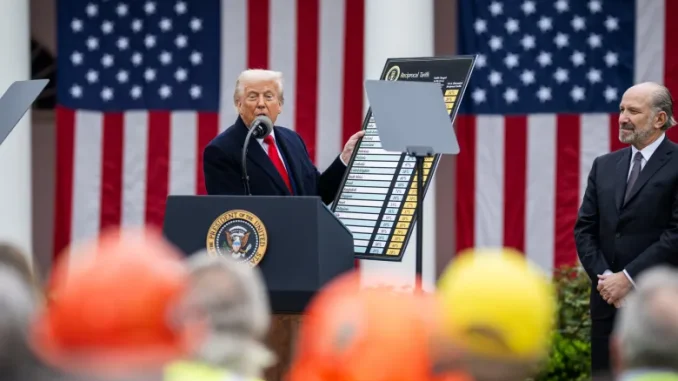
The escalating trade conflict between the United States and China is not simply a dispute between politicians or the result of misguided policies from the White House. It reflects deep strains inside global capitalism itself. Since the 2007/08 Great Recession and then the Covid pandemic, the long phase of globalisation has begun to reverse. Supply chains have been disrupted, trade growth has slowed, governments have intervened directly to defend major corporations and strategic industries, and the old ideological commitment to free markets has weakened. Capitalism is entering a more unstable and conflict-ridden phase, expressed politically in the turn by figures such as Donald Trump, Joe Biden, Xi Jinping and major European leaders toward increased economic nationalism, subsidy regimes and strategic confrontation.
Capitalist accumulation depends on the profitable expansion of production. Capital must be advanced into labour and machinery, surplus value extracted, commodities sold, and the circuit renewed on an expanded scale. Competitive pressure drives heavy investment in fixed capital, rising costs and intensified rivalry, placing growing pressure on profit margins. When profitability tightens, any disruption to circulation, delayed transport, fractured supply chains, blocked markets or payment bottlenecks, further magnifies the strain by tying up capital for longer before it can complete its circuit and return as money capital. The result is not merely logistical friction but sharper competition, higher effective capital requirements per unit of profit realised, and intensified pressure on weaker firms and weaker states.
In practice this means that ever larger masses of capital struggle to expand profitably as fixed investment mounts, margins compress and turnover slows, while trade barriers, sanctions and state rivalry increasingly disrupt the movement of commodities and investment. Governments respond by intervening more openly to defend national capitals, socialising risks while preserving private ownership and competition, whether through Trump’s tariff wars, Biden’s subsidy-led industrial policy, or the European Union’s expanding reliance on state aid and protection.
For several decades global capitalism appeared to expand relatively smoothly. Capitalist globalisation was accelerated after the collapse of Stalinism in the Soviet Union, Eastern Europe and later China, which opened vast new reserves of exploitable labour, raw materials and markets to world capitalism. In Russia and much of Eastern Europe the restoration of capitalism was rapid and destructive, marked by economic collapse, mass poverty and the emergence of oligarchic elites through the looting of state property. In China the process unfolded in a different way. The regime retained control of the major banks, energy system, transport and heavy industry while allowing private capital to expand rapidly in manufacturing and services, and a powerful export-driven growth model consolidated under the long rule of the Chinese Communist Party leadership.
Multinational corporations shifted manufacturing across continents. Vast investment flowed into ports, container shipping, rail lines, power grids and export factories. China absorbed a large share of this investment and became the workshop of the world. Western corporations boosted profitability through global restructuring, while banks and financial markets captured growing claims on surplus value generated across these extended circuits of accumulation.
Since Covid this model has entered a period of increased instability. Lockdowns exposed how stretched and fragile supply chains had become. Shortages of medical equipment, semiconductors and industrial inputs revealed how dependent the major capitalist economies had become on cheap, highly exploited labour abroad. Wars, sanctions regimes and shipping disruptions intensified these pressures, increasingly politicised by state leaders presenting supply chains as questions of “national security”.
The war in Ukraine and the sanctions regime imposed on Russia show how geopolitical conflict feeds directly into the organisation and cost of production. For decades much of European industry relied on relatively cheap Russian gas and oil, lowering unit costs and supporting energy-intensive manufacturing. The rupture of these supply links raises operating costs sharply, pushing sections of existing plant beyond viability thresholds and forcing shutdowns, under-utilisation and accelerated restructuring. What appears politically as “energy security” translates economically into compressed margins, restructuring pressure and heavier dependence on state subsidy.
These production pressures spill directly into how quickly goods can be sold and money recovered. When energy becomes more expensive, factories run below capacity, transport slows, and firms must tie up more cash simply to keep operating. At the same time sanctions, banking restrictions and currency controls disrupt international payments, delaying when exporters actually receive their money. Capital therefore remains locked for longer in unfinished goods, warehouses or unpaid invoices instead of flowing back into the next round of production. This deepens bottlenecks already created by overcapacity and slowing trade.
Rising interest rates compound the problem. Borrowing becomes more expensive and credit harder to access just as governments attempt to push corporations into large new investment programmes through subsidies and industrial policy.
Instead of goods flowing smoothly from factory to market, production and transport are repeatedly delayed and disrupted. Investment decisions are postponed, planning horizons shorten and competitive pressure intensifies. Years of heavy fixed investment have generated growing overcapacity. Large masses of machinery, factories and infrastructure confront declining rates of return as rivalry intensifies and the mass of capital expands faster than surplus value can be produced under prevailing conditions. Corporations respond by pushing exports more aggressively, demanding state subsidies, absorbing competitors and in some cases pressing governments for protectionist measures.
Foreign direct investment into China has slowed compared with the previous decade, even as Chinese firms continue investing heavily in advanced manufacturing and automation under state direction. This intensifies competition in sectors such as electric vehicles, batteries and electronics, where heavy fixed investment already compresses margins. In the United States and Europe governments are pouring public money into semiconductor plants, energy projects and battery factories in an attempt to pull production back inside national borders. Multinational corporations redirect investment toward Mexico, Southeast Asia and Eastern Europe to reduce exposure to trade conflict and political instability. Globalisation has not disappeared completely, but production and investment are increasingly shaped by tariffs, sanctions, subsidies and military pressure rather than open markets.
Marx on International Trade
Free trade is commonly defended using Ricardo’s theory of comparative advantage. This claims that trade imbalances correct themselves automatically. If a country imports too much, money flows out, domestic prices fall, exports become cheaper and balance is restored. In this theory no country can dominate another for long and all capitalists benefit from open exchange, an argument still echoed by liberal economists and free-trade politicians despite the collapse of the old global order.
Marx rejected this logic. Ricardo treated money flows as the cause of competitiveness rather than its result. In reality productivity, shaped by accumulated investment, technology, infrastructure and the concentration of exploitable labour, determines prices on the world market. Falling prices do not make weaker economies efficient. The underlying gap in productive capacity and accumulated capital remains.
Some economies develop lasting advantages because capital, technology and labour power concentrate there over long periods. They can undercut rivals while still securing healthy profits through superior productivity rather than balanced exchange. The result is persistent trade surpluses for some countries and chronic deficits for others. These imbalances generate long-term capital flows rather than automatic equilibrium.
Surplus economies accumulate financial reserves and push their corporations and banks outward into overseas investment and lending. Deficit economies become increasingly dependent on foreign capital inflows and external borrowing. The world market is therefore structured by unequal economic power between states and corporations rather than harmonious exchange.
This describes the last three decades clearly. China’s rise was based on massive investment in manufacturing and infrastructure, producing sustained trade surpluses and outward investment by Chinese firms and state banks. The United States experienced relative decline in manufacturing alongside the expansion of finance, generating chronic trade deficits and dependence on global capital inflows, a contradiction increasingly weaponised by politicians such as Trump in nationalist rhetoric but rooted in material shifts rather than policy choice alone.
Why the Trade War Erupted
As globalisation had slowed and profitability came under pressure, these uneven relations became harder to manage through market mechanisms alone. Major corporations and financial interests increasingly demanded state protection, subsidies and direct intervention to defend markets, secure supply chains and stabilise returns.
US politicians blame China’s surplus on cheating or manipulation. In reality it reflects long-term shifts in productive capacity and accumulated capital. Trump’s tariff escalation, continued under Biden in modified form, alongside sanctions on Chinese technology firms, export controls on advanced chips and massive subsidies for domestic manufacturing, represent attempts by the US ruling class to regain industrial ground and defend dominance in key technologies.
China continues pushing investment into electric vehicles, batteries, robotics and telecommunications even as world markets fragment, backed by state planning and directed credit. This adds to intense competition in sectors already burdened with heavy fixed investment and tight margins. Chinese corporations and state lenders continue exporting capital into overseas infrastructure, energy and raw-materials projects, reinforcing China’s position as a major capital exporter.
Ports, warehouses, energy systems, logistics hubs and advanced manufacturing depend on highly concentrated and disciplined workforces. Disruptions such as dock strikes, logistics walkouts and manufacturing disputes demonstrate how organised labour can rapidly interrupt accumulation at its chokepoints, even as employers and governments attempt to weaken unions through automation, outsourcing and casualisation.
Protectionism and the Trade Unions
Protectionism reflects the breakdown of the old globalised growth model and the attempt by rival capitalist states to defend their own corporations as competition sharpens and markets fragment. Tariffs, subsidies and trade controls have become central features of policy, driven by the needs of major firms seeking protected markets, secure supply chains and guaranteed profitability. Sections of the bourgeois also fear tariff wars as a disrupter etc.
In the United States this shift has been openly championed by sections of the trade-union leadership. Shawn Fain of the UAW presents tariffs and reshoring as a progressive answer to decades of industrial decline, championing these ideas during recent auto strikes. His ideas resonate with workers who have suffered real devastation, in the Rust-Belt and elsewhere. But this strategy is a dead end for the working class. It encourages workers to identify their interests with the competitiveness of their own bosses rather than with workers internationally confronting the same attacks. Instead of challenging capitalist ownership and control, anger is channelled into support for state subsidies, protectionist policy and geopolitical rivalry. In practice reshoring under capitalism does not mean secure employment or democratic control. Public money flows to corporations while automation, speed-up and restructuring intensify exploitation. Retaliatory tariffs raise costs across supply chains and are passed on to workers and consumers. Employers then use these pressures to justify wage restraint and job cuts.
Protectionism weakens working-class independence even when it appears militant. It fragments solidarity and prepares workers to pay the cost of trade war, rearmament and confrontation. Protectionism cannot resolve overaccumulation or falling profitability. It merely redistributes crisis between rival capitalist classes while preserving private ownership and competition.
From Trade War to Brute Force
As market coordination weakens, states increasingly pursue direct control over oil, gas, minerals, shipping lanes and financial systems. Economic rivalry spills into sanctions, blockades and military force.
The war in Ukraine and NATO expansion have accelerated this process. Energy supplies have been weaponised, sanctions multiplied and military spending surged. European industry faces permanently higher energy costs, reshaping competitiveness and investment. Arms production absorbs growing shares of state budgets, locking in long-term militarisation.
In the Americas, US imperialism has engaged in open coercion against Venezuela through asset seizures, maritime operations and the kidnapping of Maduro, aimed at controlling energy reserves and strategic position in the region as competition with China sharpens.
Greenland illustrates how even the most isolated regions become strategically decisive. Melting Arctic ice opens shorter shipping routes and exposes strategic minerals. Open threats by US politicians to seize Greenland and the political and military reactions from “allies” reveal how fragile alliances such as NATO or the United Nations become once material interests collide.
International Socialist Planning — Not Capitalist Crisis and War
Trade wars and bloc rivalry reveal a system under strain. Capitalism faces tightened profitability and overcapacity, markets fragment and states intervene aggressively to defend their own ruling classes. This flows directly from a system built on private ownership, competition and national rivalry.
In the United States this cannot be solved through regulation or industrial policy. The working class must build its own political party, rooted in the trade unions, capable of fighting for political power. A workers’ government would need to take the major banks, energy companies, transport networks, logistics firms and manufacturing giants into public ownership under workers’ control, releasing enormous resources to be redirected away from arms, speculation and corporate subsidy toward housing, infrastructure, public services and the socialist green energy transition.
A monopoly of foreign trade is central to this. Without it, corporations and finance can move money and production across borders to evade democratic decisions, blackmail a workers’ government through capital flight and currency pressure, and retain control over supply chains. With it, imports and exports can be organised in the interests of working people, essential inputs secured, and socially produced wealth prevented from leaking back into private hands. It would also be a decisive step toward international coordination of production and trade to meet human need rather than profit.
In China the tasks of the working class are similar but not identical. Much export manufacturing remains privately owned and trades directly on the world market, while even state-owned firms compete for profits, market share and overseas expansion. There is no genuine monopoly of foreign trade in the socialist sense. Existing controls function to stabilise the regime and manage risk, not to place production and trade under democratic planning. A socialist transformation therefore requires breaking the power of both the capitalist class and the CCP bureaucracy. It means a broad programme of nationalisation, including multinational operations based in China, and placing industry, the existing state owned sectors, finance and foreign trade under genuine workers’ control and management of the economy by the working class
Millions of workers are concentrated in the arteries of modern production and distribution, energy, ports, logistics, transport and advanced manufacturing. Industrial action across these sectors can rapidly disrupt accumulation and raise directly the question of who controls the economy and the state. But this struggle cannot be confined within national borders. The same corporations operate internationally and the same pressures toward trade war and militarisation confront workers everywhere. Building international solidarity is therefore decisive. Recent strikes in China alongside militant dock strikes in the United States gives a glimpse of the latent power already present in the working class.
Capitalism does not merely generate economic instability. It drives states toward coercion, militarisation and war as they compete over markets, resources and strategic position. International socialist planning, democratically organised by the working class itself, is therefore not an ideal but a material necessity if humanity is to escape the cycle of crisis and conflict built into the system.