
Preparing for the battles to come
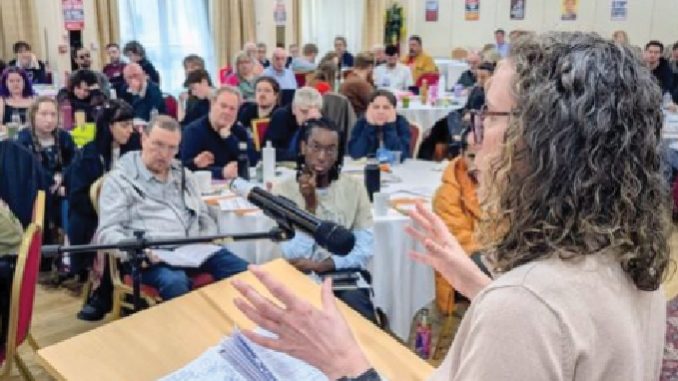
Almost 300 elected delegates and visitors attended the Socialist Party Congress. It was held in Coventry from 28 February to 2 March. Around half the people in the room only joined the Socialist Party since 2020. The enthusiasm, determination, and sense of responsibility for building the Socialist Party of all those present – young and not so young, new and experienced – was expressed in the many contributions to the discussions and the financial appeal which raised £37,876, on top of the tens of thousands raised to put on this successful event. It was impossible to leave the Congress without feeling extremely optimistic about the struggle for socialism in Britain and internationally.
A new global era
Congress began just hours after the first US and Israeli missiles had rained down on Iran, killing hundreds of civilians, including 165 school children. By the third day, many countries across the Middle East had been hit. These dramatic events graphically and brutally illustrate the new age of imperialist rivalry, polarisation and conflict described by Tony Saunois, Secretary of the Committee for a Workers’ International (CWI), and Judy Beishon, Socialist Party Executive Committee (EC) member, who introduced and concluded the opening session – A World in Crisis.
We are now in an extremely unstable multipolar world marked by imperialist conflict and wars, economic and military – of intensifying social and political polarisation not seen since the interwar years. Donald Trump is both a product and an accelerant of this new volatile era.
Trump’s intervention in Venezuela, his threats against Greenland and other countries in Latin America are the naked promotion of US capitalism’s economic interests. In particular, they reflect the rivalry between US imperialism and China, which is a principal feature of this new era. Although the US is still the biggest economic and military power globally, it has been in relative decline. While in 1960 the US accounted for 40% of world GDP that figure has now fallen to 26%. China’s share has increased from 2% in the 1970s to around 22% today.
Trump reflects the weakness of US imperialism, which can no longer even pretend to play the role of the world’s policeman on behalf of capitalism.
At home, Trump is also facing a society in turmoil and a deep political crisis. The state terror meted out by ICE in Minneapolis and the mass protests that erupted in response mark a turning point. These dramatic events, the continuing cost-of-living crisis and the Epstein scandal are further undermining all the institutions of capitalism and Trump‘s approval ratings.
We are in a period that contains elements of revolution and counterrevolution. One feature has been the rise of right-populist and far-right parties and the increasing repression and authoritarianism of capitalist governments of all colours. Where right-wing populists have come to power they have not resolved any of the problems in society. The other feature globally has been mass uprisings in countries like Bangladesh and Nepal, and a revival of the class struggle, with general strikes in Belgium, Greece, Portugal Argentina, and in India – the latter involving 300 million workers.
A missing factor globally is the existence of mass parties based on the working class that can expose and challenge capitalism and provide a socialist alternative. But the new global era and the early stirrings of class struggle are sowing the seeds for this alternative to be built.
Britain in crisis
The global instability, the sharp turns and sudden changes, the looming crisis in the world economy, will all have an impact on events in Britain.
“Just 20 months ago Starmer was elected with an historic 174 seat majority, just five less than Blair got in 1997”, said Socialist Party general secretary Hannah Sell, introducing the session ‘Perspectives for class struggle in Britain’. “But this is an entirely different world to 1997. Today the capitalist class has a profound crisis of political representation that they cannot overcome”.
This is the inevitable result of the inability of their system to improve the living standards of the majority. That is what destroyed the Tory party, once the most successful capitalist party on the planet, with millions of members, now reduced to 1.9% of the vote in the Gorton and Denton by-election.
Labour’s chosen candidate went down to a devastating defeat, in third place behind Reform, the Greens winning by over 4,000 votes. For the best part of a century capitalism in Britain was ruled via two stable parties. That era has gone for ever. Both are going to get a battering in the May elections.
Like in the Caerphilly Senedd by-election last year, won by Plaid Cymru, voters wanted to punish Labour, and looked to parties broadly seen as on the left to do so. Starmer is a “dead prime minister walking”. But even if he is replaced, possibly after the May elections, this will not fundamentally overcome the disintegration of Labour or solve the capitalists’ crisis of political representation.
One advantage that the capitalist class has for now is the early stage in development of class struggle, still low levels of consciousness and cohesion of the working class, and the absence of a mass workers’ party. It could have been so different had the leadership of Your Party built on the initial enthusiasm of the 800,000 who supported the call last summer for a new party, launched a campaign aimed at the base of the trade unions, and implemented a democratic structure that put unions at the core. But that opportunity has been squandered.
However, the issue of working-class political representation will continue to be posed sharply in the trade union movement. After all, it was the Birmingham bin workers’ ongoing heroic struggle which was the catalyst for the vote at Unite conference to review the union’s link with labour.
The pressure for strike action is mounting and the union leaders will not be able to hold back the tide indefinitely. The unions have a key role to play in fighting austerity and against the far right. But Reform and right-wing populism cannot be cut across while calling for a Labour vote. Linked to this is the question of the trade unions entering the political arena.
Many trade unionists and thousands of young people who consider themselves socialists are currently joining and looking to the Greens, who they see as an alternative at this point in time. Socialists must seek every opportunity to discuss and debate the best way to build representation for the working class, including using the petition calling on Zack Polanski to commit Green election candidates to vote against all cuts and closures.
Defeating Reform and its division is a task for the workers’ organisations, and the Congress recognised that this won’t be done by giving in to the pressure that will inevitably grow for ‘lesser evilism’. This is the argument to back one ‘progressive candidate’ against Reform even when those candidates have backed austerity and created the conditions for Reform to grow. Instead, we will need anti-austerity, socialist, workers’ councillors and MPs to organise and channel the mass opposition that will inevitably erupt against right-populism here, just as it has against Trump in the US.
Building our work in the trade unions
One of the widely recognised strengths of the Socialist Party is our roots in the workplaces and the trade unions. Opening the session on our work in the unions, Rob Williams, Socialist Party industrial organiser, explained that strike action is not at the level of 2022-23, but is higher than before Covid. Replying to the discussion, EC member Paula Mitchell pointed out that there is the potential for national action in schools and further and higher education, while pressure is building on the question of NHS and local government pay. Members reported the enthusiasm for motions on working-class political representation they proposed to union branches, as part of the ‘Trade unionists for a new party’ campaigning the party has been involved in.
Stormy events are looming and we must strive to raise the confidence of workers and young people, including by campaigning for a fighting leadership of the trade unions for the battles to come. We do that through a combination of putting demands on the existing leaders and building left opposition in the unions, including by standing candidates in trade union elections offering a socialist programme.
Our caucuses, which bring together Socialist Party members active in the various trade unions, are vital for organising our work in this crucial arena. Delegates active in seven different unions spoke in the discussion, with many others not able to contribute because of lack of time. A young member in Unison, called on all young Socialist Party members to get active in their union and respective caucus.
Members from Birmingham and Gloucestershire explained how they had been consistently visiting the picket lines and bringing solidarity to workers involved in the two longest strikes – the bin workers, out now for 15 months, and the phlebotomists, on strike for almost one year. 22 different Socialist Party bulletins have been distributed in Birmingham helping to point a way forward for the strike.
Socialist Party members are part of the left opposition in the most important unions. There are 11 Socialist Party members on national executive committees and members are standing as candidates for election or re-election this year for NECs in three unions, UCU, Unite and PCS, and for four service group executives in Unison.
In many areas our members are working with local trades councils to organise People’s Budget conferences, drawing up an anti-austerity programme for local council areas. We are also active in the National Shop Stewards Network, which provides a fighting programme for activists, and we will be mobilising for its 20th Conference on 27 July and lobby of the TUC on 13 September.
As well as taking part in the caucuses, all trade union members were encouraged to read, write for, and sell our Socialist newspaper.
May elections
Congress discussed the elections on 7 May, which will be the first in many cities under a Labour government since 2010. As there is unlikely to be a national Your Party stand, the Socialist Party will be supporting and promoting the appeal of the Trade Unionist and Socialist Coalition, which we participate in, to ‘help get socialism on the ballot paper’, and its aim to get a sufficient number of candidates to achieve ‘fair media coverage’. The key task for Socialist Party members is encouraging trade unionists, young people, community and anti-war campaigners, Your Party supporters and all those opposing war and austerity to stand.
Preparing for a new period of struggle
Who would have thought that a discussion on party structures would be one of the most lively of the Congress? But it was. That’s because, as Sarah Sachs Eldridge, EC Secretary, said in her introductory speech, the session was about the vital question of how our party can prepare for the mass struggles that will inevitably erupt, given the deep crisis of capitalism.
The resolution the Congress was discussing began by stating that “our party seeks to arm the fighting layers of the working class and youth with perspectives, a programme and a clear idea of the next steps needed to take the movement forward”. That is primarily a political task, but being prepared “requires attention to building teams that take responsibility at every level of the party”.
Congress is the primary decision-making body of the Socialist Party. In between Congresses, political and tactical decisions are taken by the National Committee, elected at the Congress, and an Executive Committee, elected by the National Committee. As we are moving into a new period, in which events are speeding up and decisions need to be made rapidly, the resolution proposed that we move to a tighter National Committee that can meet more frequently, with more time to discuss perspectives and respond to events.
The resolution also raised the need to strengthen the building of teams at every level of the party, including at regional and branch level. National Councils, with delegates elected from every branch, and also from our national trade union caucuses, national youth and student bureau, and national special oppression groups, would aim to meet twice a year. In particular, delegates stressed the importance of maximising the voice of our worker and trade union members.
The resolution was passed with no votes against and three abstentions.
Conference then went on to elect a new National Committee and to discuss how we can increase our finances, part of “sharpening all our tools” for the new period, as National Treasurer Isai Marijerla put it. 2025 was a year of improvement, especially with regards to the regular subscriptions members pay but there is still great potential to increase all aspects of our income, from subs, fighting fund and sales of our publications. Developing finance organisers and teams will be key to this, and is primarily a political task.
Youth are the future
Listening to our young members is always a highlight of Congress. But this was especially the case this year, with a growing number of youth playing important roles in building the Socialist Party at every level. The final session discussed our work amongst students in the universities, colleges and schools. Socialist Party members have helped build and are active in Socialist Students, which is striving to develop as a mass broad socialist student organisation.
Young members spoke enthusiastically about the campaigns and events they have been involved in and are planning for the coming months: the school and college walkouts against Trump’s visit last September; debates with the Greens; campaigning and standing youth candidates in the local elections; protesting against the war in Gaza and against a wider war in the Middle East; campaigning against rent hikes and rip-off charges on campus; building for International Women’s Day events against sexism and the system; fighting closures and showing solidarity with university workers fighting cuts and redundancies; fighting the far right; standing in student union elections to build a combative student leadership.
In addition to all these and many other campaigns, Socialist Party youth and student organiser Adam Powell Davies explained that nationally a Socialists Student youth contingent would take part in the 28 March ‘Together’ demo against the far right. Also protests would be organised against the G20 meeting which will be held in Britain in 2027.
Young people are especially hit by the crisis of the capitalist system and many are searching for a socialist solution. Socialist Party members will be doing all we can to ensure that our ideas reach as many of those young people as possible.