
In 2025, 59 women were killed by their partners, former partners, or family members, and the Minister of Justice stated that approximately 14 women are assaulted every hour in Romania (taking into account only reported cases). This year, in a tense political context marked by austerity measures, femicides have received increasing media attention, especially the cases of Teodora Marcu, Romina Incicaș, Anda Gyurcă, and Mihaela. Public outrage was swift, partly due to the negligent response of the authorities and partly due to the shocking brutality of the aggressors (Teodora was shot while walking with her 3-year-old child, Romina was hung from a car door and dragged for several kilometers, Anda was killed with an axe and set on fire, and Mihaela was stabbed 15 times while holding her 2-year-old child in her arms).
Many of the women killed had protection orders against their killers, some were persuaded by police not to file complaints, and others repeatedly reported death threats to the authorities but were ignored. There were also typical cases of judges responding to violence prior to the crimes with minimal or ineffective measures or with no measures at all. Added to this is the fact that Anda’s killer has not yet been caught by the authorities, despite being sought internationally for several months, even though the police had been notified by the victim’s family before the murder that he had declared his intention to kill her.
In this context, protests against femicide or violence against women took place in several cities, demanding “the recognition of femicide as a distinct crime,” meaning a murder committed against women, not just murder, but also other measures regarding the efficiency of the authorities, education, and so on. These demands were accompanied by speeches about how gender-based violence is a systemic problem and statements such as “the system has failed.” But in what way is gender-based violence a systemic problem? Which system has failed? And why do the authorities often not act to protect women?
A capitalist problem
If we want to address systemic problems, we cannot avoid discussing the economic system we live under: capitalism. Whether we are talking about education regarding gender-based violence or about how authorities act and what they represent, all of this is shaped by a system that protects the profit of a minority rather than the needs of the majority.
For women, the dictatorship of profit means that they are economically and socially oppressed, but that they are constantly sold the illusion that capitalist “progressivism” will liberate them. The capitalist class can “support” women’s rights under pressure from struggle, but it resists this coming at the expense of their profits. This is not a problem for wealthy women, but for the majority of working class women it can reduce them to ‘paper rights’, if the resources to exercise those rights are not available. And it also sometimes withdraws rights that workers have won in struggle, especially in times of capitalist crisis.
For example, in Poland, the current anti-abortion law was imposed in the early 1990s in the context of the restoration of capitalism, under pressure from the Catholic Church, which became an important pillar of the new post-Stalinist political order, despite opposition from the majority of society. Subsequent attempts to completely ban abortion, supported by right-wing parties such as PiS (Law and Justice) and religious institutions, have generated unprecedented mass mobilizations: over 140,000 people in more than 60 cities participated in “Black Monday,” namely strikes and protests against the proposed total ban, and the parliament’s hesitation to pass the law was a direct result of the pressure exerted through protests and strikes in October 2016. The movement continued in 2020, when the Constitutional Court made the legal framework even more restrictive, triggering new waves of protests and strikes by workers, especially miners.
Similarly, in the United States, the right to abortion, through the constitutional decision Roe v. Wade, was won through mass movements. Tens of thousands of people mobilized during the feminist movements of the 1960s and 1970s and the protests against the Vietnam War, in a context of growing radicalization. The repeal of this right in 2022 shows how gains won by the masses can be reversed by conservative forces and institutions of the capitalist state when the system feels threatened, is in crisis, or when the working class does not continue mobilizing for more profound change.
In both cases, after a right had been won by the masses, it was withdrawn even though the majority of the population did not agree with this withdrawal. This clearly shows that the masses being “educated” about women’s issues is not enough for a better society for women. Of course, not in all cases where women’s rights were lost was there broader understanding of sexist attitudes in society, something that remains undeniably important to address. But precisely because the logic of profit is unstable and is based entirely on the exploitation and suffering of the working class, those who do not benefit from profit, the workers, are the ones who must control the education of society and its radical change for the good of women and beyond; they are the only ones who have a real interest in doing so.
As in many other countries, in Romania, the “right” to abortion exists in law, but abortion is often inaccessible to the working class. Over 80% of public hospitals in Romania do not offer abortion services, and in 2021, 11 out of 41 counties reported no abortions performed in public hospitals. As public hospitals are increasingly impoverished by the political class, the private medical system is turning abortion and other medical services into a business, and many cannot afford to pay. In addition, some gynaecologists refuse to perform abortions in public hospitals, justifying their refusal on religious grounds, and in many cases, the same gynaecologists perform abortions in their private clinics. Such refusals in the public health system should not be accepted by workers. These gynaecologists are already in a contradictory class position, being their own bosses with their own private practices, more petty bourgeois than workers, unlike most doctors in Romania. The real solution, both for making abortion and other medical services accessible, remains the complete nationalization of the healthcare system, under the democratic control. People who work in hospitals know best what they need to take care of sick people, and because the whole society needs the healthcare system, decisions should be made by the majority, based on the needs of the community in question.
Meanwhile, AUR, the far-right party, has proposed a law that would classify abuse of a pregnant person at any stage of pregnancy as a double crime. Several anti-abortion organizations have expressed their support for this bill, which could mean an indirect ban of abortion. And the neoliberal opposition, currently in power, is doing nothing but introducing more and more austerity measures and gradual privatization.
In recent months alone, the Bolojan government has cut scholarships for underage mothers, frozen public sector salaries, left thousands of people unemployed, and reduced hourly wages for workers in education, a sector dominated by women. All of this makes life excessively difficult for women who are trying to escape abusive partners but are financially dependent on them. This is especially true since many of the jobs in which women dominate, such as teachers, educators, nurses, caregivers, etc., are already paid less, precisely because those who pay the salaries hide behind sexist ideas such as the one according to which caring for children and the sick is a “female duty.” Thus, austerity disproportionately affects working-class women, and the crises caused by capitalists are placed especially on their shoulders, while they often do most of the unpaid domestic work. Today we have the technology to make housework easier, there could be public laundries and canteens, as well as quality public services for the care of children, the elderly, and the sick.
In contrast, capitalism cannot afford to let go of the sexist stereotypes that keep many women as cheap or unpaid labor and leave others economically dependent on violent partners. Many working-class women who are abused cannot afford housing or rent, and shelters are too few and too poor. In addition, abuse against women often increases during capitalist crises as a result of the violence of the exploitative system and economic problems combined with the fact that some men feel entitled to dominate women.
The origins of sexism and violence against women
Despite the fact that capitalist austerity and exploitation kills women every day, there are still feminists who do not see a direct link between violence against women and the way the economy is organized. Many of them acknowledge that capitalism plays a part, but mistakenly believe that the main source of this violence is patriarchy (the organization of society around men). But the fact that some men believe they have a right over women’s bodies, lives, and deaths is neither coincidental nor does it stem from a “natural” human or “masculine” violence.
Friedrich Engels has already shown what many recent researches on pre-capitalist societies confirm, namely that before class societies and private property existed, there was no systemic oppression of women. In fact, there was no oppression between people, and violence between them was rare or isolated. They organized their food and goods, raised their children, and made decisions together. And women’s labor, domestic or otherwise, was not disregarded as it is today. Even if, to a certain extent, labour was divided between women and men, this division was not strict. Recent discoveries show that many women went hunting and many men went gathering or took care of the home. And every form of labour was considered equally valuable.
However, with the emergence of private property, the traditional family arose from the need to pass on wealth, and women’s sexuality and bodies began to be controlled to ensure this transfer. The concept of “woman” became linked to the ability to bear children. Women became the property of men, and men exploited in society were given the power to dominate in the family and the “right” to be violent towards women. This did not happen accidentally or because of a “moral decline” of men, but because the oppression of women is one of the parts that makes capitalism work and men have received a symbolic concession from the system that exploits them outside the home.
Women’s status and work were completely transformed and placed in an “inferior” category, their role reduced to reproducing the workforce and providing free or cheap labor. And today, capitalism maintains this role, constantly adapting it to new material conditions, because it cannot afford to get rid of it, no matter how much it uses “progressive” rhetoric. But working-class women and men can afford to get rid of capitalism and all the oppression that comes with it. Not only can they afford it, but they need to do it. And to free themselves from capitalist exploitation and oppression, they must unite in the struggle at work.
That is why the idea that men benefit from patriarchy could not be more wrong, precisely because it divides working-class women and men and ignores the real culprit—the capitalist class. Working-class men do not gain any real advantage from oppressing women, but only add another “lock” to the “chains” that bind them to their own exploitation when they do so. At the same time, it is very true that women suffer double oppression under capitalism and that we need to challenge any misogynistic or sexist tendencies in men, but it is important to go further than that and fight primarily the source of women’s oppression, namely the current economic system, capitalism. Violence against women fueled by patriarchal attitudes is very real and serious, but patriarchy is a consequence of class society. And any opposition to the systemic violence against women must center this aspect.
This is even more obvious when we consider bourgeois women or those with neoliberal policies in leadership positions. They do nothing but deepen the suffering of working-class women, while maintaining advantages that make their own feminine condition much easier. Even though all women, including those in the capitalist elite, experience gender-based violence and sexism (in different ways), only working-class women, together with the rest of the workers, can eliminate gender oppression by offering a socialist alternative to capitalism, based on the needs of the majority, not on exploitation and oppression in the name of profit.
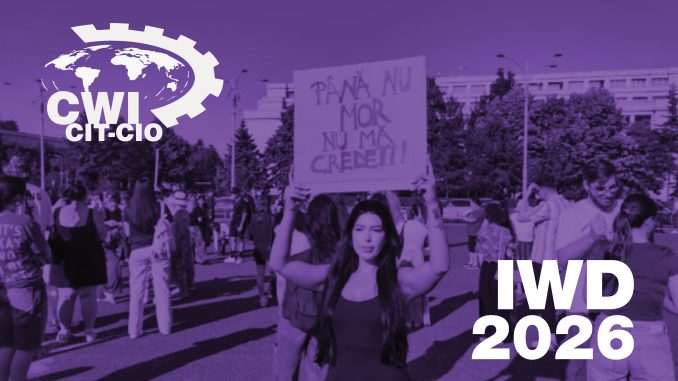
In Bucharest, at the “Together for Women’s Safety” march in October, there were several signs with anti-capitalist messages, such as “Femicide is the symptom, capitalism is the cause,” “Unity in the fight against capitalism,” and even some anti-capitalist chants. And in addition to the liberal media criticising this, as expected, a scandal erupted in which a bunch of participants in the same protest declared, as wrong as it could be, that this anti-capitalist position is just a distraction from the feminist cause or just propaganda that has no place there. But one thing remains certain, namely that the anti-capitalist feminist position is beginning to take shape in Romania.
How can we get rid of capitalism?
Although in cases of violence against women or femicide, the need to receive immediate support from the authorities and ultimately to obtain justice is entirely understandable, we cannot ignore the fact that the authorities actually represent the bourgeoisie, those who systematically perpetuate oppression and violence against women. That is why, when we want systemic change for women, we cannot rely on the police or judges, because no matter how well educated they may be and how non-sexist they may be, their role is first and foremost to protect the interests of the capitalist elite, at the cost of an oppressive society, especially for women. For real change, we must consolidate the power and control that workers have in society, because they are the only ones who have a class interest in permanently ending the oppression of women. The authorities could only help women systemically if they were controlled by workers.
And when it comes to workers with sexist attitudes, the task of educating them falls to other workers, and this can happen most effectively in trade unions, the largest workers’ organizations today. The Women’s Organization of the BNS- National Trade Union Bloc (the second largest trade union confederation) published an open letter to the government calling for the recognition of femicide as a distinct crime and for the strengthening of victim protection. The BNS also organized a public debate dedicated to eliminating violence against women and was involved in the “16 Days of Activism Against Gender Violence” campaign. The Cartel Alfa National Trade Union Confederation also issued a press release stating that violence against women is a “social and trade union emergency.”
The fact that trade unions are beginning to take the initiative is an important step forward, and the fact that violence against women is a trade union and workers’ issue is absolutely true. However, trade unions need to become more militant, demand greater changes for women, and stop relying on the “goodwill” of those in power, instead putting constant pressure on them to obtain more and more benefits for workers. Workers need to take an independent stance to defend their interests, without compromising with those who have an interest in profiting from their labor. Instead, representatives of the Ministry of Internal Affairs were invited to the public debate organized by the BNS. It is also no coincidence that the “16 Days of Activism Against Gender Violence” campaign was supported and promoted on the Romanian Police’s website. Such a campaign, based on “awareness” and organized by liberal NGOs, not by workers, does not affect the current system that kills and exploits women on a daily basis, but allows the bourgeoisie and the authorities to uphold feminist “values” in the name of “morality.” But beyond the rhetoric about principles, the oppression of women must be addressed at its root, from the way the economy is organized.
To achieve this, we need to build a socialist alternative to capitalism from the bottom up, in an organized, democratic, and worker-based manner. Starting with the unions, they should be controlled from their base. Union leaders who compromise with the bourgeoisie or its representatives should be replaced by workers who are ready to defend only the needs of workers. Workers are the ones who make society function; without their work, nothing would run. They are also the only ones who can make society work in their favor, not in favor of an elite minority.
The struggle for a society without violence and exploitation begins in the workplace. In 2026, strikes are likely to take place in several sectors, with workers in education and health sectors already declaring their intention to strike. The power is in the hands of the workers, and it is time for them to use the most important weapon they have: the economic one. A work stop means, first and foremost, a halt to the bosses’ profits, and this can bring big changes, including for women. Strikes could and should include demands against gender-based violence, as this is only the beginning of building a safe and prosperous society for women and for the rest of the working class.