
The results of the first round of the municipal elections on Sunday 15 March confirm one thing: there is a lot of anger against the rotten policies carried out in the towns and cities against the inhabitants and which are often in the same vein as those carried out by President Macron at the national level. The vote for La France Insoumise (LFI – France Unbowed) has been multiplied by eleven since the last municipal elections in 2020. Despite the attacks and lies from all sides, the good votes for the LFI lists have portrayed the opposition to the policies of budget cuts carried out by the Macron-compatible municipal majorities.
Polarisation is Deepening
The rejection of Macron’s policies and those of the right is such that Macron’s party Renaissance (previously En Marche) only ran in ten cities, and the Republicans (LR) in 152 municipalities, compared to 543 in 2014. Hundreds of presented lists were masked behind “various centre” lists or “various right” lists, some of which have been used as a ‘sanction vote’ against lists of outgoing mayors.
In its strongholds, the Socialist Party (PS) is struggling to make progress and is facing residents of working-class neighbourhoods who are very angry with them. In many towns and cities, the outgoing mayor has been re-elected. Where that mayor is PS, it is often as part of lists of unity of the ‘left’ in the first round (without LFI). And they are performing less well than they did in 2020 before they allied.
The Communist Party (PCF) won 172 municipalities in the first round, and continues to decline from election to election. Historical strongholds, such as Harfleur or Ivry-sur-Seine, were lost or are being contested, with the far-right National Rally (RN) gaining.
In the neighbourhoods, among workers and young people, there is a high abstention rate
Abstention is at 43%, down from 2020 (during the Covid pandemic), but the trend of declining turnout since the early 2000s continues. A whole section of workers and young people did not vote.
The RN vote increased in medium-sized cities, and it won 24 municipalities in the first round, half of which are cities they already governed. The RN continued to capture part of the protest vote, which allowed it to make progress in several cities, but this increase is much less strong than that of LFI. They are even down compared to the reference point of the municipal elections in 2014. Although the RN scored well in some large cities (such as Marseille and Nîmes), their results in most large cities such as Paris, Lyon, and Toulouse were below 10%, and they were eliminated from the municipal councils in the first round. The RN will be present in the second round in 20 of the 42 cities with more than 100,000 inhabitants, and their victory is not assured.
Success of the left list ‘Décidons Petit-Quevilly’
Despite all the efforts and joint propaganda of the Macronists, the PS and the far right, the vote for La France Insoumise exceeded forecasts: out of 500 lists, 166 exceeded 10% of the vote! In several major cities, LFI has made a breakthrough: in Paris, Lille, Toulouse, Limoges, Roubaix… in Saint-Denis, the second largest commune in Île-de-France, it won in the first round!
Continuing the success of the LFI vote into the second round will make it possible to create an atmosphere of resistance against Macron’s policies and against racist attacks.
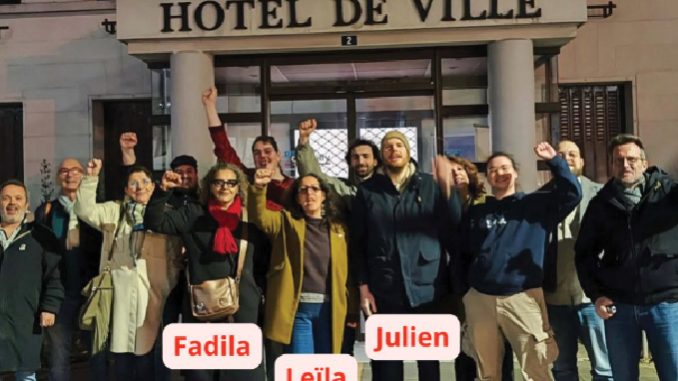
The campaign of the collective “Décidons Petit-Quevilly” was a success! This “liste insoumise et Populaire” (‘France unbowed and people’s list’), led by Leïla Messaoudi of Gauche Révolutionnaire (CWI France), multiplied its votes by 2.5 times and won 17.5% of the vote in this working-class commune of 22,000 inhabitants near Rouen. Thus, the Décidons Petit-Quevilly collective is anchored in the city with, from now on, three combative elected representatives on the municipal council who will fight against destruction of public services.
On March 22nd, vote for ‘insoumise’ and combative lists wherever possible!
These results show the current polarisation. In many cities, three, four or more lists have qualified for the second round and list mergers are taking place. In Paris, LR mayoral candidate Dati, who described the other right-wing list running in the city, Horizons, as “the dumbest right in the world”, merged with it between the two rounds.
Where the PS and the right are neck and neck, ‘technical’ mergers between PS-Greens and LFI lists sometimes take place, as in Lyon against the right. But in Toulouse, a “governance agreement” was made: LFI would take over the mayor’s office and the PS the metropolis… while the PS supports budget cuts and LFI wants to oppose them. There is a similar situation in Limoges.
We in Gauche Révolutionnaire favour the LFI lists being maintained in as many places as possible so that this vote continues to serve as an extension of the anger. The list mergers with the PS are debatable. Indeed, the difference in management between the PS and the right is often minimal, similar in particular on budget cuts and attacks on municipal workers. In Lille, the PS allied with the Greens against France Insoumise, which came in ahead of the Greens, showing how those forces put their own interests above all else.
Where the RN or its equivalents are in a position to take a city, technical mergers are the only electoral means to block them. But this is not a political response. The PS is not a bulwark against either Macron or the development of the RN vote. On the contrary, it was Hollande’s policies as PS president in 2012-2017, and then the PS’s vote on Macron’s budget, that goes against the interests of workers and leaves room for the RN to masquerade as an opposition to Macron.
We are opposed to any agreement to be in a municipal majority or a budget vote agreement with the PS. It must be very clear that any electoral deals only make sense on the basis of total independence and that elected representatives are not bound in any way in votes on the budget or otherwise. What we need are combative elected officials who defend the interests of workers and the majority of the population – including breaking with the policies of Macron and the RN.
In Marseille, to beat the RN, we have to organise in our neighbourhoods, workplaces and places of study!
There is a risk that the country’s second largest city could be taken by the RN. In Marseille, out-going mayor Payan’s PS-allied list (36.70%) had a very small lead over the RN’s Allisio list (35.02%). The right got 12.41% and the LFI list of Delogu got 11.94%.
We are in favour of preventing the RN from taking the city. But the RN will only really be defeated by a mobilization of residents, workers and young people, focused on concrete social demands for the city: decent housing, free transport, etc, which the RN will never do because they manage for the interests of the capitalists and not for those of the population.
Unsurprisingly and shamelessly, on Monday morning Payan submitted his list alone for the second round – ignoring LFI. He therefore trapped, electorally, all those among the youth and workers who voted LFI. Payan’s objective: for Delogu’s LFI list to withdraw completely, with a consequence being that LFI would not have any elected representatives on the municipal council. This dirty trick by Payan and the PS with the support of PS leader Faure and PS National Assembly member Hollande is intended to force the people of Marseille to vote for the list of the PS and its allies against the RN – while if re-elected they will continue to carry out their policies of budget cuts and urban development at the service of real estate and construction shareholders. And they will continue to let unsafe buildings collapse…
On Monday evening, hundreds of people gathered in front of Payan’s headquarters to protest against this manoeuvre and demonstrations are called throughout the week. Finally, France Insoumise announced at noon on 17 March that it was withdrawing its list. It would have been good to increase the pressure all day and to call on the trade unions and other workers’ organizations and associations to organize the fightback.
Many people are refusing the risk of seeing the RN lead the city of Marseille. And under this pressure, many will vote for Payan and the PS, even with disgust. Only a large-scale mobilisation can reverse the balance of power. The mobilisation must grow all week in the city against the RN and to make it clear to the PS that their programme and their policies are not ours and that if they are voted in, they will be scrutinized.
Beyond LFI, it is ultimately the role of the organisations of the workers’ movement, especially the unions, in particular those of municipal workers and those in the ports and docks, to call for mobilisation, and why not a day of strike on Thursday against the RN, racism and the destruction of public services – and a large mass demonstration on Friday evening.
Macron’s last year must be a year of struggles!
Anger is already present in many neighbourhoods, among workers and young people. The successes of the LFI lists, and more broadly of the lists that reject austerity policies, reinforce the idea that we must fight against the policies of Macron and others who fundamentally agree with him. His last year must be a year of ordeal for him by building a mass movement. Let’s get organised! Come and talk with us and join Gauche Révolutionnaire!