
The second round of the municipal elections confirms and amplifies the trends observed in the first round (read our statement): deep social anger, a massive rejection of austerity policies, and a political polarisation that is taking root in working-class neighbourhoods as well as in former working-class towns. Disgust with the politics of the traditional capitalist parties is expressed in a record abstention rate (excluding the Covid period) at 43% (– 10 points compared to 2001).
Despite the manoeuvres of the Socialist Party (PS), the Macronists and the right, the lists of LFI and the combative lists have progressed since the first round, sometimes spectacularly. La France Insoumise (LFI) — “France Unbowed” — was founded in 2016 by Jean‑Luc Mélenchon
In several cities where the LFI lists have been maintained in the second round, they have gained votes, showing that popular support exists and can be strengthened when a clear alternative is present.
In the southern city of Marseille, LFI maintained its lists in the second round in four of the eight sectors and obtained nearly 2,200 more votes in those areas. LFI lists won hundreds of municipal councillors and eight towns: St-Denis/Pierrefitte and La Courneuve (department 93), Roubaix (department 59), Vénissieux, Saint-Fons and Vaulx-en-Velin (department 69), Creil (department 60), as well as Le Tampon (department 974, Réunion).
This progress shows that social anger is looking for a clear political outlet, independent of the PS and the ‘left’ that accepts or defends capitalism.
The PS: a party evermore openly aligned with the interests of the capitalists
The second round highlighted a significant phenomenon: electoral support for the PS by the capitalists in several large cities, notably in Lille. The capitalists supported voting for the PS because they felt the threat from LFI in this big city.
The PS has confirmed that it is no longer in reality perceived as a bulwark against the far-right National Rally party (RN), nor is it much different to the right, even locally. In Marseille, the PS’s power move to prevent the presence of LFI in the city council is the most brutal illustration of this. The PS preferred to weaken the popular and anti-austerity opposition rather than build a real front against the far right.
Of the 850 lists presented by the PS in the 2008 municipal elections, it presented only 85 this year, having had to hide in pseudo-union lists of the left in many cities. These elections confirm that for most young people and workers, the PS is no longer a party for workers, but a loyal manager of the interests of the ruling classes, ready to do anything to maintain its positions. It and its allies are paying the price at the ballot box. Between 2008 and today, PS, the Communist Party (PCF) and the Greens have lost 15,000 seats.
The RN: a real danger, which can only be defeated by mobilisation
The RN is making progress in several cities, but its support base remains fragile in the major cities. The RN has also widely schemed, with parts of conservative Les Republicans (LR) or other right-wing groups, to position itself to get into power. In fact, its own lists had 108,000 fewer votes than in 2014. Where they were re-elected, it was because their elected representatives have become local barons, in the same way as the right. Not even one of them represents opposition to Macron’s policies.
Where the RN has really threatened to take cities, as in Marseille, only the mobilisation of workers and youth, of the organisations of the workers’ movement, can put an end to that threat, not the electoral arrangements of the PS. While technical list mergers can be a tool to prevent the RN winning elections, they are in no way a political response.
The RN will only be really defeated by a mobilisation of residents, workers and young people, focused on concrete social demands.
LFI: breakthroughs, anchoring and responsibilities
The results of the second round confirm that LFI is becoming the central political force in many working-class cities, including in the cities of the former ‘red belt’. The conquest of municipalities, such as Saint-Denis, and the progress in Marseille in the sectors where the list was maintained (in total, LFI won 593 seats in the municipal councils), show a deep dynamic.
This dynamic raises a strategic question: what political force can really take forward the social aspirations that are being expressed?
Having electoral programmes is good, especially when they pose as an alternative to the false left that makes social cuts in the cities and serves soup to president Macron and prime minister Sébastien Lecornu in the National Assembly. Now, to stop the policies of the government and the bosses, we need a political party of our own of workers and youth. A party in which we can discuss: how to build the response to Macron, what are we putting forward in our trade unions so that they engage in battle, what type of society are we fighting for in place of capitalism and its dictatorship of profit?
LFI will have to demonstrate, in the cities it governs and where it is strongly established, that it can carry out anti-austerity policies, breaking with the logic of management for the capitalists. The first municipal budget will be a key test!
Gauche Révolutionnaire: building a force of struggle against Macron and capitalism
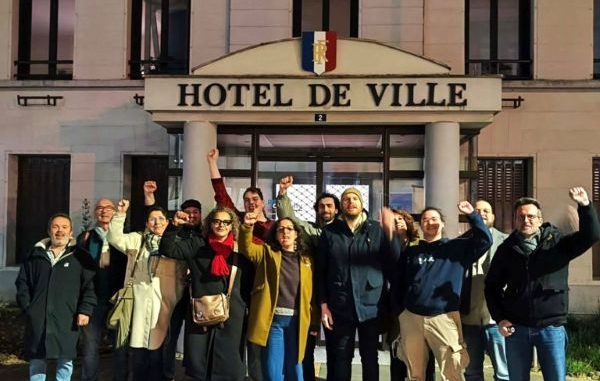
Everywhere, workers, young people and trade unionists have followed these elections closely and want to discuss what to do next. ‘Décidons Petit-Quevilly’, the ‘popular and unbowed’ list in Rouen headed by Leïla Messaoudi of Gauche Révolutionnaire, more than doubled its votes and obtained three combative elected officials.
Run by a collective that has been campaigning since 2020 in the city as a clear, social, combative campaign – independent of the PS – it has been able to win support among residents and workers. And the campaign has shown that to a significant extent it is drawing people together to fight for and win measures that are in their interests.
The Décidons Petit-Quevilly collective has therefore established certain roots; a must for all militant forces that want to put an end to policies that create austerity and crisis for us, and profits for the capitalists.
What is needed now: organisation and mobilisation!
Social tensions, anger in the neighbourhoods, and the risk of social explosions show that the situation is unstable and can change quickly. The last year of Macron’s mandate must be a year of struggles.