
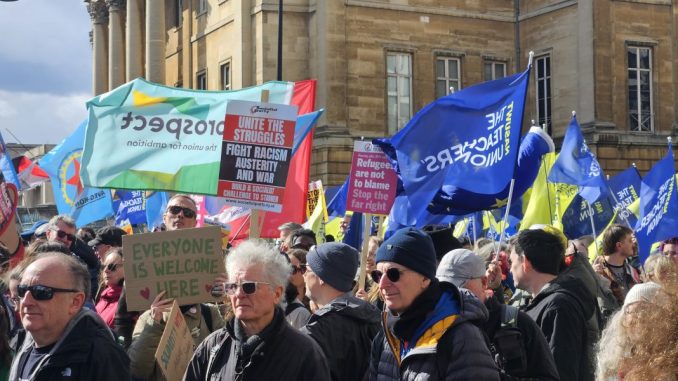
Hundreds of thousands of people took part in the anti-far right Together demonstration on 28 March in London. The driving force behind the mass turnout was a desire to show that far-right ideas and politics are not welcome in our streets, communities, and workplaces.
The demonstration would not have been the size it was without the backing of the trade unions – which collectively made up the largest organised bloc. Had the trade union leaders themselves called the demonstration under a slogan such as ‘No to austerity – jobs and homes, not racist division’, it could have appealed to an even broader layer of the working class, including to unorganised and demoralised layers, drawing them into the struggle for a better life and livelihood. Unfortunately, on this occasion, organisation and leadership was franchised out to organisations like Stand Up to Racism and the Together Alliance. The slogan raised was a completely insufficient: ‘Love, hope and unity’.
Taking part in a huge demonstration, particularly if it is your first one, can be an empowering experience. It can be an antidote to the sense of helplessness felt by the continuation of wars, conflicts, and environmental and cost-of-living crises.
The 2024 far‑right anti‑immigration riots, last year’s large ‘Unite the Kingdom’ demonstration organised by Tommy Robinson, and the fact that Nigel Farage’s Reform UK is leading in the polls are all reasons why people are feeling worried.
Divisive, anti-migrant, racist propaganda are not unique to Reform. These are carried out by all the capitalist politicians and their parties, to make migrants and other minorities scapegoats for the crises caused by them and their system.
Those who attended the demonstration would have come back feeling a sense of unity, the collective strength, and the power that we can defeat the far right and the establishment parties thriving on divisive policies.
Where next?
This positivity, energy and momentum need to be built on. The need to combat racism and the far-right has been an urgent task. Following the demo, a serious discussion needs to take place in the trade unions, workplaces and local communities about what strategy, programme and tactics are needed to cut across the support for Reform and far-right ideas.
Our placard on the demo called to ‘unite the struggles against racism, austerity, and war’. You cannot fight one without fighting the others. The cost-of-living crisis and the brutal continuation of austerity, which is seeing our services atomised, is pushing people into towards Reform.
A serious alternative that campaigns for jobs, homes and services for all, can unite and mobilise millions of people to cut across racism and division. The organised working class, the trade unions with 6.5 million workers, should lead.
Union lead
For the Together demo, unions such as the National Education Union put significant resources in. Socialist Party members on the union’s executive argued that therefore the union and its members should have a say over the slogans and demands put forward. For example, to link the struggle against the far right to the struggle the NEU is engaged in against school funding cuts and for a pay deal to meet rising inflation.
The trade union movement has the power to mobilise millions onto the streets and into action, as was seen during the 2022-23 strike wave. And for example in the 2011 anti-austerity demonstration of over 750,000 – that led directly to the N30 pensions strike of 29 unions, effectively a public sector general strike, involving 2 million workers.
The broad nature of the Together Alliance meant that those that have different interests from the working class are brought together and, in order to achieve that, the demands that can win a united struggle of working class and young people are not put forward. It also means some right-wing politicians, including Starmer loyalists, who are responsible for carrying through brutal austerity measures, were uncritically included.
London Mayor Sadiq Khan sent a video message, a poem about how ‘you are welcome in London’. But it is him and his Labour Party that is also pushing more working-class and young people out of London as they can’t afford it. As mayor, he is head of Transport for London, engaged in attacking the terms and conditions of London Underground workers who are set to take strike action. Mistakenly, most trade union leaders who spoke at the demo, and others including Socialist Workers’ Party general secretary Lewis Nielsen, speaking on behalf of Stand Up To Racism, made no criticism of the New Labour government’s austerity measures. This approach will not win the support of workers angry with Labour.
The main demand of the demo ‘Love, Hope and Unity’, does very little to cut across the increase in right-wing populist ideas. Together Alliance’s tactics for turning the tide is to encourage people to register to vote, forwarding messages to five WhatsApp groups, and beginning to organise. These steps do not address the fundamental tasks required to build a mass anti‑racist, anti-far-right movement.
What we need is struggle and a fightback against the conditions that breed support for Reform and the far-right. And that also means challenging Reform and pro-cut candidates in the May elections.
Kevin Courtney, former joint general secretary of the NEU, explained very clearly that the Together Alliance is a non-political party alliance and therefore will not tell people who to vote for and who not to vote for in the 7 May local elections. Ironically, he said that as he encouraged people to register to vote. With hundreds of thousands on the streets, just getting them to register without putting forward who they should vote for is not an effective approach.
Workers’ political representation
It is urgent that the trade union movement discusses how to solve the crisis of working-class political representation. If in these elections there had been a big, nationwide anti-austerity election stand led by the trade unions it would have had a huge appeal, and would be the most effective way to cut across support for Reform in May. It would be a big step towards the mass workers’ party that is needed.
That there is huge desire for such an alternative is shown by the fact that in 2022, over 500,000 signed up to Enough is Enough and in 2025, 800,000 people signed up to Jeremy Corbyn and Zarah Sultana’s Your Party.
The increase in membership and support for the Greens also reflects the cry for a political alternative to Starmer’s Labour. Voters are looking to punish Labour, as shown by historic defeats for both Labour and the Tories in two significant by-elections: in Caerphilly Senedd, won by Plaid Cymru, and Gorton and Denton, won by the Greens.
Zack Polanski received the loudest cheer when he spoke at the end of the demo. He was introduced as ‘a beacon of hope’. Many see the Green Party as a viable alternative to Labour. However, the record of Green councillors has so far been one of carrying through the same policies and measures as other establishment parties.
That’s why the Socialist Party supports the petition launched by leading trade unionists calling on Zack Polanski as a new leader to change course and mobilise his party in the struggle against local council austerity. The petition calls on Zack Polanski to commit that “no candidate shall appear on the ballot paper on behalf of the Green Party who has not made a public commitment to vote against all cuts and closures to council services, jobs, pay and conditions.”
So far, when it has been put to him, Zack has been unwilling to give that commitment. However, there has been enthusiasm from a layer of new Green members and supporters, as well as Green candidates and existing councillors signing.
Continuation of austerity measures – from Green councils or any of the establishment parties – is divisive. Attacking one section of workers against another, closing one service at the expense of another – it is such policies that have created fertile ground for the growth of Reform.
The Socialist Party is part of the Trade Unionist and Socialist Coalition (TUSC). We are campaigning for the biggest possible anti-cuts, anti-war, stand in the May elections. All TUSC candidates are committed to a no-cuts position. A genuine anti-cuts stand which rejects the logic of the capitalist system and mobilises local communities and workers to fight for more funding and resources to meet need. The wealth is there; we just have to campaign to take it off the billionaire and profit-driven bosses, part of a struggle for socialist change.