
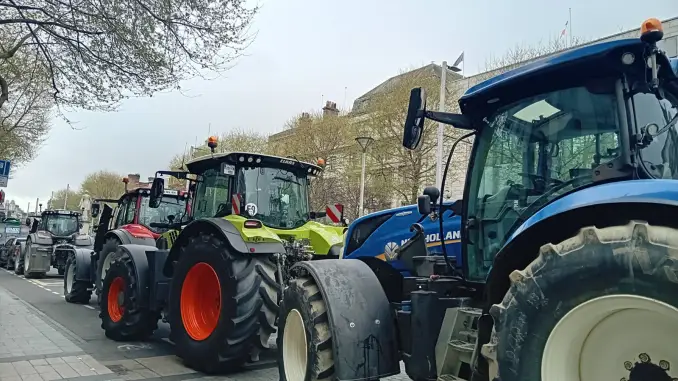
This week’s fuel protests in southern Ireland are just the first shocks to land in the country after Trump and Netanyahu unleashed hell on Iran. Motorways across the country and O’Connell Street in Dublin city centre are under blockade as hauliers, farmers and others take militant action to demand cuts in the price of fuel. The protests enjoy considerable public sympathy as the working class, small farmers and others come to terms with the looming cost of living crisis. The second one in just four years.
Profiteering has been rampant since the third Gulf War began. Fuel prices have soared across the economy. The destruction of fossil fuel processing infrastructure in many states in the Persian Gulf makes it a certainty that this crisis will only get worse.
As pumps begin to run dry and blockades of fuel supply terminals remain in place, Taoiseach [prime minister] Micheál Martin’s government has been plunged into a deep crisis with no easy way out. The façade of ‘stability’ has been cracked, probably for good. This is also a crisis for the working class which, in a car dependent society, faces the prospect of not being able to travel.
Who is leading and organising the fuel blockades?
These protests are not organised or led by the trade union movement. Small business people in the haulage and farming sectors are leading them. Far-right elements and right populist politicians, like Ken O’Flynn, have been integrated by the organisers. Solidarity from left and social democratic TDs [members of the Irish parliament] has been firmly rebuffed. Nonetheless, the protests have laid down a militant marker.
Talks between the government and the forces behind these protests are taking place. The government has some scope to further reduce VAT, excise and other taxes on fuel. Much of the overall cost of fuel is driven by ‘middlemen’ in the supply chain. Removing these forces would go some way to reducing fuel costs.
Threats to deploy the Irish army to break the blockades at fuel terminals like Whitegate in Co. Cork must be firmly condemned by the labour movement. State repression of the fuel protest movement will, without a doubt, be then applied against the workers’ struggles sure to erupt in the period ahead.
It must be emphasised that a workers-led stoppage would be of a different character to the present blockades. It would be organised democratically by rank-and-file workers, at local, regional and national levels, ensuring supplies to hospitals and other essential services. It would reject the false alternative of the populist right and far right and make class appeals to the wider population who are suffering as much as the hauliers, farmers and contractors from rising fuel costs.
The current crisis has rapidly brought into focus key questions about what forces control the supply of fuel and energy. How these questions are answered in the coming period will shape the Irish, European and global economy for decades to come. What is clear is that the anarchy of the ‘free’ market is unable to cope with the deadly and sudden shifts in global politics that are now underway.
Labour movement must respond
These protests have shown that militant action, directed at key points in the economy, can bring immediate results. Already the government has extended diesel fuel rebates. The labour movement must recognise that militant action both works and will be necessary. An unprecedented cost of living crisis is on its way; one which may eclipse that of 2022.
These fuel protests raise important questions for the leadership of the Irish labour movement. Who will take the lead in the struggles to come? The trade union movement or the far right and populist forces fronting the present blockades? Who will be seen to fight for workers?
What is certain is that old systems of partnership with employers and government and class collaboration can have no place in how the trade union movement responds to the coming crisis. Workers’ need to be prepared to take militant action to defend our living standards. If trade union leaders see their role as conciliating with a capitalist class intent on savage austerity, these leaders must be challenged and, if necessary, replaced. It is almost inevitable that the fight to defend workers will involve ‘illegal’ strike action. All of the fuel protests this week have been ‘illegal’, but they have worked.
Focusing on the plight of hauliers in turn demands an examination of conditions for workers in the sector. The haulage industry has traditionally been viciously anti-union and has not hesitated to engage in union busting or to deploy the legal system to stop workers joining trade unions. There are no Sectoral Employment Orders or Joint Labour Committees for the haulage sector; two basic mechanisms to ensure workers’ get a fair deal. Union busting in the haulage industry must end and trade union rights and entitlements extended to all workers in the sector.
A socialist programme for energy and transport
Socialists demand the nationalisation, under democratic workers’ control and management, of all fuel and energy infrastructure. Fuel and energy prices should be capped. The myriad of private companies, all of them engaged in price gouging and profiteering at this time, must be brought under public ownership. Capitalists are using the crisis to maximise their profits – they must be stopped. The financial accounts of these companies must be opened for inspection by workers and trade unions. Profits must be expropriated.
This sudden and unexpected fossil fuel supply crisis shows that there needs to be massive investment in sources of energy like solar and wind. This must be publicly owned and planned. Renewable and sustainable energy sources must be delivered to everyone, not just the richest households. Those parts of the economy wasting vital energy, such as data centres, must be immediately restricted, and a long-term plan for these sectors put in place and run by working class people democratically in the interests of the majority in society,
Public transport must be free of charge and extended across rural areas. Reopening rail routes, like the Western Corridor, is an imperative. The MetroLink project in Dublin must proceed. There must be a shift away from road haulage onto rail haulage, provided by a unionised publicly run company. This crisis provides an opportunity to address the deep dysfunctions in transport infrastructure. Micheál Martin’s government must be pushed by the trade union movement on this issue. The days of a car dependent transportation system may well be numbered.
Capitalism sets the world on fire: only socialism can end the chaos
This week’s protests are the first tremors of the massive upheaval that will surely follow from the war against Iran. It could well be magnitudes worse than the 2022 Cost of Living Crisis. Inflation for March is 3.6%; the highest since January 2024. Trade unions need to stand ready to fight to defend pay. Pay must match and exceed inflation. No job cuts. No pay cuts. We won’t pay for this!
Trump has plunged the world into chaos. He personifies the madness and chaos of capitalism and imperialism. Everyone can see now where this inevitably leads. We need to end this system. We need socialism and the democratic public ownership and control of the energy we all rely on to live.