
A socialist programme is needed!
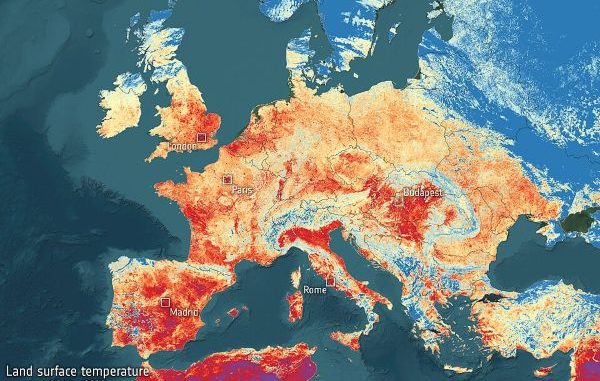
Several heatwaves swept across Europe and Germany this summer. Whilst forest fires raged in France and Spain, amongst other places, temperatures in Germany were also above 40 degrees. According to the Robert Koch Institute, there have already been almost 10,000 heat-related deaths this year. Capitalism leaves most of the population defenceless against these conditions.
A deadly emergency
The weekend of 26–28 June was a historic one. For three days in a row, the highest temperatures ever recorded in Germany were recorded: 41.3 degrees, 41.5 degrees and 41.7 degrees. And this in June, right at the start of summer. What we experienced so brutally that weekend are the direct effects of climate change. June was the hottest June in Western Europe since records began. The average temperature was just under 21 degrees, almost three full degrees above the June average for the years 1991 to 2020. Sea temperatures also broke records.
It is hard to overestimate the impact of the advancing climate crisis in Europe and worldwide: heatwaves, droughts, floods, wildfires, typhoons, water shortages, crop failures, loss of biodiversity, increased extreme weather events and, ultimately, simply rising temperatures that threaten human survival in parts of the world.
But it is not only in the Global South that there is a risk of heat-related deaths: the RKI estimates that more than 5,100 people died in Germany this June because of the heat. The Federal Statistical Office even estimates excess mortality at 6,800 people in the week of 22–28 June alone. In Cologne, the police recorded 120 unexplained deaths in the weekend of 26–28 June alone — almost four times as many as on an average weekend. Added to this are 35 men and boys who drowned whilst seeking relief from the heat in unsupervised bodies of water. The heatwave also claimed countless lives in other countries: Paris made shocking headlines with its overflowing mortuaries. Overcrowded A&E departments and severely overstretched emergency services, forced to respond to a flood of emergency calls, complete the picture of this dramatic crisis.
Emergency measures: nowhere to be seen
Whilst vast numbers of emergency services personnel were deployed and the mortuaries were filling up, there was no response from the Chancellor’s Office. Two weeks after the extreme heatwave, the German federal government finally published a document entitled ‘Protection against high temperatures’. This “protection” consists of drinking plenty of fluids, shifting activities to the cooler morning or evening hours, wearing headgear and using sun protection — a farce and a complete underestimation of just how taxing days-long heat is for healthy people without any means of cooling down, and how dangerous it is for the elderly, the sick, children and infants (and pets). It continues: “It is important to keep yourself and your home cool during high temperatures,”, as if there were any escape from the heat when, for several days running, even at midnight the air temperature remains at 30 degrees. And as if “cooling down” were an activity one could undertake on one’s own.
Of course, some people are perfectly capable of undertaking ‘cooling activities’, namely, all members of the Federal Government, who most likely barely noticed the heatwave whilst sitting in air-conditioned rooms. For protection from the heat is a class issue: the wealthy, and in particular the capitalists and their politicians, have the necessary means to weather such periods of extreme heat unscathed, even unimpressed. Living in villas in leafy residential areas, with air-conditioning, private swimming pools and the ability to grant themselves time off from the heat. Neither German Chancellor Merz nor any of his capitalist friends, nor their elderly family members, need fear dying from the heat.
The situation is very different for most of the population: according to estimates, only six per cent of households have an air-conditioning unit. Those who belong to the remaining 94 per cent of households — in other words, almost everyone — can at best alleviate the heat with an ice lolly or a fan (which becomes ineffective above certain temperatures). This means that the dangers of the heat only affect those who cannot afford individual protection against it themselves: the working class, pensioners, young people and children. The capitalists and their political representatives, on the other hand — who have caused climate change for decades, covered it up and enriched themselves from it — are the ones who get off most lightly when it comes to its consequences.
For effective protection against extreme heat
Further heatwaves – similar or perhaps even worse – are on the way. The fact is that preventing heat-related deaths would be a piece of cake if the federal government would just lift a finger and invest a fraction of a fraction of the money it is currently spending on war and armaments. The government is moving in the opposite direction: this hot summer, for example, a health insurance bill is being passed which will deprive the already overburdened hospitals and healthcare workers of billions and lead to job losses.
What is needed now is an immediate emergency programme to minimise the number of heat-related deaths during the next heatwave:
- If several consecutive days of severe heat stress (with a perceived temperature of 32°C or above at midday) or a single day of extreme heat stress (with a perceived temperature above 38°C) are expected, a heat emergency must be declared.
- During a heat emergency, all public buildings equipped with air conditioning must be made available as cooling centres for everyone, round the clock. Should these prove insufficient, private hotels and conference centres must also be utilised for this purpose — compensation should only be paid where proven need exists.
- An emergency plan must be drawn up for every hospital and every care home, setting out how reasonable temperatures can be maintained or how vulnerable residents and patients can be evacuated to air-conditioned rooms. The installation of air-conditioning systems and/or other measures to cool rooms and facilities must be implemented before the end of this summer.
- Public baths and outdoor swimming pools must be open free of charge and with extended opening hours to provide a place to cool down.
For effective heat protection in the future
Rising temperatures necessitate additional, far-reaching measures. A state investment programme is needed to adapt infrastructure and housing to the expected temperature rises in the medium term. Such an investment programme should be overseen by a democratically elected committee comprising representatives of trade unions, tenants and the working population. Sol (CWI in Germany) calls for, amongst other things: The issue of funding is crucial to all these matters. To date, the federal government has deferred responsibility for heat protection to the federal states and the heavily indebted local authorities. Sol opposes any attempt to pass on the costs of the climate crisis to the working class. We demand:
- An immediate halt to all austerity programmes at federal, state and local authority levels
- Preparing the healthcare system for the new challenges: instead of cuts, we need more staff and more specialised equipment for treating those affected by the heat.
- Fitting every hospital and care home room, as well as schools and nurseries, with air conditioning
- Heat-mitigation measures in towns and cities: more green spaces and trees, the removal of impervious surfaces, light-coloured paving instead of dark asphalt, water dispensers and drinking fountains, and misting systems in town centres.
- Investment in public indoor and outdoor swimming pools to prevent closures or to reopen them.
- Investment and a recruitment drive in local public transport, and the introduction of free public transport
- Adaptation of all public buildings – such as schools, childcare centres, nurseries, libraries and theatres – as well as offices, factories and all residential spaces, to rising temperatures, including through measures such as green roofs and green façades, building insulation, heat pumps, etc.
- Democratic urban planning through elected committees comprising representatives of trade unions and the local population, with the involvement of experts in urban planning, climate research, etc.
- Landlords must be obliged to carry out modernisation work where necessary, so that rented accommodation does not exceed certain temperature limits – without the possibility of passing on the costs of such modernisation to tenants’ rents. Property companies must be expropriated.
- Introduce binding regulations on heat-related school closures and childcare provision in air-conditioned rooms, as long as no cooling system is available.
- Convert production in, for example, car factories threatened with closure to the manufacture of air-conditioning systems and sun protection, in order to meet the high demand for cooling systems.
- Massive expansion of renewable energy and the transfer of energy companies into public ownership under democratic control and management
- The federal government must provide the necessary funds for this transformation by cutting military spending and taxing the rich and large corporations.
- The costs of fitting out company premises and rented flats must be borne by the capitalists or landlords. The federal government should provide interest-free loans to private landlords and micro-business owners to retrofit their homes and workplaces.
- We call for a wealth tax of ten per cent on assets exceeding one million euros, a highly progressive tax system, and drastically higher taxes on corporate profits and inheritances. We call for a one-off levy of 30 per cent on the financial assets of millionaires and billionaires.
- The transfer of banks and corporations – starting with climate destroyers such as RWE and the like – into public ownership under democratic control and administration by the working population
- We will not pay for the capitalist crisis – No to job cuts and redundancies, cuts to social services, local authority budget cuts and the erosion of workers’ rights – trade unions and the Left must now organise and unite the resistance
- Instead of market competition and the profit-driven economy – democratic economic planning and international cooperation – for socialist democracy worldwide
For effective heat protection in the workplace
The current regulations on heat in the workplace are vague, offer insufficient protection and are known to very few people. In summary, they look something like this: from 26 degrees, the employer must ensure cooling through measures such as external blinds, effective control of sun protection, ventilation in the early hours of the morning, relaxation of dress codes, the use of fans, etc. At temperatures above 30 degrees, more of these measures must be implemented. From 35 degrees onwards, a room is deemed unsuitable as a workspace without technical or organisational measures (such as air showers or cooling breaks) or protective equipment. The problem with this regulation is that there is no firm obligation to lower the temperature until the 35-degree threshold is reached. What is the point of ‘smart sun protection’ if the room still heats up to 33 degrees?
The other question is how such regulations are monitored. The current federal government is planning to cut back on health and safety provisions. Ver.di, the union, is warning against the removal of up to 130,000 health and safety representatives in workplaces. Even now, trade unions are criticising the implementation of the regulations currently in force. Particularly in companies without works councils, there is no supervisory body to represent employees’ interests on this issue. If heat protection is to be monitored, it must be done by those who have a stake in it: the employees themselves. In every workplace, the workforce should discuss the implementation of heat protection and its integration into day-to-day operations.
Adequate protection during working hours must be mandatorily implemented and monitored. Trade unions and staff representatives should draw up a proposal to this end. This should include a tightening of the generally applicable legal regulations or ordinances in the interests of all employees. However, it should also encompass a significant expansion of workplace oversight of these regulations, as well as of working hours and working conditions, by democratically elected staff committees (for example, through workplace ‘heat protection councils’) – including the right, in the event of unreasonable temperatures or conditions in the workplace, to reduce working hours with full pay compensation or to cease activities that pose a health risk.
In doing so, we must not limit ourselves to mere appeals to ‘lawmakers’. Instead, trade unions can demand collective agreements on heat protection and go on strike for this cause, as well as put forward concrete political demands themselves.
System Change!
Yet all this is merely treating the symptoms and will reach its limits if climate change is not halted. Only decisive action against global warming and a break with the profit-driven capitalist system can save us from a climate dystopia. Sol has set out a programme to save the climate in several publications (e.g. https://solidaritaet.info/2023/01/rwe-enteignen-klimakrise-sozialistisch-loesen/).
Of course, without pressure from trade unions and from the workplace, hardly any of these measures can be expected from the pro-capitalist figures in the Chancellery — yet another reason to take to the barricades against them and fight for socialist change. For every heatwave that comes is proof of how capitalism has destroyed the planet and the very foundations of our existence, and of how we must overcome it to keep the Earth a place worth living in.
Sources:
- https://www.bundesregierung.de/breg-de/aktuelles/schutz-vor-hohen-temperaturen-2198598
- https://www.tagesschau.de/wissen/klima/robert-koch-institut-hitzetote-deutschland-100.html
- https://www.rki.de/DE/Aktuelles/Neuigkeiten-und-Presse/Meldungen-PM/Meldungen/2026-07-09_WB-Hitzemortalitaet.html
- https://www.tagesschau.de/wissen/klima/copernicus-hitzerekord-juni-100.html
- https://www.zdfheute.de/wissen/wetter-hitze-temperatur-rekord-deutschland-100.html
- https://www.mdr.de/wissen/naturwissenschaften-technik/wie-koennen-wir-gebaeude-wohnungen-besser-kuehlen,hitzewelle-140.html
- Technical Regulations for Workplaces ASR A3.5 ‘Room Temperature’
- https://www.duesseldorf.de/gesundheitsamt/gesundheitsschutz/hitzewarnungen
- https://www.zeit.de/politik/deutschland/2025-06/arbeitsplatz-hitze-jan-van-aken-linkspartei-schutz