
Nearly three years after the start of the Israeli state’s genocidal war on Gaza, the satellite images on Google Maps have been updated. They reveal the extent of ongoing devastation and deprivation imposed on Palestinians whose homes are in the strip.
Rows and rows of buildings reduced to dust. Homes, workplaces, places of leisure, completely flattened. In their place, tent cities, now the home of 2.1 million people. Two thirds of the buildings in Gaza have been destroyed.
The images are shocking and emphasise, despite over a year of supposed ceasefire, the ongoing humanitarian crisis, with disease, hunger and dispossession commonplace. And despite the slight changes of emphasis amongst the bosses’ politicians, real action to end this situation from governments across Europe isn’t there.
The before-and-after photos show destruction on a par with the aftermath of a nuclear blast, created by the bombardment of tens of thousands of missiles. The Israeli state’s genocidal slaughter, with capitalist elites internationally complicit, has exposed to millions that this capitalist system is one capable of untold destruction and suffering as a result of their wars of plunder.
Fear of mass working-class opposition and a threat to their rule weighs heavy in the calculations of the capitalist classes in their descent into deeper and broader conflicts and wars.
Their actions have already provoked mass movements. In Britain, huge protests against the war toppled Tory home secretaries, contributed to the end of a Tory government and sowed the seeds for Keir Starmer’s resignation.
Now as politicians beat the drums of war, and want us to pay for increased spending on the military with more cuts and hits to our living standards, we should continue that struggle. They are worried about the impact our actions can have – that’s what’s behind every attempted attack on our democratic rights.
We can take inspiration from the young people fighting back across Europe; from school students in France, housing protesters in Spain, to the school strikers against conscription in Germany.
The capitalist system offers a world filled with wars making all of us less safe, and attacks on our living standards to maximise the profits of an uber-wealthy elite.
That’s why we’re organising for the international youth walkout on 20 November. To fight for our futures, not their wars. The way to provide us all with a world in which we can thrive, instead of struggling to get by, is to take the wealth and power out of the hands of the thieving few, and democratically utilise the world’s resources to provide us all with a home, a decent job and end climate chaos.
Join us, fight for socialist change!
4,000 sign up in Britain
Adam Powell-Davies, Socialist Students national organiser
With six weeks to go, the campaign for the 20 November International Youth Strike has been taken up a notch.
In the past week, high school students across France have blockaded schools and rallied against austerity and brutal police repression. In Spain, students and young people have been part of the mass protest movement against evictions and the capitalist ‘rentier economy’.
German students, who have walked out in their tens of thousands this year against the threat of conscription and military spending, have now decided to strike again. On 20 November, they will be joining tens of thousands of others across Europe, under the slogan, ‘fight for our future, not their wars’.
The message from Socialist Students to young people returning to campus and their classrooms this term has been simple: ‘Join the international fightback – walk out on 20 November, and get organised with Socialist Students’.
Socialist Students members have had a phenomenal response. In the past month, over 4,000 students have left their details to find out more about joining the International Youth Strike or to sign up to Socialist Students.
Hundreds have attended our open meetings, to come and hear why we say that ‘fighting for our future’ means getting organised for a socialist alternative to capitalism.
And we haven’t waited around to get students fighting back. On 25 September, we held protest actions all across Britain in solidarity with the German school strikes. We are attending protests in solidarity with French school students.
On 10 October, Socialist Students members from across the country will be forming up at the national Palestine solidarity demonstration in London. We’re looking for any students to get involved in the International Youth Strike campaign.
We’re determined to make sure that young people in Britain are part of it. Join Socialist Students if you want the international fightback to be socialist.
Liverpool – 600 want to hear about strikes, climate, socialism, and fighting the right
Becca Bayman, Liverpool Socialist Students
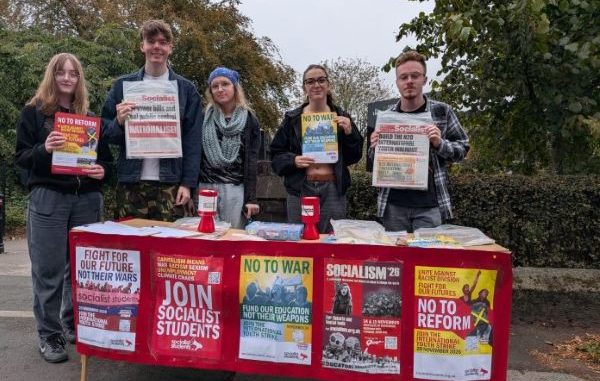
We had multiple Socialist Students campaign stalls on campus every day at the University of Liverpool. We received 600 contact details of students eager to learn more about socialism, a record high for Liverpool uni.
Young people are becoming more aware of the need for an alternative to combat the issues they see in their daily lives. 65 people attended our freshers meeting.
People asked about how to combat climate change, and whether the Green Party is capable of this. We raised the need for nationalisation and workers’ control of technology.
Students questioned the logistics of going on strike, and how we protect and support striking workers, and the role of trade unions in this. There was more awareness of the workers’ movement than in previous years.
The issue of militarisation came up, in response to our campaigning for the 20 November walkout. We explained why wars occur under capitalism, and why resisting militarisation requires resisting capitalism altogether, and the need for democratic workers’ control of the economy.
We were asked about how we should orientate to young people who have been influenced by right populism, and how we can win them over to socialist ideas. We argued for an alternative to the establishment parties to address the problems facing the working class.
We anchored this on the history of Liverpool’s Militant (Socialist Party’s predecessor) council during the 1980s. The socialist council had overwhelming support from Liverpool’s working class, because it created thousands of jobs and built thousands of council homes.
We were asked about the difference between ourselves and other political groups on campus. We’re working with other groups, especially across Europe, to build the 20 November youth strike. We explained that the broadness of our organisation allowed for maximum debate and democracy.
We frequently referred to the fight for socialism extending beyond campus. This requires us to sink deep roots into working-class organisations, like trade unions.
Our fight for socialism is based on Marxism, that helps analyse and understand capitalism. The failure of capitalism is inevitable, but socialism is not. So workers and young people must actively fight and organise.
SOAS – international solidarity
JJ, Waltham Forest Socialist Party
As it’s an internationally renowned humanitarian education centre, SOAS attracts students to central London from all across the globe. Our commitment to international working-class solidarity resonated.
We referred students to partner organisations of the Socialist Party in the Committee for a Workers’ International (CWI) in the US, France, Nigeria, and Germany. We had a long discussion with a student from Singapore about the issues plaguing the working class in her country, and how socialist change is the answer.
We promoted our solidarity rally with German students over their government introducing conscription, scheduled later in the day, and international youth walkouts on 20 November against the rise in militarism. Socialist Students values action as well as discussion.
Students commencing their education journeys have a backdrop of record youth and graduate unemployment. Tuition fees are scheduled to rise above £10,000 next year.
Students are paying more for less, while navigating a broken rental market and cost-of-living crisis. Our positive reception at SOAS showed the rise in support for socialism, as young people look for an alternative to capitalism.
Manchester – fightback energy
Eesha, Manchester Socialist Students
Over three days of campaigning, we handed out 3,000 leaflets, and saw 350 students sign up to fight against the militarisation of our education system. The energy for a fightback was palpable.
Students had little faith in new Labour prime minister Andy Burnham. Not only is the cost of education continuing to spiral – tuition fees and accommodation in particular – this money is being shamelessly invested in, for example, the Defence Universities Alliance. Manchester uni is gearing research towards weapons-making, and encouraging students towards careers in the military.
90 students attended our freshers meeting. There were lively political debates about whether there is need for militarism in an increasingly unstable capitalist world, and if the nature of capitalism inevitably leads to war.
Many people also talked about the logistics of a fightback – spreading information, international solidarity, lessons from student campaigns of the past, and the 20 November walkout.
Manchester students are not just angry. We are ready to take action.
Now we have to keep the momentum going.
Greenwich – what about our future?
Jay Coward, South East London Socialist Party
Young people want a way to fight for their future, and exercise their concern about where they’ll go after graduation. After freshers, we’ve been back at Greenwich uni every week with a campaign stall, followed an informal café meetup, before our Socialist Party meeting.
The chair of the women’s liberation group said that she had to pay to get a shuttle bus to campus, despite being advertised as free. This could be Greenwich Socialist Students’ first campaign!