
“I pledge to the greatest president in the history of the United States that loves us so much he can’t even breathe, that I will go out with my family, my friends. I’ll do it anyway, I don’t care if I’m registered or not, I’m going to try and cheat like hell like they do.” This was the pledge the faithful were asked to make at the Republican pre Midterm election convention in September. Attendees (and the empty seats undermined Trump’s desperate claims it was full) were also played a video reminding them that “On June 14th, 1946, God looked down on his planned paradise and said, ‘I need a caretaker,’ so God gave us Trump.”
No amount of divine intervention could mitigate the impact of shattered promises of Trump 2.0: bringing back jobs, good wages, no more foreign wars and a great economy that mobilised an election turnout, beyond the “Make America Great Again” (MAGA) base, in 2024.
But do not rule out more stunts to try and stop the hit, Trump and the Republican party are generally expected, in the media and polls, to take in the November 3rd elections. Trump just managed to halt Defence Secretary Pete Hegseth’s crazed promise of a livestreaming of a military execution!
Trump is expected to lose the House of Representatives and possibly the Senate. A blow to the figurehead of right-wing populism internationally – the Midterms of course, are as ever, a big money contest – on ads alone over $11 billion has been spent with millions more expected in the final days. These elections are only a much-distorted reflection of the moods in US society – especially of one important element, the radicalisation of tens of millions of workers and youth, many looking to the left.
Trump and his courtiers have enriched themselves since he moved back into the White House. The Financial Times (London) estimates that Trump has ‘earned’ “$2.2bn since his return to the White House, largely from crypto ventures” (29 October 2026). The next day the New York Times reported that Trump alone “is now worth about $7 billion” (30 October 2026). Republican party leaders can add a new Fox news poll to their list of worries, showing the number one issue of voters polled in its generally right-wing audience saw corruption as the main issue (Sunday Times, London, 18 October 2026), even on top of the boiling rage at the cost-of-living crisis.
America is so unaffordable that even Trump’s promise in Dallas to give $5,000 to every adult, plus special payments to farmers, seniors and Obamacare users – hasn’t dented the polling gap, or lifted Trump’s approval rating of 37%. Trump is widely seen, even among many who voted for him previously, as being in the pocket of “big tech”. He dismisses the concerns of the three quarters of Americans who do not want data centres built near their homes – especially as energy costs, the biggest current driver of inflation, are already spiralling – being at risk of being “backwards and poor”.
Trump can and has pointed the implementation of his promise of what is a brutal, racist border and immigration policy, including the use of his ICE paramilitary style thugs. But even this has seen falling support in society, generally, in response to killings, violence and prison camps. Plus his rural base is suffering as the local economy faces labor shortages and increased costs for hiring.
Power struggles are escalating in Trump’s administration, a press secretary had to go after five days, there are scandals over misallocation of funds, misuse of credit cards by Ambassadors and jostling for position, in anticipation of electoral defeat.
If a deep blue, Democratic, wave materialises, including victories in states like Texas it will be a stress test of how much Trump, and his MAGA movement, have transformed the Republicans, the ‘Grand Old Party’ (GOP). The loss of the Senate could lead to a focus of opposition from Republicans in Congress. However MAGA’s takeover of the GOP has been extensive, and it still holds onto a voting base of tens of millions, unlike the neo cons and other faded wings of the party. 60% of Republican still identify as MAGA, 19% of US adults (You Gov, March 2026).
There are fractures in MAGA, that could widen after the Midterms. Especially in the atmosphere of a Republican primary contest for a 2028 presidential candidate. On issues such as the cost of living and support for Israel, former MAGA mouthpieces, Majorie Taylor Greene and Tucker Carlson jumped overboard in the first half of Trump’s second term. It remains to be seen if a purer “American First” nationalist populist grouping, which these figures espouse, coalesces and organises opposition to Trump in MAGA. Elements of MAGA, can in the polarised situation of the US, go even further to the right. If a combative working-class political alternative is built outside the old parties, sections can even be won in the opposite direction.
In the 2028 race to win the GOP nomination JD Vance may opportunistically attempt to reach out to the “America First”, as he has shown unease with Trump’s war on Iran including reaching out to the regime for peace negotiations (New York Times, 28 October 2026).
But the Midterms will, even if the Democrats make major gains, not be an endorsement of their pro big business leadership and policies. They are at their lowest support among voters since 1990, with 63% disapproving (Wall Street Journal 2025). If the Democrats do not do as well as expected – it is because they are also rightly despised by wide layers who see them as part of the corrupt corporate elite. A 30 October BBC In-depth (30/10/26) report said that “The Real Clear Politics polling average shows the American public sees the Democrats as only marginally better than the Republicans. Recent polls show the Democratic Party still has a net unfavorability rating among Americans”.
The disillusionment at the two-party system is shown by the growing number of voters registering as “independent”, which Gallup totalled 45% at the end of last year. These voters can affect results; the number of independent candidates is also significant. A tight Senate race, the result of which can affect the balance of power in Congresss, is taking place in Nebraska where, with no Democrat standing, a populist standing as an “independent” Dan Osborn and running as a former union worker and a veteran, is tied in the polls with the Republican. Osborn however has been endorsed by the Nebraska state Democrats and has taken funding from Democrat PACSs.
The current “Democratic Socialist” and left progressive wave of candidates running as Democrats, who have generated the support of youth votes in the primaries, is also a reflection of the lack of support for the policies of the corporate Democrat leadership. Polls show the 34% of Democrat voters now identify as “Democratic Socialist”, with 65% viewing this idea of socialism positively.
In and outside Democratic Socialists of America’s (DSA) official support, while they all are clearly influenced by the progressive policies from the Sanders and Mamdani’s campaign demands around universal healthcare, rent controls and opposition to the Gaza genocide, however even those who identify as “democratic socialists” do not raise ending capitalism or have a clear socialist program.
Just under half of DSA backed candidates won their primaries, but the nature of the majority of the candidates running on the Democrat ballot line is shown by 67 of them having military intelligence backgrounds (Covert Action magazine). The party has raised billions in corporate funding in this election cycle including $80 million, from billionaire Bloomberg.
Economic misery and worry will be factor if the Republicans lose ground in states where they won easily in 2024. Diesel, on which many farmers and truckers rely, is up 75% per gallon from winter 2025. US families face increasing grocery costs and mortgage rates. Trump has consistently cut taxes on the super-rich, increasing the US governments indebtedness, millions, angry enough at the cuts to Medicare, welfare and federal programs sense there is even more to come. Trump has failed also, in his campaign to force Warsh, the new chair of the Federal Reserve to cut interest rates, economic conditions in Trump’s remaining time in office are more likely to lead to rises in the cost of borrowing for workers and small businesses. Trump’s carrying out of the wishes of big tech also builds the risk of a crash in the AI bubble in the economy.
The impact of Trump 2.0’s protectionist tariffs has also not matched MAGA’s promises. Trump made the case at General Motors in Michigan last July, that 30,000 new jobs had been created in a month, he also pointed to companies like Amazon having large scale investment plans. The AI bubble means increased manufacture of chips and servers plus materials to build data centres, militarisation means more orders in the defence industries and in aerospace. But other sectors have been vulnerable to tariffs, including wood, textiles and furniture. Imports have increased over the last year. Despite increases last summer saw employment in manufacturing 82,000 down on January 2025 – most manufacturing growth is in industries with high tech output with machines that require foreign parts (Financial Times, London, 29 August 2026, Tej Parikh). Trump’s tariff plans have been hampered by the Supreme Court, and other major economic powers responding, from China to Canada.
Trump’s war on Iran, causing the blocking of one of the worlds key trade routes and therefore inflation, never had majority support in US and received a backlash across society. There have been purges of generals, admirals and other senior officers, and a number have voiced unease at what they see as unnecessary military adventures. Military families are also angered by the conditions faced by rank-and-file sailors on naval vessels on tours for long periods, including poor sanitary conditions, food shortages and the danger from bombardment in US forces middle east bases.
Opposition to Nathanya’s onslaught on Gaza has been a theme the primaries – the pro-Israeli government AIPAC lobby group, while making it clear it will still intervene in elections has been forced by the sea change in mood in the US to halt direct endorsement of candidates.
Trump 2.0 has been even more authoritarian. In a bonapartist fashion – this President has attempted already to “cheat” the coming election, he launched an offensive on the Civil Rights Act, there have been major battles over redistricting and was only temporarily blocked in the Supreme Court from attacking voting rights around postal ballots. But there will be 1,000 election monitors sent out and a federal database has been created to “chase” ineligible voters. Trump at the time of writing says he will file a lawsuit to block certification of the Senate race in Alaska if the Republicans lose. Trump joked at an October Iowa rally about an unconstitutional third term, an idea he has repeatedly raised. Trump would have to change the 22nd amendment, but this is very unlikely as it would need votes of two-thirds in both houses of Congress and then the agreement of 38 of the US’s 50 federal states, unless the Supreme Court ruled the 22nd amendment itself unconstitutional, something that would cause a major crisis.
The hope of some liberal commentators though that Trump will accept a loss in the Midterms by simply focusing on enriching himself, losing interest in the presidency and using his executive powers is likely to prove to be wishful thinking. Claims of stolen elections, maybe with even more ramped up rhetoric, compared to 2021, and cheating by the Democrats are more probable. The January Capitol riot in 2021 also shows Trump is also not above inflaming his base to fight for his legacy.
The Democrats, on the back of a positive result could try once again the road of impeachment rather than building a popular movement. Even if this succeeded in removing Trump from office, it would likely be after a series of long-drawn-out court battles, Trump will also have no qualms in using the legal system not only to defend his administration but to point to the real, corrupt nature of the Democrats.
The working class, capable of drawing in behind it all who want to fight, is the only consistent and most powerful potential defender of democratic rights – Trump could be more quickly removed by this class moving, including through the labor unions.
Organised labor can be mobilised as a more powerful check on Trump attempting to bypass congress, mass calls of sickness by sections of workers stopped the federal shutdown and nonpayment of wages in Trump’s first term. This is why, the current call for a general strike by sections of the labor unions for 2028 is too late, union activists and reform caucuses need to mobilise a strategy to push leaderships to call such mass action, earlier. Such a lead, if seriously campaigned for, would get a colossal response in US society and transform the situation, however the present labour leadership are not prepared to take initiatives and, if forced to do so, will try to limit them. This is a further reason why there a movement from the bottom needs to be built to transform the unions into combative, democratically run organisations.
Trumps attacks on labor and the authoritarian response to the mass movement in Minnesota against ICE in early 2026, show the administration and the wider ruling class are fearful of such action by the working class. As the primary season has entered the final weeks, the paramilitary brutality of ICE has ramped up. The idea of a “general strike” has been rediscovered by a new generation, and the Trump administration was rocked by the mass protests in the Twin Cities forcing the removal of brutal Bovino and an end to “Operation Metro Surge”.
Frame up trials, state surveillance and crackdowns now target the unions, activists and socialists who were involved in organising the “no work, no school, no shopping” shutdowns and the rapid response groups which defending communities from the lethal fascistic methods of ICE squads. Already there are lengthy prison sentences for anti ICE activists in Texas, the full solidarity of the whole labor movement and working class across the US must be mobilised to fight this state repression.
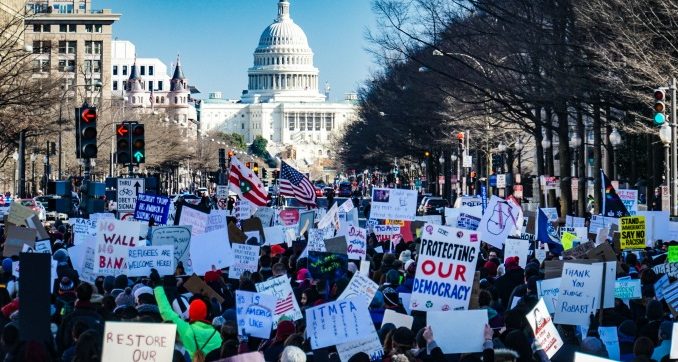
In the first half of Trump’s presidency protest movements have frothed up but then dissipated at worst into ‘lesser evilism’ unless decisive and coordinated leadership with working class methods was shown. This has been seen with the large “No Kings” mobilisations seen nationally and which now have, in the weeks before the Midterms, mainly focused on calls to vote against the Republicans. There were also the walkouts in the autumn in colleges, involving thousands, against the brutal gang rape, and lack of action against violence against women from authorities at Cornell. Hundreds of data centres have been blocked by community campaigns and mobilisations, but as yet no national coordination exists.
Discontent in society also gets reflected in the mass attention on symptoms of the brutal sickness of US capitalist society in the botched execution of Christa Pike and the Lindsay Clancy murder trial, raising issues around mental health and the lack of universal healthcare and the failures of the justice system. Political violence is also a feature, the attention on the Charlie Kirk assassination (followed by sackings of workers who commented unfavourably about his right populist views) and the support for Luigi Mangione, the suspected assassin of a private healthcare CEO. Youth frustration and disorder was seen across the country this summer in teen “takeovers” and confrontations with the police.
The lack of leadership and leading of struggles from the union bureaucracy, who are tied politically to the two-party system, also holds back the full potential of organised anger against Trump and the bosses. There have been significant strikes involving large numbers of workers this year, nurses in New York and Boston taking action, Meatpackers in Colorado, teachers in San Francisco and the Long Island railroad that show a willingness to fight, but did not win what they could have achieved due to a lack of leadership. The popularity of the idea of getting organised in unions continues to grow, the latest high-profile example being the Dallas Cowboys Cheerleaders, while polls show that 50 million workers want a union contract.
The Democratic Party leadership are not going to mobilise mass opposition to Trump in the second half of his term, they will attempt to dampen down anger, divert it into support for their presidential campaign and will claim their hands are tied, either by Trump bypassing Congress or, if the Midterm result is close, by the balance in the legislature.
They will also, combine facing down those progressives or DSA backed representatives who, even in mild ways, challenge their big business agenda, either through confrontation or co-option or a combination of both. It is possible the DSA backed representation may end up being larger than the “squad” bloc formed in the House during Trump’s first presidency. Socialists have a responsibility to engage with the mass societal discussion taking place around “democratic socialism” and place demands on these representatives who could be in a powerful position if they coordinated as a bloc in Congress. The raising of issues on behalf of workers, the oppressed and youth can not only be a weapon against Trump but expose the Democratic Party corporate leadership. But lessons from the past must be learned.
The “squad”, including Alexandra Oscario Cortez, failed to stand up to the Biden presidency and facilitated its support for anti-union policies and the Israeli government, shutting down the national railroad strike. Instead of a bloc that fought for the interests of working-class people, AOC and the others won praise from Democrat corporate leader Nancy Pelosi for how cooperative they were. This didn’t just cause huge demoralisation in the left, including throwing DSA into crisis but is partially responsible for the re -election of Trump, due to the Democrats, and the squad’s failures and betrayals, in the run up to 2024.
Currently AOC and members of the squad, in the absence of an alternative are still seen as a reference point by a layer, this is seen in the interest around a possible AOC run for the presidency, and the increased donations for Ilhan Omar after the federal raid on her home. Sanders and AOC have attracted large audiences for their “fight oligarchy” rally tour nationally raising support for policies like universal healthcare.
The vote in the primaries for “democratic socialists” and progressives is an attempt, particularly by a younger layer to find a way fight back against Trumpism. This was also seen in the mobilisation for Mamdani’s successful mayoral campaign on affordability in New York city in 2025. Mamdani’s large current approval rating is a result of achieving relative reforms (given what has taken place before) on childcare, taxation of the wealthy and rent. But he hasn’t mobilised his base to fight back against Trump and the Democratic Party leadership.
Instead of mobilisation in the name of “good governance” Mamdani has met with Trump on housing, and made deals with private developers, he has campaigned in this election cycle for the New York state governor Kathy Hochul a corporate anti-union politician who has attacked striking nurses, he has also cited the anti-trade union Taylor Law, in a lawsuit to stop UFT union organised education staff from getting agreed bonuses. While gaining popularity for being perceived to be dealing efficiently with homelessness and road maintenance he angered activists by refusing to support protests at the visit of Nethanayu and to utilise the full powers of his office, beyond condemning in words the ICE raids on the Bronx. Unfortunately, the DSA backed candidates for mayor Los Angeles and Washington DC this November say they are going to imitate Mamdani’s “good governance” under slogan’s like a “city that works”.
The winding up of “Our Time” in New York which originally was set up as an independent organisation rooted in his support base to pressure his office from the left – shows the pressures around ‘lesser evilism’ and the Democratic Party. It is not possible to fight “Oligarchy” by making deals with its politicians let alone try and transform a party, the Democrats, that upholds oligarchic capitalism and is not a genuine political organisation, but an undemocratic electoral machine.
If the Democrats win big in November, there can be illusions that they will push Trump back, also the mood to fight Trump might be lifted. That means the frustration at their attempts to derail struggle will be even greater than under Trump 1.0, even the current authority of Sanders or Mamdani may not be enough to prevent a mass searching for an alternative and further radicalisation.
The “third party” the US needs, is a workers’ party, based on the organising power of the unions independent of corporate backing. That’s why Socialists support steps in that direction in this election such as the campaigns of Kubicek a DSA member, running as a Socialist independent in Rhode Island for the state house and Andrea James, a left independent who broke from the Democrats, running for governor of Massachusetts. Such a mass party wouldn’t just fight elections but organise workers, youth and the oppressed in struggle. Socialists fight for the public ownership of major banks, industries and technology.
Currently only 27% of Americans express “a great deal” or “quite a lot” of confidence in the core institutions of US capitalism, 250 years after the republic was created in a revolution. A second socialist transformation that lifts the technological level and potential, even from the most advanced productive forces present in capitalism today – is required. The working class can own and democratically plan the economy to meet the needs of all, in the US and internationally.