
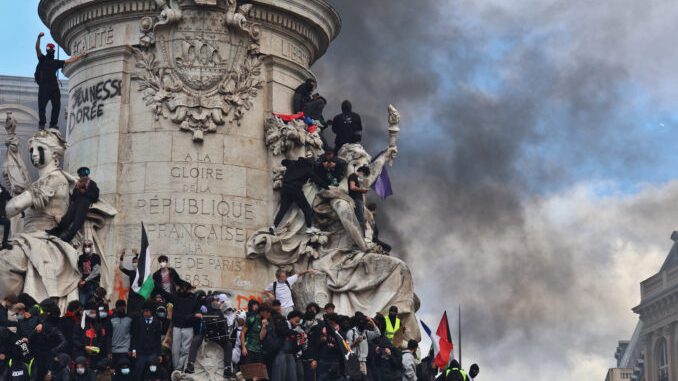
Decades of neoliberal policies at the expense of the population, rising prices, rearmament have created an explosive mixture across Europe. Now mass protests are developing, opening a new page in the history book.
The 2020s were already the most turbulent decade in a long time. Every one or two years there was an upheaval that revolutionised international conditions: in 2020 the Corona pandemic, in 2022 the Ukraine war, in 2023 October 7 and the beginning of the mass murder of the Palestinians, in 2024 the re-election of Donald Trump. Now a new upheaval of the situation could be in the offing. But this time it is not driven by the inherent instability and crisis-ridden nature of capitalism or the brutality of its proponents; rather it takes the character of mass movements from below. Young people and workers are taking to the streets in numerous countries, striking schools, universities and companies and inspiring each other. A huge wave is rolling across Europe, showing the potential power of the working class and youth.
A comprehensive presentation of all international protests and strikes is not possible here. The box (below) lists important developments.
Decades of Neoliberal Policy
For decades, governments throughout Europe have been pursuing neoliberal policies with social cuts, privatisation and the dismantling of public infrastructure (schools, hospitals, public transport, etc.) in an attempt to try to resolve contradictions, conflicts and crises within the rival capitalist states. As a result many well-paid jobs have been replaced by precarious work.
While the state made cuts at the expense of the mass of the population, rearmament began to be pushed forward. Large corporations were subsidised so that they could make even higher profits while the rich and super-rich got richer. All this at a time when, in a number of countries including the US, real wages stagnated or even fell.
But the high profits are hardly invested in the “real economy”. In addition to privatisation, a large part flows into speculation. One result of this is the growth of speculative bubbles—such as the one surrounding AI—which may burst sooner or later, with devastating consequences for the “real economy.” On the other hand, real estate speculation is making both rents and home ownership increasingly unaffordable. The war of aggression by the USA and Israel against Iran from February 28 also gave inflation a new boost.
These economic and political developments created the basis for the social explosion that is developing before our eyes throughout Europe. And this is not limited to Europe: the mass movement in Bolivia during May and June stemmed from the same causes, which also served as the backdrop for other movements, such as the “Cockroach” movement in India.]
“Between the Bond Market and the Barricades”?
One of the factors driving the crisis is the upward trend in interest rates. Central banks—such as the ECB and the U.S. Federal Reserve—have raised interest rates this year for the first time in a long while. Furthermore, so-called long-term interest rates on debts —the yields on government bonds and similar securities—are also rising. For instance, German federal bonds reached their highest yield levels since 2011, and U.S. Treasury bonds since 2002. This reflects both rising inflation and the growing concerns among speculators regarding the scale of national debt.
Conversely, this makes it more difficult for governments to meet the demands of protest movements through debt-financed spending. This is particularly true for France, where national debt stands at approximately 120% of the gross domestic product—twice the level permitted under the Maastricht criteria. The British Financial Times describes France as being caught “between the bond markets and the barricades.” This suggests that the conflict is likely to escalate further—and not only in France. However, when their power is under acute threat, rulers are always prepared to make concessions and temporarily forgo profits.]
November 11 saw an impressive general strike took place in the Spanish state, directed primarily against the devastating housing situation. It was the first such strike in 14 years and on a larger scale than the previous one. Participation in the strike was so high that, due to reduced production at 10 am, electricity consumption was 12.9 per cent lower than on a normal working day. Over four million people took to the streets despite torrential rain, with 700,000 in Madrid alone. The following day, the Spanish transitional parliament passed measures designed, amongst other things, to protect against evictions and to restrict the power of vulture funds (property funds). Although more far-reaching measures are necessary, this shows that mass struggles can make a difference. Of course, this concession was also linked to the elections on 29 November. And it is striking that most of the measures adopted do not cost the state any money.
Violence?
The capitalist media and politicians are trying to weaken the movement by exaggerating looting and violence. This drips with hypocrisy in the face of police violence against the protests in many countries, not to mention the violence in imperialist wars, etc. The mass of people demonstrate determinedly, but peacefully. We also do not know what proportion of the violence in France, for example, is due to police provocateurs or fascists who have infiltrated or attacked the movement.
The workers’ movement rejects senseless violence and looting as a way of struggle. Its first task is to offer a leadership that makes it clear that it does not just want a limited protest to ‘let off steam’, but wants to lead the movement to success and to do so organises a common determined mass struggle. Understanding the angry, frustrated mood of some the workers’ movement needs to show collectively, not individually, how to fight back.
In light of police violence and the threat posed by fascists—as seen, for example, in different places in France and, in Germany, during the “Gen Z regelt” protests in Karlsruhe on 31 October—the question of self-protection by the movement itself may also arise; such a mechanism could, in turn, address and counter senseless acts of violence that offer no way forward.
Racist agitation
The exaggeration of violence is often associated with racist agitation against alleged migrant perpetrators of violence. The racist attack on October 23 in Trappes near Paris, in which the perpetrator deliberately shot at blacks and Muslims, killing one person and wounding several, was a consequence of this. After that, the anti-migrant agitation continued in the German media and were amplified by the German Interior Minister falsely claiming that “violent left-wing groups and migrant hooligans” hi-jacked the October 31 protests.
Upheaval elections
In Serbia, the movement that began with the collapse of the roof of the train station in Novi Sad has led to the election of the ‘Student List’ after two years. The voting out of Vučić is a reason to rejoice. The student list has many positive program demands, including higher wages, a better right to strike, a ban on water privatisation, and a halt to further privatisations of public property. However, the composition of its candidates includes pro-capitalists. As implementing these demands will meet with resistance from investors and capital owners and put the alliance to the test, there is the danger of opposition from within the List blocking the movement’s demands.
At the very least, the movement must be prepared to put pressure on the new government. For this purpose, it would be good if the structures created in the movement (district committees, etc.) remain active. In Serbia, the protest is mainly directed against the corruption of governments. This entails the danger of simply seeking the ending of corruption in the hope of having a ‘honest’ system, when the profit system itself breeds corruption. That is why Socialists must explain that capitalism does not exist without corruption, in one form or another, and the need to break with this system.
Even though voter turnout has fallen in many countries, especially in working-class neighbourhoods, currently more people still participate in elections than in the largest demonstrations. Therefore, in addition to the escalation of protests and strikes, it is also necessary to build or strengthen a socialist political alternative both in elections and in society.
Despite the mass protests, a government of the right-wing PP with the participation or support of the even more right-wing Vox is threatened in the Spanish state on November 29 because of the fundamentally pro capitalist policies of the ruling social democrats.
Presidential elections will be held in France in April 2027. In the polls, Marine Le Pen, the candidate of the right-wing Rassemblement National, is clearly in the lead. The camp of the established parties is fragmented. Jean-Luc Mélenchon, the candidate of the left-wing movement La France Insoumise, has recently begun to catch up.
At the moment, it looks like French election heading towards a run-off between Le Pen and Mélenchon. Against the background of the current mass movement, polarisation is likely to increase. The propaganda of Macron and the bourgeois media against the movement is in fact electoral aid for the law-and-order candidate Le Pen, to whom she drives frightened voters. If Mélenchon does not succeed in breaking voters away from Le Pen in larger numbers, especially those attracted by the social elements in her populist policies, she will win the elections. But this is not a foregone conclusion, especially if La France Insoumise is developing more into a democratically organised party in which the working class can find its own voice with the current movement. The French elections will not end the turmoil. A Le Pen government would itself further polarise the country and inevitable lead to a stormy period, especially if Le Pen attempts to introduce cuts. The constellation of current mass movement and upcoming polarized elections currently makes France a key country for the further development of Europe and beyond, especially if an example is set on how to undermine and defeat the populist and hard right.
Taking resistance to new levels
At the beginning of November there was the first call for international protests from various trade unions and tenants’ organisations from seven countries for 20-22 November. This date has already been chosen by a coalition of youth organisations as a day of action and protest around the slogan “Fight for Our Future, Not Their Wars”.
The recent strikes in France, Spain and Portugal have caught the imagination of many. Demands should be made for a European wide day of strikes and protests in the first months of 2027 against austerity and rearmament. If an international youth strikes and protests are possible on 20 November, then the trade unions should also be able to organise coordinated strikes by workers throughout Europe with their apparatuses and resources.
However, most union leaderships clearly lack the will to do this this requires organising both in the unions and from below. A serious mobilisation is necessary, at the nationwide level with strike committees, works meetings (as well as school and university assemblies), networking of companies with each other and with schools and universities up to the national level plus activities within communities. Internationally, struggling workers should also network. These networks could not only organise struggles, but also discuss and make proposals for further intensification of the protests – towards multi-day and, depending on the state of the movement, even indefinite general strikes and the building of a mass democratically organised movement as an alternative to pro-capitalist governments: workers’ governments.
Unfortunately, such steps will not be implemented spontaneously. They require a clear programme and plan, something that mass socialist workers’ parties can help create and then build broad support for such combat steps in dialogue with the masses.
This will not succeed overnight. And mass movements cannot remain at the same level for an extended period of time. Either they increase or go back again, resigning themselves to small concessions that are temporary under capitalism. Intimidation and demoralisation through repressive measures is also possible in the medium term. The result can be a period of disappointment and frustration.
It will probably take a series of more waves of mass protests in which the participants gain experience of struggle, gain confidence in their own strength and lose illusions that their goals can be realized within the framework of capitalism. But in such struggles, the willingness to fight for a socialist society will develop, and with that socialist workers’ and eventually revolutionary mass parties that can overcome capitalism.