
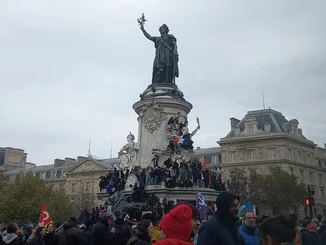
The inspiring mass movements of millions, on demonstrations, general strikes, and protests that have rocked Spain, France, Portugal, Italy, Serbia, Albania and other countries such as Belgium and Ireland represent a turning point in Europe. The significant European youth protest N20, mobilising hundreds of thousands of young people in 25 countries, coinciding with a general strike in Italy where over one million took to the streets was a part of these struggles. Together they herald a new chapter in working class struggle and the political and social polarization across the continent. Although not on the same level, and with important political and social differences, the continental spread of the current movements has an echo of the revolutionary wave that swept Europe in 1848.
Whilst the movement in each country has its own characteristics, features and demands they are unified in reflecting the rage and anger of millions against the consequences of capitalism in its protracted death throes. There is outrage at the glaring inequality, corruption, austerity, worsening environmental disasters, racism, rearmament and war that capitalist crisis is imposing on society. There is a mood of revolt against the ruling elite and the system especially amongst wide layers of a new generation moving into struggle for the first time as they feel they have ‘no future’. The hallmarks of 21st century capitalism have penetrated the consciousness of millions of workers and youth and prepared the way for the social revolt that is developing.
The protracted death throes of global capitalism, marked by a fundamental change in geo-political relations, dominated by the relative but accelerating decline of US imperialism mirrored by the rise of China, is paralleled by the sharper decline of European capitalist powers. All of which are debating how to cut living standards. This is now reflected in a political, social, and economic crisis in all European nations.
The optimism and confidence of the European ruling classes which was evident at the time of the introduction of the euro in 2002, amidst the hopes for stability, prosperity and greater European integration and unity has melted away like the snows of yesteryear. We are not witnessing a temporary cyclical crisis of capitalism during an era of boom or upswing. In such a period relative economic, political and social stability are of a longer duration than any cyclical crisis. The drawn-out death agony of capitalism means that crises, both economic, political and social are of a longer duration than any temporary cyclical growth or “stability” which are temporary and shorter lasting.
In country after country capitalism is gripped, or threatened, by stagnation, decline or regression. The awareness, in most countries, that for the first time since the post-Second World War upswing, the current and future generations will be worse-off than their parents has penetrated the consciousness of millions. Dreams of greater European unification have given way to division, conflict, and upheaval. These are the underlying factors that have now exploded at this turning point on the European continent.
At this stage, the epicenters of the struggles are in France and Spain. In both cases the recent eruptions of mass protests – especially by the youth – strikes and general strikes, have not dropped from the sky. They reflect the accumulated polarization and anger which has been developing over the years.
France in Revolt
France has seen a collapse in the social base of the traditional parties, both the “left” – the Socialist Party and Communist Party – and of the bourgeois parties through which French capitalism ruled. Hatred of the “centrist” Macron, who has destroyed the “centre”, has now boiled. A mass movement encompassing initially school students but widening to include workers in both the public and private sector, pensioners and others has erupted. Mass politicisation and polarisation is gripping French society. This is reflected in the widespread sales of books by the right-populist RN’s Jordan Bardella and of the new programme by left-populist LFI, led by the combative Jean-Luc Mélenchon.
Significantly, the heroic movement of the school students, protesting against the decrepit conditions and resources in schools, began in the French overseas department of Mayotte in the Indian Ocean – located between mainland Africa and Madagascar. The struggle that erupted there was the match that ignited the movement across France. It spread first to the working-class banlieue (suburbs) whose residents often have family connections with France’s overseas departments. It has now engulfed all sections of French society. The school students’ movement acted as the gatekeeper of a broader social explosion.
The mass protests of the youth encompass many features. Amongst them is a semi-festival atmosphere like the first spring of a revolutionary awakening. Confidence, hope and joy abound on these mass protests – the first awakening of a new generation. The plethora of ‘New World Orchestras’ in city after city performing in the streets and ‘Places’ playing the revolutionary anthems of the ‘Internationale’, ‘Bela Ciao’ ‘El Pueblo Unido’ reflect this spirit.
On the other hand, the depth of the crisis is revealed in the brutal repressions carried out by the French state machine as they have clubbed, gassed, blinded and severed the hands of those performing concerts or occupying the streets and ‘Places’. The violins, trumpets and double bases of the orchestras have collided with the batons and grenades of the paramilitary riot police. The RN has postured as the party of ‘law and order’ against the movement. A section of the state machine, especially within the police, is sympathetic to the RN and includes racist elements openly hostile to workers and young people from North African, African and Caribbean backgrounds, as well as fascist elements consciously opposed to the left and the workers’ movement. Macron has used the state machine to try and intimidate and defeat the movement. At the same time, a section of it is partially out of control. This is a warning to the movement and the masses for future battles as the tumult develops into and beyond the Presidential elections in April/May 2027.
Yet in the face of such brutal repression, reminiscent of the thuggery of a dictatorship, the youth have been fearless. The loss of fear of the state machine in all potentially revolutionary upheavals is a vital phase of mass movements. The young teenagers singing and dancing in front of massed lines of robocop cladded riot police are simply mocking the state, proclaiming their fearlessness. The state machine is alienating an entire generation. This will weaken and undermine its grip on society in the period that now opens in France.
Within this movement sections of the middle class have joined with those from the most downtrodden and oppressed sections of youth and the working class.
A degree of paralysis and division has gripped the ruling class and its political representatives. The National Assembly unanimously defeated the government’s proposed budget of 43 billion euros cuts passing the poisoned chalice to the Senate.
A pre-revolutionary situation?
Taken as a whole, along with the divisions in the French ruling class, these are some of the conditions necessary for a pre-revolutionary situation. Others, especially the decisive entry of the working class as a class placing itself at the head of the movement, its political consciousness and organisation together with a revolutionary socialist leadership and party have not yet matured. The absence of which can prolong, check and eventually derail the revolutionary process.
In France, and elsewhere, there has been an advance in political consciousness in that although not expressively socialist, a strong “anti-system” or anti-capitalist sentiment exists.
Trotsky pointed out in his article, “Once Again, Whither France” written in March 1935; “the first and most important premise of a revolutionary situation is the most intense sharpening of the contradictions between the productive forces and the property relations. The nation stops going forward.” He continued: ” But a revolutionary situation does not fall from the sky. It comes about in the class struggle. The party of the working class is the most important political factor in the development of a revolutionary situation.”
We can also add important aspects of this applies to a pre-revolutionary situation that can develop in France in the next period. Some elements of it are already present. But today, as when Trotsky was writing, the role of a workers’ party, with a revolutionary socialist programme, and the organisation and political consciousness of the working class are crucial factors in the prospect of a pre-revolutionary situation now maturing in France. Some features of this already exist. Like a revolutionary situation, a pre-revolutionary situation does not drop from the sky and is not pre-ordained. It depends on how the crisis and class struggle unfold in the coming weeks and months.
Social Revolt Converges with Presidential Elections
This powerful mass movement is converging with the forthcoming Presidential elections, the first round of which is due on 18 April. At this stage, the highly polarised political situation has squeezed out the “centre”. The battle is currently set to be between the RN, led by Le Pen and the radical left-populist movement, LFI, led by the combative Jean Luc Mélenchon. The ruling class is desperately scrabbling around like crazed rabbits in search of a viable “centre” candidate. Should they fail to find a viable “centre” alternative, most of the ruling elite is likely to opt for Le Pen.
The combative Mélenchon and the LFI are a crucial political point of reference and have won the support of millions. Although of a left-populist character, lacking a clear socialist expression, with features more of a movement than a structured workers’ party, it is essential that Marxists engage with it advocating an independent revolutionary socialist programme as the CWI French section, Gauche Révolutionnaire, does.
The ruling class, in France, and across Europe, is terrified of the prospect of a Mélenchon led government. They fear what this would unleash. His radical, but limited reformist programme, would arouse massive hopes and expectations for a fundamental transformation of society. The pressure from the masses for change would be enormous. In such a situation, the masses could begin to take matters into their own hands and attempt to seize the opportunity to enact radical reforms themselves. This could drive Mélenchon to take even more radical measures that encroach on capitalist interests.
The lessons of the first Mitterrand government, a coalition of the Socialist Party and Communist Party in the ‘Union of the Left’ elected in 1981 on a radical platform, the ‘110 Propositions for France’, are crucial. The state took control of 12 major industrial conglomerates and 38 private banks. The minimum wage was increased by 10%, the working week was reduced to 39 hours, a fifth week of paid holidays was introduced, the retirement age was lowered to 60 and a wealth tax was enacted. A public works programme was launched along with the creation of thousands of civil service jobs.
It was a programme more radical than that proposed by Mélenchon today. Mélenchon is demanding radical reforms, but within the limits of capitalism and is not preparing the working class and masses for the ferocious reaction his victory would provoke amongst the ruling class.
He justifiably calls for the end of the Fifth Republic and for a Sixth Republic. Yet why leave such a call hanging in the air with no content? Why not pose the issue of a new social system that breaks with capitalism and demand a Socialist Republic?
To abolish the Fifth Republic and establish a Sixth Socialist Republic, the working class and youth need to be prepared. There is an urgent need to organise the mass assemblies in the workplaces and amongst the students to organise the next phase of the struggle and elect committees of action linking workers and students together in an organised united movement.
Moreover, a workers’ party with a socialist programme is urgently needed. Such a party needs to be urgently built to prepare for whatever follows the Presidential elections. The LFI movement, or sections of it, could be the basis from which a party could be built and fight for a workers’ government based on the LFI, militants from the Communist Party, workers and youth. Unfortunately, Melechon is opposed to building such a party.
Mitterrand’s 1981 government failed to break with capitalism. Capitalists and the international markets launched counterattacks and economic sabotages. Mitterrand capitulated rather than taking decisive steps to mobilise the working class and break with capitalism. In March 1983, his government took a massive U-Turn in what was known as the ‘Tournant de la Riguer’ and introduced sweeping austerity measures.
Inevitably Mélenchon would face a similar reaction from the ruling class and capitalism internationally. Under pressure from a mass social movement, it is not excluded that he could be pushed in a more radical direction. It is possible, depending on the strength of the mass movement, the conflict could be more protracted and explosive than it was in 1981/3. The crisis and polarisation today are far deeper than at that time.
In such an explosive situation, with their interests seriously challenged and threatened, the ruling class could be driven to overthrow his government in some form of coup. A coup can take many forms. It does not necessarily mean direct military intervention, but a form of Bonapartist regime seizing power similar to Charles de Gaulle’s coup in 1958 could not be excluded.
The threat of Le Pen
However, at this stage a victory by Le Pen appears most likely although this can change, especially if Mélenchon and the LFI can win some of the workers and youth who are currently looking to the RN. This would provoke both alarm and fury amongst big sections of the population, especially the migrant population, in France and internationally. A sharper, even more polarised situation would certainly open up. Mass mobilisations, violent clashes and battles under a Le Pen Presidency, are a certainty at a certain stage.
In either scenario France is poised to be plunged into an even more bitter and polarised social civil war than that which already exists. Both possibilities would also aggravate and deepen the divisions and tensions that exist within the EU. The developments in France are part of the character of the new era of capitalism’s protracted death agony. France is not alone in being shaken to its’ core by political and social tumult.
Spain erupts
The historic four million strong general strike in the Spanish state on November 11th was an expression of the mass social revolt unfolding there. It followed the magnificent mass movement over housing that erupted following the eviction of an 87-year-old lady, Maricarmen, who could not afford to pay the 400% rent increase on her apartment by her corporate landlord. The brutality of the capitalist market illustrated by her being carried out of her flat on a stretcher as police stood at her door. Tragically she died a few days later, killed by the “vulture funds”, keen to boost their profits.
Hundreds of thousands took to the streets in protest at the housing crisis gripping Spain which also now exists in most industrialised countries. This crisis did not drop from the sky but has been accumulating for years. It has been reflected in many protests, including those against tourism that has been a factor in cities such as Barcelona driving up rents and forcing local people from their homes.
Prior to the mass movement on housing strikes were breaking out across the Spanish state including dockers in Cadiz and La Corun, care workers in Valencia, Airbus workers in Madrid and metal workers in Tarragona. These battles have taken place during a period of economic growth in the Spanish state. According to the IMF, Spain was the world’s fastest growing large economy in 2025 for the second year running. Unemployment fell from a high of 27% in 2013 to 9.8% in the second quarter of 2026. This has been combined with a limited growth of industry. All of which can combine to boost the confidence of the working class.
Yet behind the “growth” anger and fury also accumulated. The working and middle classes and young people are not driven to struggle and revolution only because of economic recession or slump. Severe economic recession or slump can stun or demoralise the working class. Mass revolutionary movements can take place during periods of economic growth or upturn. This was the case in France 1968.
The growth in Spain has been unequal. Wage rises have been won but not sufficient to keep pace with the cost of living and explosion in housing costs. While salaries in Spain increased by 30% between 2015 and 2025 rents rocketed by an eyewatering 87%. For young workers (under 35) the situation is even worse – OECD figures point to a fall in wages in real terms since 2001 by 16.8%
The eviction of Maricarmen was the spark which triggered a mass revolt. Significantly it began on housing but broadened out to reflect all the accumulated anger that has developed on the cost of living, corruption, inequality and war. Crucially in Spain the radical tenants’ unions played a key role firstly in calling national protests on housing. Then, together with others they pressurized the big trade union confederations of CCOO, UGT supported by the smaller radical CGT and CNT to call the general strike on November 11th. The leadership of the UGT and CCOO were pushed into calling the strike despite themselves by the mass movement from below. This is despite the fact that a layer, especially youth, is mistrustful or even hate the trade union bureaucracy.
This massive mobilisation of over 4 million workers is potentially a turning point in the struggle in Spain. In some respects, this movement has some more advanced features compared to what has thus far developed in France. The working class in Spain entered the struggle as a class. This was reflected on the mass protests with organised trade union contingents from the workplaces. The tenants’ unions and other social organisations in the localities played a crucial role in preparing and campaigning for the strike.
As in France the movement of the masses converges with the general election called for November 29th. As in France the election will not be the end of the social eruption which is underway. Yet unlike France a political vacuum exists on the left following the betrayal of the former left-populist PODEMOS which had the potential to develop into a powerful left alternative but squandered the opportunity.
The government of Pedro Sanchez, leader of PSOE, the Socialist Party, verbally has tilted to the “left” presenting itself as the party to resolve the housing crisis and internationally opposing the Israeli regime and its genocidal war against the Palestinian people. Opportunistically, after eight years in power, during the mass movement it proposed in Congress measures to stop all evictions until 2030 which voted down by the right-wing PP and far right racist Vox. Then following the November 11th one day general strike it decreed the same measures. Yet prior to the mass movement, it had done little or nothing to resolve the housing crisis. Despite some limited reforms, Sanchez has managed capitalism amidst corruption scandals that have involved the PSOE leadership. Moreover, the police repression carried out on November 11th and during the housing movement was directed by the Minister of the Interior.
The outcome of the election at the time of writing is uncertain. The PP and Vox were ahead in the opinion polls which narrowed following the general strike. Should the PP and Vox win they have declared they will immediately cancel the governments housing legislation. A move which may be sufficient to cost them the election. Should they still win, cancelling the government’s legislation is likely to open the way for further battles on housing and other issues including the racist anti-immigrant policies of the PP and Vox.
Prepare for future battles
Resistance to these and other attacks needs to be prepared. This is an urgent task flowing from the mass movement and general strike that has already taken place. The calling of a further 48 hour general strike would be a part of this preparation and a means of sustaining the movement in preparation for battles to come whoever wins the election.
Understandably, many workers and young people are likely to rally to vote PSOE and its allies to stop the right winning power given the absence of a strong left alternative. Given the absence of a left alternative, a vote against the right is the only electoral option. Should Sanchez manage to cling to power mass mobilisations and struggles will also be essential to ensure the implementation of the suspension of evictions. Yet far more is needed to resolve the housing crisis and other demands of workers and youth.
Preparation for a 48-hour general strike raising all the demands of the movement would take the struggle against austerity further forward. This could be linked with the calling of an assembly with elected representatives of workers, rank and file trade unionists, students, other social groups and left-wing socialist organisations to plan a coordinated campaign of struggle. It could also debate how to build a political organisation, with a programme to replace capitalism with a socialist alternative which alone can resolve the housing crisis, the cost of living disaster and other problems faced by the working class and others exploited by capitalism and offer an alternative to the existing parties of capitalism including PSOE.
Unify the struggles across borders
France, Spain, Portugal and Italy are currently in the first line of combat against austerity and attacks on working people and youth. Other countries, like Germany or Britain are in political and social crisis but do not yet have the same degree of combative struggle. The threat of the far right AfD in Germany, currently leading in the opinion polls, illustrates the danger that flows from not building mass parties of the working class with a socialist alternative and the polarisation which exists.
Yet the battles unleashed already pose the idea of a united struggle across borders. The calling of an all European one-day general strike and day of protest could begin to unite the working class in a common struggle. It could be weapon to fight the attempts of the right-wing, racist, nationalist parties of the right who aim to split and divide the working class.
A turning point has been reached in the class struggle in Europe. Now is the time for bold, united action to offer an alternative to austerity and war and begin the struggle to form a democratic, voluntary socialist confederation of European states as an alternative to a decaying capitalism.
We urge those not yet involved in a struggle for the ideas and programme of the CWI to join with us.