
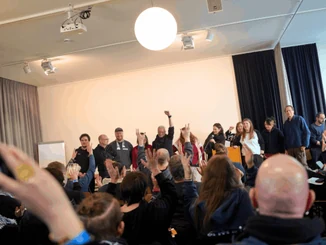
On 21 and 22 November, 130 members of the Left Party from sixty district associations founded the Socialist Network (SV) within the Left Party – a new federal working group that aims to build an effective force on the party’s left wing.
The organizers thus achieved a successful launch for this new project. But it’s not just the large turnout of 150 participants – despite the flu outbreak (approximately 50 registered people had to cancel) – that demonstrates the new network’s resonating with a segment of party activists. The weekend was characterized by a constructive and supportive atmosphere, not always typical within the Left Party, and a strong sense of unity. Quite a few participants said it was the best and most constructive meeting they had ever attended within the Left Party.
Why a new network?
The initiative originally came from Sol members who contacted other activists from district associations, youth association, AKL, LidL (Left within the Left) in Berlin, SAV and BAG Palestine Solidarity and then jointly launched the project.
The conference’s preparatory committee wrote the following regarding their motivation for establishing the network:
“The party leadership’s erosion of solidarity [with members in solidarity with Palestine] in many cases, the actual policies of the Left Party leadership in the state governments of Mecklenburg-Western Pomerania and Bremen, in the state parliaments of Saxony and Thuringia, and often also in the Bundestag, the party’s often bureaucratic functioning, the upcoming government formation in Berlin with two pro-capitalist parties, and the reluctance to implement measures in this coalition that would make the wealthy and capital owners pay, while instead enshrining hundreds of millions in spending cuts, have disappointed many of the new members. We already noticed the beginning of this process last year. In our view, it makes a strong organization and network of the party’s left wing, encompassing new and young members and not limited to functionaries and the preparation of party conferences, urgently necessary. We have also observed that the existing associations of the party’s left wing—AKL, SL, KPF, and others—have hardly been embraced by the thousands of new members. Instead, the Federal Working Group on Palestine Solidarity and… the Left Youth has become an expression of the leftward shift and has gained many new members, but naturally has its limitations due to its thematic and age restrictions. We have also observed that local networks have formed in a number of places, especially in Berlin in the form of LidL (Left within the Left), bringing together members of different groups and new party members. Based on these developments, we have concluded that a new network is needed.”
Jana Aderhold, a works councillor and city councillor from Lower Saxony, explained her reasons for participating in the Socialist Network in her opening speech, outlining four points: “So why a Socialist Network within the Left Party? Because we have to stop merely reacting. Because social justice and peace belong together. Because our strength comes from below and not from coalition agreements. And because no one in this party should be left alone.” The conference adopted a founding declaration and statutes and elected a federal spokesperson council.
Government participation
Sebastian Rave, who participated in the conference as a member of the Federal Spokesperson Council of the Anti-Capitalist Left (AKL) and spoke on two panels, writes in an article about the conference that the founding declaration of the SV does not contain much new that differs from other left-wing parties.
In terms of content, this may be true for some of the adopted positions. However, it is surprising that he makes such a sweeping statement, given that he himself criticized the conference attendees for taking the easy way out regarding government coalitions with pro-capitalist parties by fundamentally condemning them. He himself did not want to rule out such coalitions, a position also advocated by other members of the AKL’s federal spokesperson council at its last general meeting. On this issue, the new network clearly has a unique selling point.
Aside from that, the biggest difference between the SV and other associations probably lies in its self-conception and expected working methods. The project is explicitly intended as a network for grassroots members, functionaries, and party branches. The latter can also join. Above all, however, it aims to be an offering for new members, whose proportion among the participants was correspondingly high, as was the average age.
Becoming capable of action
In his opening speech, Sascha Staničić said the goal was to become capable of taking action, and not just at party conferences:
“We don’t just want to operate at the functionary level, nor just prepare party conferences or candidates. We want to be able to implement positions and campaigns. One comrade said that we want to reach a point where, within one or two weeks, the same motions are passed or initiatives launched in 50 or 60 district associations, demonstrations are called for, or the party leadership is bombarded with demands or protest letters. And based on that, our goal must then be to be elected to bodies at all levels and to change the party’s policies from the top down.”
Debates
Controversial questions were not put to contested votes by the preparatory committee in consultation with the applicants, but rather recorded as topics for debate within the network:
“The Socialist Network should also be a place for debate on socialist programs, analyses, and strategies. This will include debates on topics such as ‘Can capitalism be overcome through reform or revolution?’ and ‘What does anti-imperialism mean in concrete terms?’”
Only the Spartacists disregarded this. Their supporters, speaking on behalf of an anti-imperialist pole, had proposed, among other things, enshrining a defence of Hamas “as legitimate resistance against the Israeli occupation and genocide” and a rejection of the Jerusalem Declaration in the founding declaration. Their criticism of Hamas was limited to the claim that it “has no strategy that offers a real possibility for the liberation of the Palestinians,” thus failing to identify either the reactionary and anti-worker character of the organization or the murders of civilians as crimes. Both motions were soundly defeated, receiving only a handful of votes in favour. Unfortunately, contrary to prior agreements within the preparatory committee, the Workers’ Power Group (GAM) also took the floor and voted in favour of the motion defending Hamas. This led to widespread incomprehension among the participants.
Federal Spokesperson Council
This committee consists of ten members, as one seat remained vacant because three candidates failed to reach the required fifty percent of the votes in the second round of voting. The top-performing members elected were Sol members Chiara Stenger (115 votes) and Sascha Staničić (112 votes). Also elected were city and works council member Jana Aderhold from Lower Saxony, Jason Osterhagen (spokesperson for the Federal Association for Palestine Solidarity), Hannah Bruns (spokesperson for the Berlin State Association for Palestine Solidarity), Franz Haslbeck (spokesperson for the Bavarian Association of Workers’ and Employees’ Unions), Linda Fischer (Hamburg Socialist Workers’ Association), Marina Rodi (Freiburg District Executive Committee), Matthias Fritz (Workers’ Power Group, Berlin), and Frederic Glaser (Dortmund District Association).
Left Party leader Luigi Pantisano had previously welcomed the network’s formation in the media, commenting, “Criticize us harshly.” This was echoed by many speakers, who pledged to heed this call. Several speeches clearly expressed disappointment with the party’s development and, above all, the leadership’s actions regarding solidarity with Palestine, particularly the Vedi Emde case. Nevertheless, there was a unanimous consensus to wage the struggle within and around the party. The network is seen precisely as a means of preventing dissatisfied party members from leaving.
A short solidarity video was recorded for Vedi Emde and against her expulsion from the Berlin House of Representatives parliamentary group. Emde herself had to cancel her participation due to scheduling conflicts.
Among the participants were few functionaries from the state and federal levels (Jens Schwaab from the party executive committee had to cancel his participation due to illness), which on the one hand reflects the grassroots-oriented nature of the project, and on the other hand probably a wait-and-see attitude among functionaries of the party’s left wing, who prefer to jump on moving trains rather than set them in motion. This has now happened, however, and it remains to be seen who will join the Socialist Network. Those already present this weekend included Anne Mieke Bremer, Member of Parliament from Lower Saxony; Lin Lindner, designated Member of Parliament from Rhineland-Palatinate; Judith Huber (State Chairwoman for Rhineland-Palatinate); Jacob Bohé, State Spokesperson for the Federal Working Group on Palestine Solidarity in North Rhine-Westphalia; Karl-Heinz Paskuda, Spokesperson for the Federal Working Group on Housing; and several members of state executive committees.
This conference was a successful start for the Socialist Network. Now, however, the real work begins. Local groups and national networks must be established, coordinated intervention in party debates must be developed, and common practices must be established. The conference demonstrated that the will, the political ideas, and the enthusiasm for this are present. Socialist Network members within the Left Party will actively support the Socialist Network in this endeavour. We call upon all critical and class-struggle-minded members of the Left Party to join the Socialist Network.