
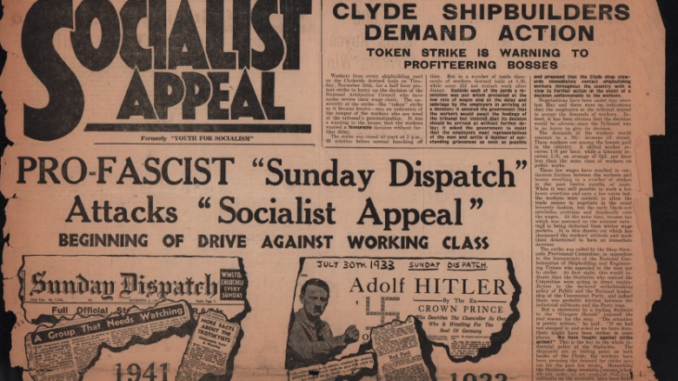
Socialist Party Scotland and our forerunner, Militant, have a rich history of struggle within the labour and trade union movement, tracing our roots back to the early days of Trotsky’s International Left Opposition against Stalinism. In the first part of a two part article, Wayne Scott seeks to highlight the lessons of the early years of British Trotskyism for the struggle to build a revolutionary party today.
In Britain, some isolated groups and individuals were initially drawn towards Trotsky and the Left Opposition’s struggle against Stalinism. This contrasted with countries such as Russia or China, where the Left Opposition had gained the support of thousands of workers.
British supporters of Trotsky in the late 1920s and early ’30s often held crude, ultra-left positions that reflected the immaturity of the movement at that time. The real genesis of Trotskyism in Britain, however, was a struggle within a South London branch of the Communist Party of Great Britain in 1932. A small grouping had been won over to Trotsky’s ideas, particularly on the need for a united front of workers’ parties against fascism in Germany.
This grouping became known as the Balham Group. They argued that the German Communists and Social Democrats must act in a united way to prevent fascism from coming to power. The line of the Communist Parties at this time was that the Social Democrats were “social fascists”, and they preached the suicidal slogan: “First Hitler, then us.” For opposing these absurd ideas, the grouping was expelled and soon formed the Communist League, which produced a regular paper, The Red Flag
Entering the Independent Labour Party (ILP)
The Communist League had a short existence, splitting over Trotsky’s advice to enter the Independent Labour Party (ILP) which had moved leftwards after disaffiliating from the Labour Party. At that time the ILP had under 17,000 members and three MPs, all in Scotland. A number of comrades accepted Trotsky’s advice, recognising the need to work within organisations with real social weight in order not to remain a sect isolated from the working class.
They formed the Marxist Group, which had 60 members by 1934. However, the ILP’s actual influence was limited, largely confined to areas such as Glasgow and generally declining. Through discussions with Trotsky, many supporters came to realise the necessity of working within the Labour Party to reach wider layers of workers. Lenin had issued similar advice to the newly formed Communist Party of Great Britain in the early 1920s arguing they should attempt to affiliate to Labour to break them out of their isolation and ultra-left tendencies.
Among these were a group of South African Trotskyists who arrived in the mid-1930s, including Ralph, Millie, and Heaton Lee, and Ted Grant. These comrades brought with them a rich history of class struggle, having been actively involved in organising the black working class in South Africa, notably leading strikes among laundry workers. The back garden of the Lee home served as a venue for many meetings.
The founding of the Fourth International
Trotsky had initially resisted calls for the formation of a Fourth International, viewing his international opposition as an external faction of the Communist International. The Communist International—launched by Lenin and Trotsky in 1919 to bring together and build revolutionary parties around the globe—was still a significant organisation with a mass base in several important countries.
Even in countries such as Britain, where the Communist Party’s size and influence was limited, Trotsky still argued that they outnumbered Left Oppositionists significantly.
However, the lack of any debate on why the German Communist Party, then the largest in the capitalist world, was unable to prevent Hitler from taking power, followed by the betrayal of revolutionary efforts in the Spanish revolution and Spanish Civil War, convinced Trotsky that the Comintern had ceased to be a living revolutionary organisation, in cases like Spain had become an open agent of counter-revolution, and that the formation of a new international was urgent.
By 1937, the largest Trotskyist grouping was the Marxist League, working within the Labour Party and including the South African comrades.
The South African comrades had welcomed the call for a Fourth International and later the proposed Transitional Programme. However, they left after Marxist League leaders had made slanderous accusations that Ralph Lee had stolen money from a strike fund—a smear originating with the South African Stalinists.
With only a handful of comrades, the group turned its back on the former organisations—largely middle-class in composition—and oriented towards the mass organisations, especially the trade unions, Labour Party and young people in the ILP. With only 30 supporters, the Workers’ International League (WIL) was formed at the end of 1937.
Lies and bureaucratic manoeuvres, including by the American Trotskyist leader James Cannon, saw the WIL excluded from the initial British section of the Fourth International, launched in 1938 as the Revolutionary Socialist League (RSL).
Despite this Cannon’s role in building up the American Trotskyist movement should not be diminished. A leader of the US Communist Party, Cannon broke with Stalinism to play a key role in the early development of the US Trotskyist movement and worked closely with Trotsky in building international support. His organisation also led the mighty teamsters’ battles in Minneapolis in the early 1930s. However, he played a poor role in Britain during this early period.
The WIL insisted that unity must be based not merely on formal agreement with the International’s programme, but on genuine unity in strategy and action.
As such, they refused to join the RSL but applied for sympathiser status to the Fourth International. This was refused by Cannon, who had a tendency to resolve debate through organisational discipline. Trotsky himself noted this about Cannon, stressing the need to pull him back organisationally while pushing him forward politically.
The resulting official British section was quickly riddled with splits. In contrast, the WIL steadily built its influence—first within the Labour Party and then as an open organisation—with a regular newspaper, Socialist Appeal, which we trace our political roots to. At its high point, comrades sold 20,000 copies per issue.
A hallmark of the WIL was its flexible approach to mass organisations. The outbreak of the Second World War saw most local Labour Parties hollowed out, as many men were conscripted and the wartime coalition parties agreed not to stand against each other in elections. This created more favourable conditions for open work.
Opposition to class collaboration
Following the collapse of the treacherous Stalin-Hitler Pact, the Communist Party fully endorsed Churchill’s war effort and the mood of “national unity”, even supporting bans on strikes.
Despite this open class collaboration, the WIL maintained a patient approach toward Communist Party members. In a debate on the war with Alec Riach—a Scottish CP member and veteran of the Invergordon Mutiny—Riach was so thoroughly defeated that he joined the WIL and became a Trotskyist. The CP’s open collusion with the bosses to break strikes created an opening for Trotskyist ideas to gain ground.
The WIL quickly began building a base in industry. In 1941, a shop steward at Rolls-Royce in Glasgow was victimised for his membership in the WIL. In response, 4,000 women workers went on strike in solidarity. In 1943, when thousands of women at Rolls-Royce went on strike for equal pay, Scottish Trotskyists gave full support to the action and fought for maximum unity between male and female workers against attempts to divide them.
This was not an easy time to strike. The mood of national unity was strong, and many working-class people were outraged that women were striking in war industries while men were away fighting. Strikers were pelted with food as they marched. The WIL did not concede an inch to this mood of national unity with the bosses.
In contrast, the Communist Party denounced the strikers as “Hitler’s agents” and instructed its members to cross picket lines.
Under these conditions, the influence of the WIL grew, and it helped form the Clyde Workers’ Committee alongside militants from the ILP and the wider labour movement. The Home Office and the secret service held extensive discussions on our growing industrial influence in the Clyde, Tyneside and beyond. They were assisted in their efforts by factory reports from His Majesty’s Communist Party of Great Britain.
Trotsky’s military policy
The comrades also took seriously Trotsky’s Proletarian Military Policy, advocating that revolutionaries should fight alongside their class in the event of war. This meant not advocating a pacifist standpoint and recognising that many British workers wanted to fight fascism, the WIL demanded trade union control of military training. The WIL argued that the British ruling class could not be relied upon in the event of a fascist invasion and would capitulate to Hitler.
Only a workers’ government could defend the working class from fascism and wage a revolutionary war appealing to the German and Italian workers to overthrow fascism and capitalism in their own countries. Direct action was also taken to defend the lives of workers in London from Hitler’s bombs. While the British state refused to provide deep air raid shelters, the WIL organised workers to smash open the gates of the London Underground stations to protect their families.
These ideas won support within the army, including at the Cairo Forces Parliament, where a majority of troops voted for the nationalisation of industry, mines, and banks upon returning to Britain—a motion submitted by a Trotskyist.
When news reached the 8th Army that WIL members had been arrested for supporting striking apprentices, the troops declared: “The right to strike is part of the freedom we are fighting for.” Jock Haston (who was arrested in Edinburgh), Ann Keen, Heaton Lee and Roy Tearse were sent to jail for the crime of supporting young workers fighting conscription down the mines.
Roy Tearse’s family have continued to play a leading role in the Trotskyist movement throughout the decades. Heather Rawling, the niece of Roy—whose parents Jack and Daisy were also both members of the WIL and later the Revolutionary Communist Party—is a committed Socialist Party member to this day.
The comrades also remained resolute in their defence of the Soviet Union. Despite the monstrous regime of Stalin, which had executed and imprisoned Trotskyists, we always defended the gains of the 1917 revolution from any return to capitalism, including through fascist conquest.
Unlike the CPGB, our programme was for a defence of the planned economy and gave our full support to the millions of workers struggling as part of the Red Army. The CP, on the other hand, was only interested in defending the positions of the bureaucracy around Stalin.
This position found an echo among the advanced workers who, despite being horrified at the Stalinist regime, nevertheless looked to the Soviet Union as an alternative to capitalism.
Formation of the Revolutionary Communist Party
In 1944, the WIL merged with the official British section of the Fourth International to form the Revolutionary Communist Party (RCP). This unification was despite the RSL’s refusal to adopt Trotsky’s Proletarian Military Policy. Instead, they distorted Lenin’s position, arguing that revolutionaries must always stress supporting the defeat of their own ruling class. This ignored the fact that many workers saw this war as one against fascism. In contrast, the WIL/RCP called for a break with capitalism in Britain and a revolutionary war against fascism.
This line was reminiscent of the German CP’s disastrous slogan: “First Hitler, then us”, which Trotskyism had fought vigorously less than a decade earlier. Such ideas failed to gain any real support in the wider movement, despite the RSL having a base in several areas, including Scotland, where they had a certain presence among miners. Their ranks also included important members such as Nan Milton, daughter of John Maclean.
The WIL had steadily grown, while the RSL had stagnated. The WIL formed the majority of the new party and retained its programme. Crucially, it retained the leadership around Jimmy and Arthur Deane, Ted Grant, Ajit Roy, Jock Haston, and others who would navigate important theoretical struggles going forward.
While the WIL and the RCP were open parties, they still called for a Labour government with a socialist programme and maintained a small base within the Labour Party. They also took part in elections where possible—most notably in the Neath by-election in May 1945. Jock Haston was selected as the RCP candidate, with a long record of struggle going back to the General Strike of 1926, where he had been arrested at age 14. The RCP literature declared: “Our candidate will fight on a platform of uncompromising hostility to the imperialist war, for the breaking of the Coalition, for the overthrow of the Churchill Government, and for Labour to take power on a Socialist platform.”
Such ideas gained an echo among the working class in South Wales, and mass rallies were organised in support of the RCP. At one rally, where thousands of workers attended, the CPGB showed up to denounce Trotskyism, stating that a “vote for Haston is a vote for Hitler”, and encouraged workers to support the coalition government. They were heckled out of the venue by a working class sick of war and hungry for change. While the Labour candidate won the seat, the RCP attracted 1,781 votes, a sizeable vote less than two months before Labour’s landside general election victory. Neither the Tories nor Liberals stood, as they backed Labour.
Post-War challenges
Although Trotsky had predicted that the war would lead to a revolutionary wave across Europe, this was only partially realised—in countries like Italy, for example. In fact, both capitalism and Stalinism emerged strengthened. The Soviet Union’s sphere of influence expanded into Eastern Europe, and the Marshall Plan gave breathing space to Western European capitalism. The Labour victory in July 1945 brought widespread nationalisation measures, which the RCP supported—but called for them to be carried out under workers’ control and without compensation to the capitalists.
The aftermath of the war saw major debates within the Fourth International. The international leadership predicted an immediate slump and failed to recognise the potential for a post-war boom or the strengthening of Stalinism.
The British leadership was far ahead in this regard, arguing that there would be a period of recovery for capitalism – though they initially underestimated its duration.