
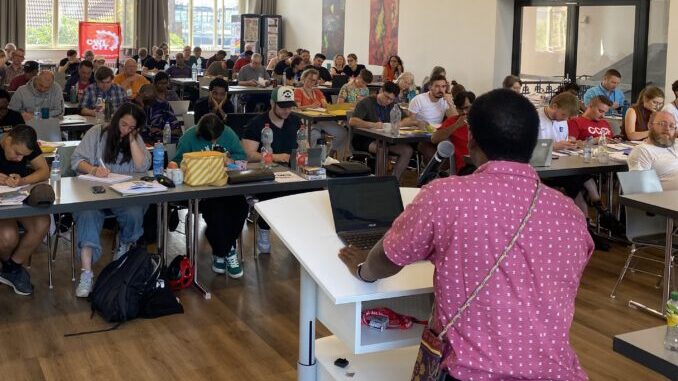
The following thesis on perspectives for European capitalism was agreed at the 14th World Congress of the Committee for a Workers’ International, which convened in Berlin, Germany, from 27 to 31 July 2025. Delegates attended in person from Europe, Asia, Africa and North and South America and online from Australia. The Congress also hosted guests from Israel-Palestine, Kazakhstan, Romania and Sweden.
The situation in Europe is characterised by multiple crises of the capitalist system, on economic, political, trading, military, diplomatic and environmental planes. Deepening capitalist crisis and antagonistic policies of the imperialist powers dispels any lingering hope of a return to relative stability and prosperity in Europe. The continent is being hammered and transformed by Trump’s assault on the ‘world order’ and by his trade and tariffs policy. At the same time, the barbarism of capitalism and imperialism is graphically manifested in Ukraine and Gaza and the wider Middle East, including the renewed Israeli/Iran conflict, and by the complicity of European powers in these bloody conflicts. The ruling classes of Europe are at sea, desperately trying to navigate through these storms and the electoral challenge of populist right forces in many countries, and class polarisation and struggles.
More than ever before, the traditional parties of capitalist rule are widely discredited, with a shrinking electoral base. In various European countries, it proves very difficult to form majority governments or coalitions or for these governments to have any stability due to their unpopularity, the intensifying conflicting interests of sections of the bourgeoisie and their inability to forge a common way ahead under the pressure of intense capitalist crises. After only eleven months in office, the right-wing Dutch coalition government, which took eight months to form, collapsed in June. As Trotsky said in 1938, the ruling classes are tobogganing towards disaster with their eyes closed.
Growing sections of the working class and youth, and middle classes, look with horror and anger at imperialism’s endless wars, the militarism drive, highly disruptive trade wars, the environmental and climate crisis, and endless attacks on living standards and democratic rights. This is having a profound effect on mass consciousness, creating alienation and bitterness, and prepares the way for mighty class explosions and revolts against the ruling elites and the entire profit-making system. The prospect for anti-war movements is posed in Europe, particularly in southern European countries, where large mobilisations against Nato and militarisation have taken place in recent years in countries like Greece. At the same time, the rise of the populist right is creating division and complications for the workers’ movement.
The worsening crisis of capitalism in Europe poses ever more sharply the question of the leadership of the working class and the historic task of overturning the capitalist order and transforming society on socialist lines. The various Left parties and formations have repeatedly been found wanting. Only a mass revolutionary socialist alternative rooted among the working class in Europe, and on a world scale, can offer a way out of the endless horrors of decrepit capitalism and imperialism. Building these forces is the key task that the CWI sets itself and flows out of our analysis of capitalism and its multi-fold crises.
Trump’s Assault on Europe
Trump’s second term in office opened with the administration taking a wrecking ball to the already creaking so-called ‘world rules-based order’ and global trade. The old imperialist “ally” has unleashed an unprecedented economic and political assault against the interests of the European bourgeoisies. This is accompanied with a ‘culture wars’ assault against the EU ‘globalised liberal elite,’ led by Trump’s ideological attack dog, US Vice-President JD Vance.
Trump had threatened to impose 50 per cent tariffs on EU imports and at the end of July the EU Commission agreed to 15% extra tariff on exports to the US. While this is less than Trump’s opening gambit, they are still tariffs on European economies that did not exist a few months ago and will have a generally negative effect on the economies of the EU.
This is a deepening and acceleration of processes already lodged in the historic crisis of capitalism and in the growing tensions and antagonisms between imperialist powers and blocks, as the CWI has previously remarked. The development of trade war and preparation of more military conflicts is rooted in the drive by the imperialist powers for a new redivision of the world.
Trump has ripped up the so-called ‘international rules-based system’ (in reality, an informal way of working between the main imperialist powers), to the horror and despair of the ruling classes in Europe. His push for a quick end to the war in Ukraine signified a breach with EU/Nato allies. The EU is facing negotiations with the US on trade and ‘defence and security’ as it seeks to avert a transatlantic trade war while keeping Washington committed, at some level, to Europe’s defence and remaining engaged in Ukraine.
French imperialism’s long-standing ambition of greater European independence from US imperialism has gathered more support since Trump’s re-election. This will increasingly come up against Germany’s military expansionism and ambition to have a more dominant military role on the continent. At the same time, the EU is divided between countries that support so-called “strategic autonomy” from those who believe, such as Italy’s Prime Minister Giorgia Meloni, the “transatlantic relationship” must be defended at all costs (mainly because the Italian ruling class do not want to be squeezed by French and German capitalism).
Nonetheless, Trump’s demands that European powers pay more towards funding NATO and his threat to end military aid to Ukraine, and to suspend US security guarantees, jolted the imperialist powers in Europe into accelerating a militarisation policy (already over the past decade, military budgets in the EU have doubled). NATO leaders call for their member states to aim to spend 5% of GDP on ‘defence’. The EU and Britain are conducting a military spending drive at levels unseen since the Cold War. Last year European military spending rose by 17% to $693bn. In addition, the EU set a €800 billion rearmament plan in March 2025 for joint European “defence” projects. The German government has set its sights on building the strongest military force in Europe, with military spending rising 28 percent in 2024. Poland’s military spending has grown by 31 percent. France has pledged to nearly double its military spending to €100 billion by 2030.
This marks the end of the so-called ‘peace dividend’ after the collapse of Stalinism. Nonetheless, at this stage, defence spending, in percentage terms, is still at a lower level of GDP than during the Cold War. In Britain, for example, the government’s recent spending review boasted it would increase defence spending to 2.6% of GDP, whereas it was 4% in 1990 (at that time, the lowest level since 1960). However, when considering specific countries, including those that have joined NATO in recent years, some nations are spending as much or more in real terms on the military than during the Cold War.
Despite the funding pleas of generals and defence ministries, cumulative spending of Europe’s Nato members over the last ten years came to $3.15tn, which is vastly greater than Russia. And Europe currently has 1.47mn men and women in uniform (more active-duty troops than the US). But there are few deployable troops, common air defence systems or tank selections agreed by EU and Nato states. At present, there are not even adequate stockpiles of weapons to supply to Ukraine. This obscene waste and lack of coordination is not accidental but a feature of the capitalist arms industry and military, which is primarily about profit and the national interest of each ruling class. The EU is an alliance of capitalist nation states, not a ‘federal super-state’. EU member states’ interests can coalesce, to a degree, around some key issues for a period but the block is organically prone to national tensions, antagonisms and clashes.
The increased military spending is being combined with continued cuts to public services and living conditions and is setting the European ruling classes on a collision course with the working class. In some countries, like Germany, the militarisation drive will have a radicalising effect on consciousness, especially among young people. The fear of war can also enable capitalist governments to win support for militarisation among sections of the working class. Nonetheless, the squandering of riches which could be spent alleviating poverty, on rearmament programmes on a scale not seen since the Second World War, will have a big effect on consciousness, though not uniformly.
The propaganda from the UK Prime Minister, Keir Starmer, and other European leaders that a ratcheting up of arms expenditure will yield a “defence dividend” in the form of “jobs, exports and lasting productivity gains” does not stand up to scrutiny. While major arms spending may possibly see a limited boost to the national economies concerned, it will tend to be offset by the government raising taxes, cutting investment elsewhere and slashing social welfare to pay for it. Moreover, extra military spending tends only to enhance productivity if it has a large research and development component. This is certainly not the case with the UK government’s plans, for example, and it is currently the second highest overall military ranking among NATO powers.
The limits of ‘war Keynesianism’’ can be seen in the case of Russia. In 2025, Russia’s military spending will reach nearly $172bn: equivalent to 7.7 per cent of GDP and a 12 per cent increase on the 2024 figure. High employment and higher wages have accompanied this process. But this cannot last indefinitely. Already there are signs the economy is overheating, leading to higher inflation and labour shortages. And while Russia’s GDP growth remains relatively strong, driven by war time demand and import substitution, the growth is unsustainable, potentially leading to stagflation (i.e. economic growth stagnates while inflation remains high).
The CWI opposes the capitalist governments’ arms drive and the cheerleading by some trade union leaders for the expansion of these industries of mass destruction. When we raise demands against this expansion, or for the stopping of arms sales to Israel or Ukraine, to win over workers in the arms industries the question of jobs and conditions needs to be taken up skilfully, with a ‘just transition’ to socially useful production posed, with no loss of pay, jobs or hard won workplace conditions. Therefore, we call for nationalisation of the arms industry under democratic control and management, as a precondition for such a transition.
Europe’s Stagnant Economy
The eurozone economy is experiencing a period of stagnation, with low GDP growth, and contraction in some member states. Some European countries face a dire situation: average household expenditure in Greece today is 31% lower, in real terms, than it was in 2009.
European economic growth is projected at around just 1% in 2025 (it was 0.9% in 2024). Unemployment is due to fall to 5.7% in the eurozone, although much of this employment is precarious and low paid, and in real terms most wages continue to fall. In contrast, during the ‘Golden Age’ of post WW2 European capitalism, between 1950 and 1973, inflation adjusted GDP grew at an annual rate of 4.8% and the jobless rate averaged about 2.6%. Current inflation has fallen over the last couple of years and stands at 2% in the eurozone (prices for everyday goods hiked up during the spike in inflation have not fallen).
Europe’s productivity growth was already lagging other major economies, such as the US, before the shocks in trade relations and the international relations marked by Trump’s coming to office. Europe’s economy benefited over the last few decades due to the EU bloc’s eastwards expansion and strong demand for exports from Asia and the US. But as China’s long running boom winds down and trade wars erupt with the US, Europe’s ‘salad days’ are clearly over.
Stagnating economies, falling living standards, increasing impoverishment of wider sections of the working class, assaults on welfare and social security, and mass job losses in sectors, such as the car industry, are just some examples of the European bosses’ relentless war against the working class.
The national question remains a fault line for the capitalist system in many parts of Europe and can erupt during a period of economic stagnation. Clashes regarding Serbs in northern Kosova, for example, are a symptom of the ongoing tensions between Serbia and Kosova.
“Progressive” or ‘left’ or supposedly “radical” nationalist parties, like Sinn Fein and the Scottish National Party, have lost ground in recent elections. Left Catalonian nationalist movements have also faced splits. At root, this reflects their acceptance of working within the confines of the capitalist system and disappointing working-class communities. At the same time, reactionary, anti-immigrant populist nationalists have in some countries been able to step into the political void, to a degree. The populist right Reform party is polling around 20% support in Scotland. While support for the right nationalist Vlaams Belang in Flanders has slightly fallen, it is still at around 23%.
EU and Eurozone
The fireworks celebrating EU and eurozone expansion are long gone. Bulgaria is the latest to be given the green light to join the Eurozone, at the start of 2026. But it is one of the poorest countries in Europe and is fraught with political tensions. The opposition ‘pro-Russian’ party campaigns against further EU integration. EU membership for countries in the Western Balkans remains in limbo at the ‘candidate’ stage. Turkey has been kept waiting since 1999. Many EU states are weary of importing poorer countries that are afflicted with ethnic and national tensions that can burst asunder. Other EU states consider closer ties with these states is necessary to cut across the influence of Russia and China in the Balkans. Ukraine’s membership of the EU, at some unspecified date, is flagged up by the European powers. But this would entail considerable economic subventions by Brussels to Kyiv, leaving aside the huge military and geo-political repercussions.
Life outside of the EU has not proven any rosier for the UK economy following Brexit. Labour prime minister Starmer boasted about his “landmark” trade deals with the US, the EU and India. The Trump administration is generously imposing a 10% higher tariff on many UK exports. The India and EU deals will bring in around just 0.4% to the UK’s GDP by 2040. To get partial access to the EU’s single market, the UK has had to relinquish some of the ‘sovereignty’ that it ‘won’ with Brexit by abiding by some EU regulations. The “open, trading” UK economy is especially prone to the antagonisms between its biggest trading partners, the EU, US and China, and the decline in globalisation.
This sorry picture helps convince right wing populist politicians in Europe, such as Orban in Hungary, and Meloni in Italy, to hold back from an outright breach with the EU, though they are still extremely critical of Brussels. Nonetheless, the underlying fundamental problems facing EU capitalism and growing political polarisation in one EU country after another, will create unbearable tensions and divisions within the bloc and its future fracturing.
The US is by far the most important destination for European goods, with more than $500 billion in annual exports to the US. European central bankers warn that the new rounds of tariffs could both reignite inflation and fundamentally undermine global trade. European states therefore face greater financial strains just as many are struggling with growing deficits and falling tax revenues, provoking political, class and social upheavals.
But even when leaving aside trade wars and future recessions, the European economy suffers from chronic long term underlying weaknesses. Despite Europe’s rich history of scientific breakthroughs and inventions, it has become an “innovation desert.” Not one of the 15 best-selling electric vehicles is in Europe. Only four of the top fifty tech companies in the world are European, according to the European Commission’s ‘report on EU competitiveness.’ Mario Draghi, who presented the report, warned the EU: “This is an existential challenge.”
The loss of ground of European competitiveness is starkly revealed by the over 30% gap in its overall GDP per capita to the US, since the turn of the century. The GDP per capita in Germany is only 1,500 euros higher than in Mississippi, the US’s poorest state. US tech companies spend more than twice what European tech firms do on research and development, according to the IMF. As productivity in European tech has stagnated since 2005, it has jumped by 40% in the US. The gap is clear in the stock market: US stock market valuations have more than tripled since 2005, while Europe’s have risen by just 60%. European companies and public sector spending on R&D is around 2% of GDP, where it roughly was in 2000, way behind both China and the US. Universities are regarded as “jump starts” for innovation and research but of the top universities reviewed by the Times Higher Education (London), only one EU institution (in Munich) is ranked in the top 30 (and then tied for 30th place).
According to the European Central Bank, the number of sectors in which Chinese firms compete directly with eurozone companies, many of which are machinery-makers, has risen from about one-quarter in 2002 to two-fifths today. And Chinese companies can aggressively undercut European companies on pricing, which has contributed to a significant drop in the EU’s share of global trade.
Germany’s Economic Malaise
Over the last several decades, Germany has been the economic powerhouse of Europe, but it has faced economic malaise for some time. Along with Austria, Germany is in its third year of recession. A series of economic challenges face German capitalism, including an aging society and lack of highly skilled workers.
Germany’s auto sector, employing about 800,000 domestically, has been key to the country’s economy. But the sector’s current crisis is seen, for example, by the reluctance to invest in electric vehicles (EVs), allowing others, such as Chinese companies and Tesla, to dominate the industry. In recent months, car makers like VW and Ford, have announced thousands of layoffs (mainly ‘voluntary redundancies and cuts in apprenticeships), as well as steelmaker, ThyssenKrupp. In recent years, VW and BMW have opened new vehicle plants in the US, to have unimpeded access to the US market and, at least, under Biden, to take advantage of state subsidies. At the same time, nearly 40% of industrial companies in Germany are considering relocating to other regions where labour and energy costs are cheaper. German employers call for “fundamental structural reforms” (i.e. major attacks on pay and the workplace conditions of German workers). The German economy’s sickness affects all of Europe, given its historic role as the locomotive of European capitalism. This is especially the case in central and Eastern Europe, where German car and machinery makers have made their “de facto factory floor.”
With Europe facing stagnant growth, flagging competitiveness, tensions and clashes with Washington, and the EU block accounting for an ever-dwindling share of the world’s GDP, right wing commentators demand an end to Europe’s “generous welfare systems.” They point to countries like France, which is facing a budget deficit of 7 percent in 2025 — more than double the allowed eurozone limit — and cry that it can no longer maintain its social security costs (France currently spends more than 30 percent of GDP on social spending, with other European states not far behind). The alternative, as far as the right-wing hawks are concerned, is that France and other European countries will face a Greece-style crisis, as their borrowing costs increase. In other words, a major assault needs to be launched against the historic social gains of the working class in these countries. With the average German employee working more than 20% fewer hours than their US counterparts, the European bosses want to turn the screw of exploitation. But all these measures, in turn, will provoke major class struggles.
War in Ukraine
The ongoing bloody war in Ukraine, and the drive of European governments’ drive to be ‘war ready’ is raising widespread fears among the masses of new devastating conflicts, particularly in some countries near to Russia.
The war, the biggest conflict in Europe since WW2, which has cost tens of thousands of lives on both sides, is in its third bloody year and with no immediate end in sight. But the Trump administration represents a sharp break with Biden’s imperialist policy on Ukraine. Trump recognises that the war against Russia cannot be won, and he also wants to pivot US imperialist resources more towards China. Trump also hopes that by negotiating an end to the war with Putin that Moscow can be prised away from the orbit of China.
Trump pledged to end the war rapidly but has found it much more difficult than he expected. He strong-armed Ukraine into its first talks with Russia since April 2022 and restored formal US/Russia relations. Along the way, Trump made a deal with Zelensky that sees vast natural resources handed over to the US (the EU has also agreed a deal with Ukraine that sees it plunder natural resources).
However, Putin is making steady territorial gains and has been in no hurry to go into negotiations to end the war. Putin met Trump face to face for talks on 14 August. To the great consternation of Zelensky and European powers, Trump has spoken of ‘territory exchanges’ in Ukraine as part of a final peace deal. This is merely the US administration’s recognition of the state of play in the battlefield after three years of war. Russia has major dominance over Ukraine in troop numbers and in the deployment of drones. The Ukraine army faces a “culture of fear,” according to a Ukraine military commander, growing call-up resistance and troop demoralisation. After being widely supported early in the war, Zelensky’s government is now facing a crisis. He replaced the popular Chief of Staff, Zaluzhnyi, who is now ahead of him in the polls, with a closer ally, Yulia Svyrydenko.
Public support for the war is also fading, with over 56% of Ukrainians favouring a negotiated settlement. There is strong opposition to lowering the draft age and to forceful recruitment tactics, and more than half the population sympathizes with draft dodgers. A bus drivers’ strike in April indicates growing public anger. The government also faced mass protests in July after trying to abolish anti-corruption bodies that were investigating people close to Zelensky.
For Zelensky, an end to the war under current conditions is unpalatable as it means Russia holding onto around 20% of Ukraine’s territory and the likely end of Zelensky’s increasingly unpopular government. Although Ukraine military has carried out some high-profile attacks against Russia, including drone attacks deep inside Russia that destroyed bomber plans, the general direction of the war remains in Russia’s favour. The longer the conflict continues, with more likely territorial losses for Ukraine, the worse will be the eventual terms of a truce for Zelensky.
At some point, this phase of war in Ukraine must end, though it can continue to drag on for months, at enormous costs in terms of human lives and materials and resources. But the absence of war will not bring generalised peace and security to Europe under capitalism. Ukraine will be de facto partitioned, with Nato-backed Ukraine forces, and Russian military, squaring off in a highly combustible situation. Many of the European powers want Ukraine to continue fighting, at this stage, in a war of attrition to weaken Russia. They fear that a US-sponsored negotiated settlement will prove disastrous for Ukraine and the European powers’ geo-strategic interests and provide Trump with the pretext to detach US imperialism further from Europe, while it attempts to woo Russia away from China. Europe will then have to fend for themselves much more against a Russia that has re-emerged economically and militarily much stronger after the collapse and humiliation of the post Stalinism years.
European powers have relied heavily on the US military superpower for decades; all the talk of European troop deployments in Ukraine and Keir Starmer’s ‘coalition of the willing’ has so far come to nothing. Apart from the fact that Nato member countries in Europe putting troops in Ukraine would be a ‘red line’ crossed as far as Putin is concerned, with consequences, the European powers would struggle to have the means and resources to carry out such a large and potentially open ended mission and would face growing opposition to it domestically. The rush to militarisation and massive arms spending by governments across Europe is a desperate effort to make up for their reliance on US military support and technical assistance and to help them try to justify cuts to welfare budgets.
Although for propaganda reasons the western European powers like the UK, France and Germany talk up the threat of a Russian direct attack to justify military expenditure, the Ukraine war does show that conflicts and wars can break out along the Russia/eastern European borders. The ‘frozen conflicts’ in the region can become ‘hot’ again, and the sphere of conflict dangerously widens. As elections loom in Moldova, the pro-EU government makes dire warnings of Russian interference and more Russian troops being despatched to the pro-Moscow breakaway region of Transnistria.
A military assertive and battle-hardened Russia, led by a right-wing chauvinist regime, on the one side, and the rapid militarisation of European capitalist states, on the other side, during a period of generalised capitalist crises and political polarisation, is a recipe for further military tensions, antagonisms, and armed conflicts. Only the organised and mobilised working class, with an internationalist, independent class programme that opposes the warmongering of capitalist regimes, on all sides, can ultimately cut across this process.
The genuine fears of growing sections of the masses about endless conflicts and wars and even the deployment of nuclear arms – since the war in Ukraine began, Putin’s sabre rattling included threatening the use of ‘small-yield tactical nuclear weapons’ – can spark mass movements in Europe against war, rearmament, and creeping attempts to re-introduce military conscription. Of course, the ruling class will attempt to garner support for rearmament by imploring ‘national unity’ to ‘defend the country’ etc., that can appeal to sections of the population for a period.
Gaza Protests
The barbaric actions of the Israeli state in Gaza, and Western governments’ complicity in Netanyahu’s genocidal policies, has already led to huge and continuous demonstrations and protests in various European countries. These movements are radicalising sections of the youth, especially those from an Arab and Muslim and other immigrant backgrounds, as well as sections of the wider working class and parts of the middle classes. As the normalization of genocidal policies and acts takes place under the rule of European capitalist governments, mass opposition in Europe is growing again. Western governments backing Israel have been forced to utter some half-hearted criticism of Netanyahu’s war crimes, although the conflict with Iran may allow them to temporarily drop their puny criticisms.
Populist Right
The failure of the leadership of the official labour and trade union movement across Europe to offer a militant, campaigning anti-capitalist programme that meets the needs of working class people and the poor in times of falling living standards, as well as, at this stage, the numerical weakness of the revolutionary socialist alternative, creates a political vacuum into which the populist right and far right nationalist forces are partially filling the void, particularly electorally. In some countries, like Austria, Belgium, Italy and the Netherlands, this has developed for some time. In other European countries, it is a more recent development. Sections of the ruling classes cultivate populist right-wing movements, alongside nationalism, racism, xenophobia, “anti-wokism,” anti LGBTQ+ and trans rights bigotry, and all forms of reactionary ideas, to divide the working class and to try to shore up their support.
It has been a mixed picture for the populist right in elections in Europe since Trump came to office for the second time. Political polarisation does not mean that most of the working class has shifted to the right. As the Trump administration openly backs like-minded populist right candidates in elections in Europe, it also provokes a backlash against MAGA style figures being brought to office in European countries. Concerns by the masses about pro-Trump governments coming to power in Canada and Australia helped return the incumbents, though without enthusiasm. The populist right faced setbacks in elections in Romania earlier this year, though that was enabled by the interference of the law courts. The French bourgeois courts decided to include in their punishment a ruling to stop Marine Le Pen from running for office. With the ‘centrist’ parties of capitalism – in particular the former social democrats and traditional conservative parties – lacking broad political support and legitimacy, there is a recourse to the law courts and other institutions of the bourgeois state by those sections of the ruling class that oppose the populist right for their own interests. The same legal manoeuvres and authoritarian methods used today against the populist and far right can be used against an electoral resurgence of the Left tomorrow.
As the CWI has noted previously, there is a marked turn by pro-capitalist governments of all stripes towards more authoritarian methods of rule. Almost all bourgeois parties have moved to the right, in the last period, sometimes copying parts of the rhetoric and demands of the populist right against immigrants or women’s and LGBTQ rights. Macron resorted to decrees to force through attacks on pension and to remain in power. Various governments in Europe have reacted to climate change protests and the Gaza demonstrations with a raft of new repressive legislation and bans on the right to protest, free speech and other democratic rights. The struggle to defend hard won democratic rights will be a key feature in the coming period, as governments in Europe and internationally turn towards more authoritarian forms of rule. Trump’s deployment of the national guard and marines against protesters in Los Angeles can be emulated in Europe by capitalist states. These processes are an expression of the realignment of the capitalist state to correspond with the sharpening character of class relations.
The 2024 European elections saw big gains for the populist and nationalist right in many parts of the EU. This was not uniform, however, with right wing, anti-immigrant parties in Sweden, Finland and Denmark falling short of many commentators’ expectations, and left parties picking up support. The hard right Vox party in Spain has gained in polls since the 2023 general election, at 14%, while the PSOE led government, failing to meet the needs of workers, hit a record low this year. The anti-immigrant, right wing AfD in Germany became the second party after the German general elections, following advances in regional elections last year. Nationally this led to the CDU and Social Democrats forming a weak government based upon under 45% of the vote. In some regions unstable coalitions have been formed to keep the AfD out of government. But this will not, in and of itself, stop the advance of the far right. The rise of the right-wing populist and nationalist parties has led to different strategies by the bourgeois parties on how to handle them.
While in Germany the traditional parties, for now, mainly try to exclude the AfD from power, out of fear of the instability and mass protests they would provoke, in other countries some of the traditional parties have tried to integrate the far right. In Austria, the ÖVP (conservatives), SPÖ (Social Democrats) and neo liberal Neos party eventually formed a coalition, in March, after the right, anti-immigrant FPÖ (Freedom Party), gained most votes in the general election. But this was only after the FPÖ walked out of coalition talks, preferring to remain in opposition, attacking the “old,” “establishment” parties – a strategy which has seen the FPÖ increase their support in recent opinion polls. The anti-immigrant and far right Chega did well in May’s general elections in Portugal, becoming the largest opposition party, playing on immigration (about a third of the active working population are foreign workers) and the country’s housing and health crisis. Chega gained most in socially depressed areas and former industrial belts and is becoming more confrontational both in and outside parliament.
In Poland, the right-wing nationalist Karol Nawrocki, backed by the Trump administration, won the second round of presidential elections by a thin margin. As president, Nawrocki can veto legislation or send it off for judicial review, blocking the aims of the pro-EU Donald Tusk coalition government. This will complicate matters for Brussels given the economic and geo-strategic importance of Poland to the EU bloc. Nawrocki promised to block Ukraine’s bid to join NATO. Although the Polish economy is “energised,” inequality disparities are some of the worst in Europe. Widespread disillusionment over the neo-liberal policies of prime minister Donald Tusk since he was elected in 2023 saw an increasing political polarisation.
Likewise, the UK Labour government’s continuation of pro-capitalist policies since getting elected on a wide but thin ‘landslide’ in May 2023, opened the way to the significant gains by the right wing, populist Reform Party in local elections in parts of England in May 2025. A panicked Keir Starmer responded by mouthing much of the same anti-immigrant rhetoric as Reform leader Nigel Farage. Starmer’s welcoming of the UK’s supreme court ruling attacks on trans rights is an indication of how the traditional parties of capitalist rule are whipping up division and pandering to prejudices.
This follows a pattern of former social democratic parties and traditional conservative parties adopting some of the rhetoric of the anti-immigrant right and even some of their policies in a bid to head off the populist right challenge. In many European countries, with France being a notable example, the ‘centre right’ and ‘centre left’ parties of capitalism are losing ground and are now minority parties. They are unable to form governments on their own anymore or as the main party in office. They are despised and distrusted by big sections of the population. The political landscape is fractured and volatile.
Like other populist right politicians across Europe, the millionaire Farage now pretends to be a friend of workers. He calls for nationalisation of the stricken steel industry and claims to support a long running strike by bin workers at Labour led Birmingham city council. Reform also calls for a reversal of the government’s highly unpopular welfare cuts. This is gaining an echo among some layers of the working class, even including trade unionists.
Far right movements combine “anti-establishment” slogans with ‘culture wars’ rhetoric. Marine Le Pen denounced the EU as “mercantile, woke, ultra-capitalist empire” at a European far right rally in June. This is not the first time that the populist nationalists and the far right have opportunistically adopted some of the rhetoric and policies of the workers’ movement.
As the CWI has previously stated, the current populist nationalist right formations are different from the classic fascist movements of the 1920s and 1930s in Europe. These were mass movements of the frenzied and ruined middle layers and lumpenproletariat, used as a battering ram by the ruling classes against the organised workers’ movement. On coming to power, the fascist regimes in Italy and Germany and elsewhere set about crushing all elements of workers’ self-organisation, trade unions, the social democratic and communist parties and soon after all democratic rights. This is not posed, at this stage, in Europe.
Firstly, because the social base for a fascist mass movement does not exist in the same way as in the 1920’s and 1930’s, as the petit bourgeois has shrunk and the working class has grown. This does not rule out the coming into being of stronger fascist forces in the future but makes this much more difficult. At the same time, there does exist a stronger democratic consciousness within the masses which is one reason that the populist right often portrays itself as champions of democracy and against the ‘establishment.’ This means that the growth of a real fascist movement will provoke a mass counter reaction, a glimpse of which was seen in the mass protests against the AfD in Germany, earlier this year. However the capitalist class is and will be reluctant to hand over political power to forces they can control less.
Secondly, there is not the same “menace of communism” as faced by the European ruling classes in the 20s and 30s. The existence of the Soviet Union and mass communist parties in many European countries, and repeated attempts by the working class to take power in different countries – which were defeated because of the lack of developed ‘Bolshevik’-type parties with roots in the working class – meant the stakes then were much higher for European capitalism.
Where hard right, populist, and nationalist figures come to power today they tend to tone down their rhetoric and policies, particularly regarding criticisms of the EU and NATO, as in the case of Meloni in Italy. But this could change in times of crisis. These parties do not have a viable alternative to the main capitalist institutions of the EU and are bound up with the bloc’s economy. Meloni had to accept higher numbers of immigrants partly due to the demands of Italian bosses and the labour market. But they are still ‘disruptive’ from the point of view of traditional bourgeois institutions and politics. The right-wing nationalist governments in Hungary and Slovakia, for example, are continually at loggerheads with Brussels over EU internal and foreign policies.
In domestic terms, the populist right parties in government pursue reactionary and anti-working-class policies as far as they can push them. Meloni successfully organised a boycott of a referendum in June against a weak opposition and left campaign. If passed, the referendum would have seen the passing of progressive legislation on immigrant rights and labour rights. In common, the populist right parties in government attempt to muzzle and co-opt the media, subdue the political opposition, and stymie the legal system.
Some of the populist right parties can lurch more to the right in office as the crisis of capitalism in Europe intensifies and the EU’s antagonisms with other imperialist powers. Exits from the euro and/or the EU cannot be ruled out by both right and left governments in the future, under immense economic, class and social pressures. And right populist forces can also see internal divisions and splits under class pressures, particularly where they have feigned pro-worker policies.
Support for the populist right can dramatically swing, particularly as they are tested in office. Before anti-Islamic Geert Wilders brought down the coalition government in the Netherlands when he claimed it would not carry out his extreme anti-immigrant policies, his party was being overtaken by the opposition GreenLeft in polls.
While Marxists must take into account the rise of the populist right and its growing electoral support in many European countries, and not attempt to downplay or prettify the situation, we need to have a balanced view. While there are undoubtedly racist and anti-immigrant sentiments behind polling support for the populist right, many people voting for these parties are doing so as a desperate protest against the establishment parties and decaying social conditions. The populist and far right parties do not enjoy the support of the vast majority of the working class. And the numbers not voting tends to increase in most countries (this can include those people not allowed to vote. For example, one third of the adult population in Vienna cannot vote because they do not have Austrian citizenship). Figures for voter turnout is not always in one direction; in Germany’s polarised election in February, turnout rose from 76.3% to 82.5%, and the AfD’s share doubled to 20.8%). However, we must warn that the longer the populist right can sink roots in society the bigger is the danger that racist and anti-migration prejudices can become more consolidated amongst a layer of the population, including parts of the working class. Understandably support for united action against the far right can grow.
The CWI stands for united action of the working and poor masses against racism and all the miseries which capitalism creates. While we would not oppose under all circumstances action against the far right that happens to involve bourgeois forces, we warn against political fronts and coalitions “of all democrats” or support for the “lesser evil,” as methods to undermine the far right. Such approaches fail to answer the economic and social issues as well as the legitimate anger at capitalist politicians the far-right exploit. The task for the workers’ movement is to present an independent class standpoint and a viable socialist alternative that can undermine the support of the populist right both in communities and electorally.
Although the populist, nationalist right often contains fascistic elements rather than being a classic mass fascist movement, they still pose a real danger to immigrants, women’s rights, and minorities and a challenge to the unity and cohesion of the working class. Pogromist attacks against immigrants in Ballymena, Northern Ireland, in June, albeit on a relatively small scale and considering the particularities of a society with historical sectarian divisions, are a warning for the workers’ movement across the UK and Europe. In southern Ireland, the populist and far right have held many provocative street events over the last couple of years, some of which have involved thousands. Although reportedly one of the “richest countries in the world” with the “most educated population” this cannot disguise the big inequalities in society. Many parts of the inner cities and rural areas feel “left behind” by the economic growth. As elsewhere across the continent, immigration to Ireland has not been met with adequate resources and infrastructure by successive capitalist governments. Exploiting the housing crisis, broken down infrastructure and high cost of living, the populist right has gained an echo among the most downtrodden and alienated layers in society.
Much of trade union movement leadership in Europe, often tied to the labour/social democratic parties, have failed or been far too slow to respond to the populist right threat. To do so effectively would mean building genuine workers’ parties. Existing Left formations have also often been largely found wanting, as they are often based on a petit bourgeois support and electoral concerns, primarily, often subjugating class policies for identity politics. This allows the populist right to paint the ‘liberal-left’ as more concerned with ID politics than the pressing needs of working class communities.
In Ireland, CWI supporters in the trade unions have played an important role in opposition to the populist right. The first trade union supported anti far-right protests in Dublin was initiated by a CWI comrade on the national executive of the biggest union in the Republic. Comrades in Northern Ireland’s largest union, NIPSA, have been to the fore in anti-racist counter protests, organising disciplined stewarding and putting forward class slogans and demands. They were vital in helping to organise union counter demonstrations to the far right in June, this year, following the pogroms in Ballymena. In Britain, CWI comrades played a key role in many of the counter protests to the far-right street provocations in the summer of 2024. Our comrades on Waltham Forest Trades Union Council, in east London, ensured the body was to the fore in mobilising thousands of local people, including many Muslim youths, against a threat of a far-right invasion of the area that failed to materialise. The comrades are campaigning in the trade union movement for unions to begin organising stewarding on a systematic basis and succeeded getting that policy adopted at the national conference of the right wing-led shopworkers’ union.
Trade Unions and Workers’ Struggles
Several European countries experienced wide scale trade union mobilisations, strikes and struggles from 2022 to 2023/24 over falling real wages and the cost-of-living crisis. Some sections of the workforces made wage gains before the union leadership in many cases ran down the industrial action. These important industrial struggles introduced a new generation to the role of unions, collective action, and tools of class struggle, such as mass picket lines. From these strikes a layer of new union militants and reps have become active, though there has not been a major influx into union activity, and it is also patchy, differing from workplace to workplace. Some of the new layer of activists express impatience and small numbers even ultra left tendencies, largely out of frustration with the unions’ conservative bureaucracy.
Although the strike levels have dissipated from 2022-23, in several European countries there are significant industrial battles. These can involve multiple issues. In February 2025, a general strike saw more than a million people take to the streets across Greece to demand justice for the victims of the Tempe train crash and in opposition to austerity and privatisation, for pay increases and the restoration of collective bargaining.
Average EU trade union ‘density’ or membership is at 23% of the workforce. There are significant variations between countries, with a higher union membership in Sweden and Italy (although nearly half of their 12.5 million members are pensioners) than in the UK, Germany, and France. There are multiple reasons for these disparities, including workplace traditions and national labour laws, the role of unions in welfare and health provision, as well as the fighting character of union leaders and rhythm of the class struggle. Trade union membership in the EU tends to still be among older workers, although in many cases membership is growing among younger workers. In the UK and some other European countries, small and newer trade unions are organising some of the most exploited workforces, including immigrants, in sectors like delivery workers, who traditionally have been overlooked by the traditional unions. In Spain, the CNT and CCOO unions have gained new membership from organising among the precariat. Marxists have always pointed out that it is not just a question of overall trade union membership, important as that is, but other key factors are the combativity of unions, the authority of the leadership and the relative strength of the unions in the economy. A minority of French workers were organised in unions during the May 1968 general strike, but they were able to bring out much wider sections of the working class.
As the crisis of capitalism deepens in Europe, the trade union leaderships and bureaucracy are coming under greater conflicting class pressures. Some union leaders have welcomed tariffs and other protectionist measures in the ‘national interest.’ In Britain, the union leaderships have been forced from rank-and-file anger below to oppose the Labour government’s attacks on welfare and disability rights. But a national demonstration was only called on the issues in June 2025, months after the Labour attacks were introduced. Even then, the protest, of only a few thousand, was under the banner of a contracted-out organisation, and not by the TUC. Clearly the union leaders did not want to embarrass the Labour government too much. In a similar vein, despite the effects of three years of recession on working class families, the Austrian trade union leaders will, in time honoured fashion, attempt to hold back struggles now that the Social Democrats are now part of the new coalition government.
The woeful response by most trade union leaders to the Gaza massacres, particularly those with members in the arms industry and supply routes to the IDF, is a further example of the overall character of the union bureaucracy. It has largely been left to rank and file union militants in a handful of countries, like Italy, Belgium, and France, to take action to try to stop the supplies going to the IDF. Pro-Palestinian and anti-arms activists are taking matters into their own hands and taking direct action at many of the arms making factories and at docks where arms are shipped to Israel (Marxists support campaigns aiming to stop the massacres of Palestinians, while patiently explaining the need to make a class appeal to the workforce etc). In Britain, some union leaders who take a militant approach to industrial struggle against worsening pay and conditions, do no more than make occasional speeches condemning Netanyahu’s actions and put the brakes on any practical actions being carried out by their members against the Gaza war. As Trotsky pointed out in the 1930s: “There is one common feature in the development, or more correctly the degeneration, of modern trade union organizations in the entire world: it is their drawing closely to and growing together with the state power”.
Many European governments and bosses are intent on increasing their attacks on living standards, increasing working hours, and making big cuts to public sector jobs and services. The union leaders will be severely tested in these circumstances. Although the full impact of Artificial Intelligence is not yet clear, it will disrupt and dislocate many sectors and workplaces, leading to the loss of jobs, including some professional jobs and skilled labour. AI will undoubtedly be used by the bosses to try to increase the exploitation of workers.
In the face of German employers’ plans to increase working hours, we see backsliding by union leaders. The leader of IG Metall has signalled a retreat on the campaign for a shorter working week. Union leaders at VW agreed longer hours and 35,000 voluntary job losses at the car company. The leadership of the main civil service union in Britain, PCS, are de-escalating industrial action preparedness just as the Labour government plans to cut 10,000s of their members’ jobs.
At root, these union leaderships and others have no confidence in the fighting capacity of their members, and they fundamentally accept the dictates of the market economy. Nonetheless, as has been illustrated many times before, union leaders, even right-wing officialdom, can be compelled to act under mass rank and file pressure, both on the industrial and political fields, while simultaneously trying to find a way to avoid or limit struggle.
Even during the early years of trade unionism, Marx and Engels recognised that trade union leaders can adapt to class collaborationism, at best hoping to negotiate with the employers to achieve more favourable positions within the capitalist system. But Marx and Engels also pointed out that trade unions act as essential working-class organisations, defending workers’ rights and they are an arena for debate on strategy and tactics. While not revolutionary organisations themselves, trade unions are a potential school for revolutionary struggle, Marx and Engels pointed out, as well as for day for day class struggle.
While, in the main, workers will turn to the traditional trade union structures, the intense pressure of class struggles, and changes in work patterns, like the growth of ‘gig-working,’ means that new trade union formations can arise, including splits from established unions. Smaller trade unions, sometimes with a syndicalist bent, have developed in several countries in Europe, often organising the most exploited immigrant workers. And older formations can find new life. Local trades unions councils in Britain, previously sometimes little more than hollow shells, have grown in size and influence in recent years; in future upsurges of class struggles they can potentially be the focus of local workers’ struggles and self-organisation.
The CWI has important roots and positions in the unions in several European countries and is developing this work in others. Where possible, we should aim to work in and initiate broader lefts in the unions and union networks, such as Network for a Combative and Democratic ver.di, in Germany, and the NSSN in Britain. It is important that we put forward a consistent programme of union resistance to bosses’ attacks, while considering rank and file union consciousness, confidence, combativeness and so on. The failure of trade union leaders in Germany to stop employers’ attacks against their members has led to more support for organised opposition in the unions. This process will develop in trade unions in other countries as intensified class struggles puts union leaders to the test. But it is not a uniform process.
At present, in many cases, the organised opposition is weak or non-existent. In France, where the political situation is very polarised and there is a deep sense of crisis in society, CWI comrades called for a three-day strike period of public and private sector workers, in contrast to the union bureaucracy’s inadequate one day strike call against Macron’s attacks. Our French comrades’ call was also in contrast to the ultra-left demand by some left groups for an indefinite ‘general strike,’ in a crude way which took no account of the current state of consciousness and preparedness of the working class.
Marxists must patiently explain their programme in preparation for industrial and class big battles to come. And internal union democracy and accountability are also key issues that the CWI champions. Decades of patient work in NIPSA in Northern Ireland, in often exceedingly difficult conditions in a sectarian divided society, have borne fruit over the last years. The recent NIPSA conference slogan – “For workers’ unity and a socialist economy.” – underlined our influence in this key union of Catholic and Protestant public sector workers.
Social Struggles
Alongside a rise in strikes and other industrial actions over the next months across Europe, we see a rise in mass social struggles on a myriad of issues. The mass protests in Turkey against Erdogan’s rule earlier this year drew in millions of workers and youth and included strikes. In Serbia, student protests over deaths caused by collapsing infrastructure, spread throughout the country, and brought in wider social issues, involving sections of the working class.
These social protests illustrate how they can quickly become a channel for general class grievances. The massive protests in Greece during the February general strike were over a train disaster that is linked to privatisations and decaying infrastructure. But without a resolute class and socialist leadership, drawing together the masses with a clear programme on the way forward, they tend to dissipate, and the ruling elites regain their equilibrium.
Nevertheless, such social movements and the awakening of youth and sections of the middle class and working class over other issues, like the rise of the far right and the environmental disaster unfolding under capitalism, can feed into the development of left political formations. The populist right’s brazen promotion of racist, sexist, transphobic and homophobic ideology, and violence, for example, is leading many youths to politically awake and get organised.
New Left Formations and the Struggle for Mass Workers’ Parties
The electoral fortunes of left parties and formations in Europe have been mixed over the last period. After a period of falling support, Die Linke (Left Party) in Germany made big gains in the last general election. This was primarily in reaction to the rise of the far right AfD and due to a new, radical sounding, leadership of the Left Party. The Left Party has also had a large influx of new members, mainly youth and in a matter of months more than doubled in size to over 110,000 members. How well this can be maintained and built upon will ultimately depend on the question of programme and orientation to the working class and the approach to joining coalitions with pro capitalist parties, at local and regional levels. Unlike many other new left forces internationally, the Left Party has a broadly socialist party programme its current leaders talk of the need to struggle, use pro working-class rhetoric, and mention socialism. But at the same time the Left Party sits in government coalitions in two German regions and a number of towns and cities where they administer capitalism.
This contradiction is not new; it was the reason for the Left Party’s long decline until the AfD’s threat revived the party. A decline in support will happen again unless the Left Party changes course regarding what it does. The first round of Poland’s presidential elections earlier this year also saw a left party, Razem, stand for the first time in such an election and win nearly 953,000 votes mainly among younger voters. This result indicated opposition to the hard right and neo liberal ‘centrist’ candidates, and the potential appeal for a socialist left challenge; a positive result which then must be built upon.
On the other hand, the Left Bloc (BE) in Portugal suffered its worst ever election results for the Assembly (parliament) in the country’s general election in May. It lost four of its five seats in parliament (in 2019, the Left Bloc had 19 seats). The far right replaced the social democratic PS as the main opposition to the conservative government. The Left Bloc is now looking for “convergences on the left” in the coming local elections, starting with the PS, a party which for decades has been firmly pro-capitalist. This is not a ‘united front’ of action against the far right but really a ‘lesser evil’ approach which does not give a clear fighting programme both against the far right and capitalism itself. Similarly, the newly formed government in Austria includes the social democratic SPÖ in the guise of its “left” chair Andreas Babler. While he stood for chair on a left-reformist programme, Babler now, as the vice-chancellor, is at the front of anti-working class and anti-migrant policies. The pro-SPÖ trade union leaders, in turn, play a disastrous role selling the government’s cuts as improvements instead of organising working class opposition. All this is done under the argument to keep the far right FPÖ out or government. This approach can strengthen the FPÖ when in opposition particularly where there is no strong socialist opposition.
Objectively, the deep crisis of capitalism, war mongering and the normalisation of genocide, environmental despoliation, and rise of the populist right, cries out for the building of mass parties of the working class with socialist programmes. But the process has not proven straightforward. The failure of the various left formations to fight consistently to oppose capitalism and for a socialist programme has complicated the process towards the creation of new workers’-based parties. This was seen most spectacularly in the case of Syriza, in Greece, in failing to take forward a radical socialist programme when in office, to meet the needs of the working class, and then accepting austerity immediately after it had been rejected 61% to 39% in the 2015 referendum,
Objectively, the deep crisis of capitalism, war mongering and the normalisation of genocide, environmental despoliation, and rise of the populist right, cries out for the building of mass parties of the working class with socialist programmes. But the process has not proven straightforward. The failure of the various left formations, most spectacularly in the case of Syriza, in Greece, and Podemos, in Spain, to take forward a radical socialist programme when in office, to meet the needs of the working class, has complicated the process towards the creation of new workers’-based parties.
The CWI’s dual tasks approach – building our revolutionary forces of Marxism alongside the rebuilding of the workers’ movement and new parties of the working class with a mass base – remains essential. But at any given stage we need to take account of the prospects for the development of new parties, the forces available and willing to take this step and our resources and priorities. For years there was constant talk in Britain about whether Jeremy Corbyn and some other independent left MPs were about to announce a new party, but the process was excruciatingly slow and opaque. Partly this reflected Corbyn’s lack of confidence following his expulsion from the Labour Party and the purging of the last remains of most of the ‘soft’ left from the Labour Party, and the hesitancy or opposition to create a genuinely open, democratic, and combative party. In the meantime, the petit bourgeois Green Party was able to pick up electoral support by tacking to the Left. In these circumstances, TUSC was an important platform for clear steps to be taken towards starting to build a genuinely working-class party with socialist policies. In July, CWI members and allies at the Unite the union policy conference successfully passed a motion that brings the union closer to disaffiliating from the Labour party. That same month, CWI member Dave Nellist launched an online meeting called “trade unionists for a new party,” which drew over 1,000 attendees. This momentum culminated on July 24, when Corbyn and MP Zara Sultana announced the formation of a new ‘party’. Within weeks, over 700,000 people signed up, demonstrating significant support for a new socialist, working-class opposition.
The CWI needs to do all we can, given our resources, to help along the process of creating new mass parties, and to argue that any new party needs to be democratic and open to all tendencies, to orientate to the working class and put forward clear class policies. In Britain, CWI comrades are engaging with Corbyn’s new initiative along these lines, arguing for a party with a democratic federal structure and orientation to the working class. At this stage, this type of work is largely of a propagandistic character in most of our sections, until real forces start to emerge. The process towards the founding of new mass parties can continue to be protracted and complicated for some time. In some sections, our comrades are able to participate in ‘staging posts’ towards new mass parties, such as the work of the French comrades in Mélenchon’s La France Insoumise.
We must avoid a linear or mechanical perspective for the development of broader workers’ parties. In some cases, existing parties can grow considerably, in membership and electorally. Former Maoist parties in Belgium and the Netherlands have made gains in recent years, although with dramatic swings in support in the case of the Dutch Socialist Party, after it entered local coalition governments. The Workers Party of Turkey (TIP) has made gains also, as has the Austrian Communist Party (KPÖ). The KPÖ’s electoral growth is based upon presenting themselves as an incorrupt party, combined with consistent local activity on housing, and by their political functionaries only taking a workers’ wage. They, like the Belgian Pvda/PTB, combine this with a ‘social worker’ type approach, often helping people individually instead of organising a collective fightback. How long such gains by the KPÖ can be held is another question, as the rise and then decline of the Dutch SP shows. A transitional programme and method of work – linking the day-to-day workers’ struggles, and economic, social, and political demands, to the fight for fundamental socialist change – is crucial to build successfully.
While, in general, the development of broad workers’ parties represents a stage of mass consciousness of an awakening proletariat, it is also possible that in some countries revolutionary parties can independently build considerable forces in the coming period. This would then pose the vital questions of those revolutionary forces’ orientation towards broader pro workers’ and left parties and the united front tactic etc.
At the same time as grappling with the complicated tasks of political representation, we need to directly appeal to youth and workers to join our revolutionary socialist forces, with audacity, initiative and elan. In particular, the CWI can reach youth in mass movements, workplaces, and working-class communities through a bold campaigning approach and with ideas that show a way out of the horrors of capitalism. The comrades in England and Wales are initiating school and college walkouts on ‘Day X’ – the day Trump is due to visit Britain – which could gain a significant echo. Many student campuses across Europe are alive with ideological debate and activism on many issues, from Gaza to climate change to cuts to education. Many of the activists of recent movements have experienced the incapability of the petty bourgeois concepts and leaders and are looking for other explanations and answers to questions of sexism, racism, climate change, war, and social injustice. A bold Marxist profile and willingness to debate and contest other forces on the left will sharpen our cadres and win us new activists, including youth.
The character of the current capitalist crises in Europe, which is inextricably linked to world capitalist crises, and the speed of events, and twists and turns in the situation, means that we must be conditional about various aspects of perspectives, while identifying the most important trends and direction of developments. But we can say with certainty that we have entered a particularly convulsive and destructive phase of capitalism’s prolonged death agony, with profound consequences in every sphere. This is shaking up consciousness and leading millions questioning the capitalist system. Many will be open to a socialist alternative, particularly with an internationalist outlook and programme. The central task facing the CWI in Europe is to build our forces among the working class and youth where we have sections and groups, and to aim to extend the forces of Marxism into more countries of the region.