
Labour chancellor Rachel Reeves’s Budget on 27 November re-emphasised the burning need for mass working-class opposition to Labour austerity. That need, increasingly acutely felt, was at the root of the explosion of enthusiasm for Jeremy Corbyn and Zarah Sultana’s Your Party announcement this summer, with over 800,000 signing up in support.
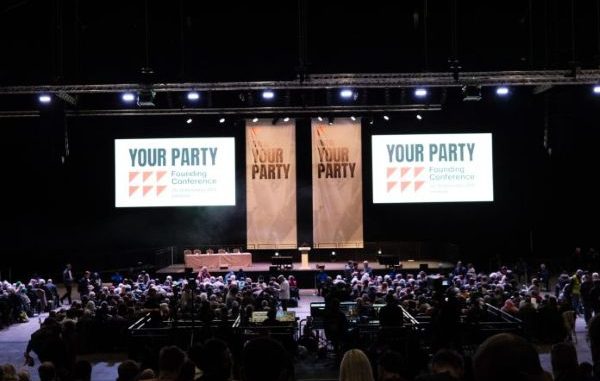
Just a few months later, Your Party’s founding conference has taken place. Unfortunately, on its formal creation, at this stage of the developing process, Your Party falls short of being the new mass workers’ party with a socialist programme that is needed.
However, despite this, and despite the attempts of the capitalist media to cast the event in the worst possible light, many of those leaving Your Party’s founding conference in Liverpool on 30 November will do so feeling more positive than they will have done on arrival. Around 2,500 individuals who had been ‘sortitioned’ by an online lottery attended the event.
A similar number watched online from their homes at any one time, all able to participate in voting. But none of these were delegates who had been democratically elected by branches, let alone by trade union bodies, and therefore able to represent the collective organised voice of those fighting on the ground.
A total of 22,000 were eligible to vote, less than half of the 55,000 reported as having signed up as members; suggesting many had not been motivated to click to register for voting rights. That the numbers were much lower than what could have been achieved is inevitably a result of the sapping away of enthusiasm following the damaging public disagreements at the top, including between Corbyn and Sultana.
Several contributors to the discussions spoke of their desire to “unite the left”. In fact the conference itself was made up largely of those existing left-wing activists, many of whom will have engaged in similar projects in the past. As the Socialist Party conference bulletin said, “It’s time to turn to the working class”.
Socialist
Such is the desire for a political alternative to the left of Starmer’s Labour that, even at this stage, 12% would consider voting for Your Party, a YouGov survey in advance of conference found. The Tory Telegraph laughingly described this as ‘dire’, despite it being better than the 11% Labour achieved in the recent Caerphilly Senedd byelection, because it has fallen from a high of 18% in the summer. But 12% after the problems of recent months gives a hint of the objective potential for a new party.
This was a conference which did succeed in creating a new left-wing political party, with those who voted overwhelmingly supporting its description as “socialist”, and for ‘strengthening the trade union relationship’. Overwhelmingly, the mood of participants was to be in favour of amendments that pointed towards a more inclusive party and were more positive in tone.
A clear example of the desire of many Your Party members to turn to the working class was the overwhelming support for an amendment, put in by members of the Socialist Party, calling for Your Party to bring together conferences of trade unions, community groups and others to draw up needs-based council budgets, to be fought for in council chambers by future Your Party councillors and others. 90% voted in favour.
Tom Baldwin, Socialist Party National Committee member and an organiser in Bristol, spoke in support, explaining how a no-cuts stand could “make anti-austerity real… To match the fine things agreed, not just in words but in deeds… Linking what we do in elections to the struggles of our class”.
Support for that amendment is an opportunity to fight for Your Party to orientate towards the working class and trade unions. It can be an important lever to try to ensure that the May elections are used as an opportunity to reach and win support among the working class.
Where Your Party councillors, or those aligned or endorsed by Your Party, are in office, it can be used as a tool to try to ensure they take a fighting stance.
Opportunity for wide stand missed
Unfortunately, the conference did not vote for the option that would have given the opportunity for the widest possible stand in May. Instead, members, including self-selected online voters, narrowly agreed to restrict backing for candidates to those deemed “in a position to meaningfully contest for their seat”. The process will be overseen by the Independent Alliance MPs, together with a Members’ Oversight Committee “consisting of five ordinary members selected by sortition from the whole membership”.
Not to offer millions a working-class, anti-austerity alternative under a common banner in May’s elections is a mistake, and misses the chance to cut across electoral support for Reform UK, a desire expressed by a large proportion of those in attendance. Like, for example, how Jeremy Corbyn’s 2017 general election stand was able to win the votes of a million 2015 UKIP voters.
The working class faces a profound crisis of political representation, more acutely felt now with a capitalist Labour government carrying out attacks on workers – given cover at this stage, in different ways, by the leaders of the trade unions. Leaders who will find themselves under increasing pressure from their members, and from wider working-class discontent.
Responsibility for the fact that the working class is without its own political voice lies squarely with the trade union leaders.
Trade unions
Just over three years ago, in the beginning period of the strike wave, 400,000+ signed up to Enough is Enough, headed by Mick Lynch and Dave Ward – then leaders of striking trade unions RMT and CWU – including with the involvement of Zarah Sultana, hoping for the creation of a new workers’ party. But they did not take the opportunity to begin the process of building a party, instead using their authority to back Starmer’s capitalist Labour Party.
Later, in 2024, there was the potential, as the Socialist Party campaigned for, to draw up a union-backed workers’ list of candidates, including Jeremy Corbyn as an independent, to contest the general election. Under pressure from members, the RMT and its general secretary Mick Lynch backed Corbyn. Such a workers’ list could have established what would have been looked to as a workers’ bloc of MPs to challenge Starmer’s Labour government from day one.
The trade unions represent over six million workers in Britain – already organised in workplaces to defend workers from bosses’ attacks. The Socialist Party is helping to organise pressure on the leaderships of those unions to take steps towards independent working-class political representation, coordinating groups of activists to fight inside the unions’ democratic structures.
Unfortunately, Your Party has been formed with no involvement of the democratic structures of the trade unions. Its founding constitution points to a 12-month strategic plan to consider affiliations, including trade unions. The Socialist Party-initiated amendment to make that an immediate priority was ruled out of order.
As it stands, a union affiliating to Your Party would do so with even less democratic say than it would have as an affiliate to Starmer’s Labour Party. At Your Party conference, it was only Socialist Party members who were arguing for the organised working class to have a democratic say in the party’s structures.
Speaking to a pre-conference rally of her supporters, Zarah Sultana said she does not favour trade union affiliation, citing the potential influence of right-wing trade union leaders. In fact, that approach lets the trade union leaders off the hook, making it easier for them to use their authority to hold back struggle against this Labour government, including through the development of a new workers’ party.
From the rostrum, Socialist Party member Paul Couchman, secretary of Surrey County Unison with over 6,000 members, spoke in a personal capacity.
Nationally, Unison is led by right-wing, Labour-supporting Christina McAnea. Socialist Party members are supporting her opponent Andrea Egan in the general secretary election, who has said “she will launch a comprehensive review of the union’s relationship with the Labour Party”.
Paul explained how his “branch committee would have proudly sent delegates, if allowed”, arguing in favour of trade union affiliation.
The amendment ‘strengthening the trade union relationships’ was strongly supported, 83% in favour, reflecting an acknowledgement of the power of the organised working class. But its call for a special commission “consisting of senior trade union movement figures, for the Party’s first two years”, does not point to what is needed.
Instead, Your Party should be approaching trade union executive bodies, asking to meet to discuss how its elected representatives can best act on behalf of the trade union’s members and the wider working class.
Democratic deficit
The ‘strengthening the trade union relationships’ amendment was one of many demonstrating the severe democratic deficit of the conference and of the whole process. As a ‘roadmap amendment’, it was added to the original documents, themselves drafted by anonymous unknown individuals, based on a ‘black box’ online crowd-editing tool and feedback from the regional assemblies. It was not allowed to be amended.
Those unknown, unelected, behind-the-scenes figures organising the process decided what was and wasn’t up for a Roadmap Amendment ‘debate’, with just two or three speakers for each option. What would be discussed and how was not known until days before the event. The media was given a timetable for discussion less than 24 hours before the start of conference, and that was before attendees were shown an agenda.
Unfortunately, the ‘standing orders’ established for party democracy do not set the basis for future decisions to be based on maximum discussion in branches, and voted on by a conference of accountable elected delegates. Instead, future conferences will maintain an element of sortition, and have motions decided by an online vote of all members. As the Socialist Party warned, this will mean a highly centralised leadership being able to set the agenda and exactly what questions are up for discussion.
Your Party’s founding basis does not establish it as member-led or democratic. Socialist Party members looked for every opportunity to speak in favour of amendments that argued for more member democracy, including against expulsions.
Dual membership
On the eve of conference, before the question of dual membership had even been debated, it was widely reported that three leading members of the Socialist Workers Party had been expelled for their membership of another party, and others were denied entry. The Socialist Party opposed this and other provocative measures.
This was also clearly the mood of Your Party members, with a clear majority voting for the only option that allowed dual membership – although who is eligible will still be decided by the Central Executive Committee to be elected by the end of February.
Socialist Party National Committee member Alex Smith spoke in favour of dual membership, receiving huge applause. Alex is an organiser in Liverpool where, in the 1980s, the Socialist Party’s predecessor Militant led the Labour council.
“In the 1980s in this city, the Labour council built more council houses than the rest of the country put together, new parks, sports centres, that are still serving the community today… Margaret Thatcher could not send in the commissioners… The reason for that was because in this city, the local trade union movement – not the leaders, who always opposed what we did, but the local trade union branches, shop stewards and so on – supported the campaign. That’s why Your Party needs to turn towards the working class and its organisations…
“When one of the leaders of that campaign Tony Mulhearn’s expulsion from the Labour Party was upheld… Tony turned round and said: ‘You can expel us from the Labour Party, but you can’t expel us from the working class!’
“The way you build a mass socialist party with a working-class base, is not to expel socialists from the very outset. Socialists and Marxists are a part of the working class and we should be allowed to organise in this party. Socialist organisations should be allowed to affiliate… Let’s not do to this party what the Labour Party did to Militant!”
Socialist Party fringe meeting
Our history of leading mass struggles of the working class was a feature of the discussion at the Socialist Party fringe meeting of 150 on Saturday evening. Around half of those in attendance were Socialist Party members who had been selected through sortition.
In total, members of the Socialist Party were able to contribute to the discussion from the conference floor eleven times – arguing for our key demands for Your Party to turn to the working class and to allow trade unions to affiliate with a collective democratic say, and for a wide, anti-austerity stand in the May elections. A struggle for those ideas is still necessary.
Your Party now exists, and so still do the differences between those at the top. Neither side is fighting for what is necessary in a new mass workers’ party.
What drove the summer enthusiasm for Your Party – a burning desire for a new party to the left of Labour and the objective need for the working class to have its own party – remains.
The struggle for a mass workers’ party, and every concrete step towards one, remains vital for socialists. As a means by which to raise the confidence and cohesion of the working class engaging in the struggle against Starmer’s austerity and for socialist change.
Socialist Party members will continue to take part in Your Party, arguing for it to take steps towards building the mass workers’ party we need, while also continuing to campaign in the trade unions for independent working-class political representation.