
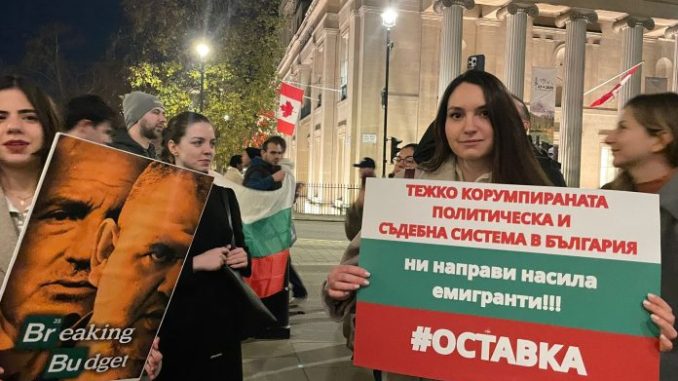
On 1 December, the biggest protest in over 30 years took place in Bulgaria. Tens of thousands of protesters took to the streets of the capital Sofia, and many other cities across the country chanting “Mafia, out! Mafia, out!”
This was a culmination of protests which began on 26 November after the Prime Minister Rosen Zhelyazkov’s coalition government announced a 2026 budget plan full of tax hikes and spending cuts. The government withdrew the budget but protests continued, calling for their resignation and new elections. This reached breaking point on 12 December. Protests demanding resignation took place across Europe, including in London.
The next day, the televised resignation of the PM and his government came minutes before the National Assembly was due to vote on a no-confidence motion. The electric energy of this wave of protests has reignited a mood for change among young Bulgarians.
In London, social media networks have been established between protesters with hopes of more planned action in the new year for the implementation of a fair voting process in the next general election.
The Zhelyazkov government’s 2026 budget plan was set in euros for the first time. The budget included rises in social security contributions and higher taxes on dividends. This is under a regressive tax system where the poor pay more than the richest in society.
Some of lowest pay in Europe
While Bulgaria has one of the lowest minimum wages in Europe, where doctors take on part-time work to survive, the police have had their wages increased by more than 50%. This is one of the many reasons the protests have erupted.
Since this coalition government took office in January 2025, after the country’s 7th general election since 2021, Bulgaria has been ranked the most poor and corrupt country in the European Union. Despite this, Bulgaria’s ascendancy to the eurozone was approved earlier in the year. Anti-euro riots and protests swept the country, sparked by far-right ultra-nationalist party Vazrazhdane (‘Revival’). There has been a fear of pro-Russian influences stopping the ascension of the euro, with President Rumen Radev being a focal source of this.
Since the fall of the Stalinist regime in the 1990s, successive governments have kept state spending low through mass privatisation, chronic low wages and pensions, while concessioning public services to Stalinist-era elites who transformed themselves into business oligarchs.
The recent political and social discontent is a reflection of the deeply fragmented and shallow trust in establishment politics. The most recent coalition government was formed of three parties – one of which is the direct successor of the Bulgarian Communist Party. Many people support the EU and the eurozone as a way, they see it, to challenge and eliminate corruption. However, the EU’s Maastricht Treaty which sets out the criteria needed to enter the eurozone, has meant Bulgaria’s 2026 budget plan foreshadows the undemocratic and unelected decision making wielded by the EU. Governments prioritise the interests of business and the banks over the desperate funding of essential services for the working class. And Bulgaria is no different with income spending in proportion to its GDP being one of the lowest in the EU.
European Union
After millions of euros of funding given to Bulgaria, none of that money has benefited the lives of working-class people. With increasing fears of a financial crash on a scale similar to that of 2008, the EU would be likely to try to force the Bulgarian government to implement austerity measures like those of Greece, where the minimum wage was lowered by 22%.
Events like those would further exacerbate the problems faced across the Balkans. It is not a coincidence that there have been similar expressions of anger in Romania, Serbia, and Hungary. The rise of ‘Gen Z’ protests, as named by international media, are a welcomed step towards fighting back against undemocratic and corrupt politicians.
But the current leadership of this movement in Bulgaria has been the right-wing capitalist party that was founded on the basis of being anti-corruption and pro-EU. PP-DB (‘We Continue the Change – Democratic Bulgaria’) has been the largest parliamentary opposition to the government.
Not another capitalist regime
A government made up of any collection of capitalist parties will inevitably fail to improve the lives of workers and young people. In fact, on the basis of capitalism in crisis, it will be compelled to attack them. It will therefore fuel further protests.
Youth and workers should organise independently of the capitalist parties and elites, linking up protests through democratic committees at a local, regional and national level. These bodies could put forward demands for a living wage, properly funded housing, education and health, and so on – linking that to the need for public ownership and democratic planning to meet the needs of all.