
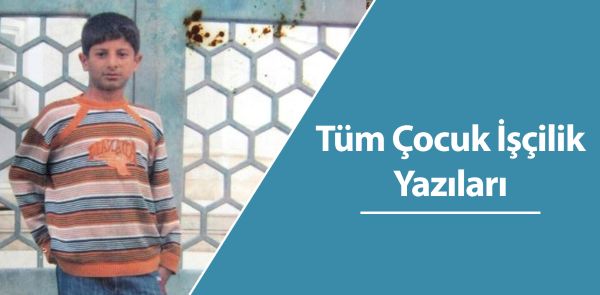
The MESEM (Vocational Education Centers) system in Turkey has recently received attention both within the country and abroad after the unlawful arrest of 16 TİP (Türkiye Workers Party) youth members from several different universities. It is impossible to describe with words the pain and suffering caused by this inhumane sham of a project. Even still, here we will try to inform you of the details and help the voice of child workers in Turkey reach the wider world.
“I woke up before sunrise. The room is quiet but inside my head, I am not. The alarm goes off, then again, and again. I open my eyes and look at the ceiling. It almost feels like that little crack there is speaking to me: ‘Today, too, will pass; but you will not.’ ”
The Old System
Under the old education system in Turkey children aged 14-18 would enroll in vocational/technical high schools where they would be taught both the normal curriculum and practical classes. Only final year students would spend a portion of their time at internships instead of school and even then they were allowed to spend at most one day at the internship. The work places the internships took place in were approved by the government and independent supervisors were tasked with protecting the children during their time there. The last year students were also paid a portion of the minimum wage by the government and another portion by their employer for their time spent at the internship.
Turkey still had a problem regarding child workers with the old system in place. Most of the students enrolled in the vocational high schools worked off-record to help their families, either during school hours or during their free time. However, the new system has made child labourers a government policy. And pave the way for way worse conditions in both government supervised and off-record work spaces.
“On the way to work, a million different thoughts are racing through my mind. Will I be getting paid today? What if I get told off again? What if I make a mistake? There is a constant voice of fear in my head but I’ve learned to live with it.”
The New System
Under the new system students enrolled in vocational high schools aged 14-18 can choose to take practical classes for 4 days of the 5 day education week. The students have to find their own workplace and sign a contract with their boss on their own, no government support is provided. Students who are out of work for two consecutive weeks fail their class and as a result have to repeat a year.
Unlike the old system, the people tasked with supervising the children’ s work place are now their teachers. On paper their teacher has to approve everything is safe however since the employers receive no negative impacts when they do not follow the teacher’s assessment; they simply fire students whose teachers are causing issues.
Students from classes 9-11 are paid 30% of the minimum wage while students in class 12 are paid 50%. They also receive insurance from the state for work accidents and illnesses. All of these are covered purely by the state, the employer doesn’t spend a cent out of their pocket for having a child work 4 days of the week.
“Nine o’clock and my shift begins. I study cyber security and software programming at school but my work is mostly laying cables and setting up computers. Two hundred volts of electricity. A momentary mistake, a moment of absent-mindedness and a spark. Life could change in an instant but nobody cares.”
Though officially students are allowed at most 4 days of the week to spend at their work place, off the record they sometimes work for 6 or even 7 days a week. All this time in addition is not covered by the government and since they won’t receive any negative impacts, it’s up to the employer to pay overtime. Most of them don’t.
Students who are not enrolled in vocational high schools but who fail a year are given the option to either repeat the year or enroll in a school under the MESEM system. This has driven many students who had a bad academic year into the workforce.
According to the data collected by the Ministry of Social Security only 4 in 1000 work places, at which children are employed, were regularly examined for work safety. (Between 2020-2023.)
“22.30. It’s evening now but the work does not end. The boss says “handle this too” and we do; then “this needs some work too” and it never ends. I see my reflection in the mirror and I don’t even recognize it.”
Statistics on Child Workers
The current number of students enrolled in the MESEM project is 392.887 according to independent sources and 543.109 according to the Ministry of Education’s own reports. This, however, does not constitute the total number of child workers in Turkey. Somewhere between 400.000-500.00 children are estimated to be working off the record, at times for even less money. Most of these children are enrolled in what is called Open High Schools (Açık Lise) where they are not forced to attend classes but can still earn their diploma by succeeding in their exams. These children presumably work 5 to 7 days a week in addition to studying for their tests on their own.
Since the MESEM project started being tested in the late 2010s, the total number of child workers has risen drastically. According to the data collected by TÜİK (Turkey Statistics Organization) the total number of child workers has risen from 720.000 in 2019 to 970.000 in 2025. Another report on the subject using TÜİK and Ministry of Education data estimates that at least 1.372.000 children are employed in the workforce as of 2025.
“It’s midnight when I get home.” My mom has turned off all the lights, perhaps praying that I had already come home and she just hadn’t noticed. I get in bed with only one thought plaguing my mind: same thing tomorrow.”
The AKP government has been attacking compulsory education for years. MESEM and their other education policies (like bringing back repeat-years) have worked in tandem to put around 1.5 million children out of public education in the year 2025.
Unfortunately, 87 children will die in 2025 from work accidents. In any media outlet worth its name these are called as they are: “Child Worker Murders”. Of these children, 15 were enrolled in MESEM and as a result the government is directly responsible for their deaths. Between 2013-2024 the total number of child worker murders was 743.
“Sometimes my foreman tells me: ‘I was working at your age too.’ But sometimes I just want to live. To study, listen to music, rest a little. Unfortunately there isn’t even time to be human here.”
Government Response to Criticism
The AKP government has not shown any indication that they will be pulling back from the MESEM project. An important part of their voter base is made up of small business and workshop owners, who are the main beneficiary of the MESEM system. The AKP policies to erase compulsory education and introduce children to the workforce at an early age work in tandem. They see the children working under MESEM and off-record as a cheap source of labour. Masquerading all this is the likening to the old ways of technical education in the Ottoman era with 9-11 graders being apprentices and 12 graders being journeymen. Except even the Ottomans had stricter laws on work safety and child worker rights.
Yusuf Tekin, the current Minister of Education, has gone on record again and again describing MESEM as a project of great importance to the country. That it would be impossible to provide capital with the necessary workers at the right price without the project. That to stop the project would be to “cut the veins of production”.
“More than anything, I want to be seen. Not as a statistic but as a human. Not as an apprentice but as a person. There are thousands of young people like me in this country but we all keep quiet. Because when we speak we are ‘disrespectful’ but when we do not, we are forgotten. Maybe that’s the real problem: We have been forgotten.”
Many protests have been held in response to the MESEM project, most well-known so far being the one organized by TİP Youth. A group of TİP students from various universities gathered together in İstanbul in order to obstruct the MESEM Summit organized by the Ministry of Education.
17 students, and 4 teachers from private schools also there to protest, were taken into custody after a clash broke out between the event security and protestors. The teachers and 1 student were released afterwards, however 16 of the TİP Youth were arrested. They have been in prison for two weeks now and they are being charged with “assault with a weapon” due to the red dye they used at the protest..
“As you are reading this letter, I will have sold a day of my life for 4 Euros.”
-17 year old student, enrolled in MESEM
What Must Be Done?
Thanks in great part to the protest organized by TIP, MESEM has garnered attention nationwide and internationally. Though state regulations were known to be lax and the system corrupt, this latest media coverage has opened the eyes of many to the fact that things were much worse than it looked.
The movement in Turkey must take advantage of this before the public interest shifts to other topics and start a campaign to stop MESEM completely. Even in the case that the project is not stopped completely, the campaign may better the lives of students enrolled regarding work safety and amount of recompensation received. The campaign must unite unions, political parties, independent organizations and universities under one banner to fight against child labour.
Protests and rallies are of course the best way to keep this momentum going. However, the recent arrests of not just the 16 TİP Youth members but other students and other anti-government citizens must be taken into account. The oppressive force of fear was broken in part during the massive protests in March but it is not yet completely defeated. Weak rallies and protests might work against the movement, so decisions of when and where to protest must be strategic.
When physical protests are impossible, time must be spent on forming and keeping a public opinion on the subject. Any action which would not normally receive repercussions but would create media coverage regarding MESEM must be taken. This might include planting saplings for and renaming streets after child workers who’ve lost their lives or public commemorations.
Even if the campaign to end MESEM is successful, it might take anywhere from months to years to be put in practice fully. And even then, children working off-record will still be in the hundreds of thousands. As sad as it is to say, if the aim is to end child labour completely, we are looking at a years-long project. Thus, providing economic and social support to the children and their families independent of the government policy might be the most important aspect of the campaign. Free meals and tutoring would be possible to accomplish at least locally, with little cost in the face of the good it would do. Strong ties of solidarity must be established, no matter the specific methods, both to move the campaign forward and to help the children get by even a little better than before.
In closing we must touch on the fact that the repeal of the MESEM project without the betterment of the affected children’ s economic status would push most of them into off-record work places. In such a scenario the “victory” would be hollow. As a result the campaign must involve demands to ensure that school students receive high-quality education, including training schemes that guarantee well-paid decent jobs at the end, and free school meals and maintenance grants to help students with their studies.
Sources
https://www.isigmeclisi.org/cocuk-isciler
https://www.isigmeclisi.org/21479-siz-bu-yaziyi-cocuk-haklari-gunu-nde-okurken-ben-bir-gunumu-200-tl
https://bianet.org/haber/2024-2025-ogretim-yilinda-en-az-72-cocuk-isci-hayatini-kaybetti-311689