
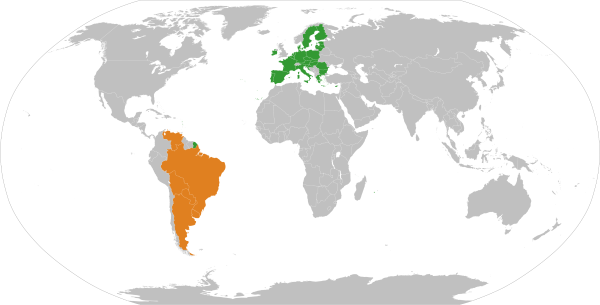
On Friday, the 9th January 2026 a majority of representatives of the EU-countries finally agreed to a treaty with Mercosur, the Southern Common Market, a South American economic bloc. It seems that 25 years after the negotiations started, this dinosaur of treaties finally will come to life. It represents the desperate attempt of the European capitalist governments not to be totally pushed to the back given the increasing dominance of China and the US.
Mercosur is one of the many trading alliances that was formed in the 1990’s, in a decade dominated by neoliberalism and quickly expanding world trade. Back then, free trade was a dogma of world capitalism. Several trading alliances and blocs were formed. Many countries took part in more than one trading bloc but none of them finally could overcome the competition that is deeply rooted in the DNA of capitalism. They all were under the dominance and for the benefit of the strongest imperialist powers. They were also based on the exploitation of workers and small peasants, of resources and the environment, especially in the poorer neocolonial but also developing countries (of which, some later became the BRICS countries).
But the 1990s also started with developments that led to the Zapatistas’ uprising in Mexico, which erupted against one of these treaties (NAFTA). Many large international protests against some of the treaties followed: against TTIP, CETA, and against the Mercosur treaty.
While pro-capitalist politicians argued that those treaties would boost economies and bring benefit to all, protesters correctly warned of their devastating effects. The rights of indigenous people, of local peasants, of workers, trade unionists, and environmental protection, were under increasing attack using those treaties.
These protests made it harder for the ruling classes to sign such deals. On top of that, the deepening economic crisis of the last decades led to a change in the world economy. While trade still is strongly international, at the same time there is a tendency towards nationalism, both economically and politically. Trump’s “America first” policy is the most glaring example of a trend that is implemented by many ruling classes across the world. Given the increased competition on the world market, big capital demands from politicians that they act in its economic interests – militarily abroad and by ‘protective’ measures at home. Smaller economies and those economies depending more heavily on exports have a difficult position in this situation.
The EU – a phased-out model
In this situation the EU is in a complicated position. On the one hand, it exists as a bloc between the stronger and more dynamic economies of the USA and China. On the other hand, the individual European nations put their own interests first, even at the expense, at times, of the EU, as such. The new-old Mercosur treaty has to be understood in this contradiction. To come to an agreement after 25 years of trying, the EU had to dispense with one of its founding principles, that of unanimity, and changed to a majority decision making process. The deal has now been agreed by the EU council majority.
The pact is a deal of the EU with the Mercosur bloc in Latin America (Argentina, Bolivia, Brazil, Paraguay and Uruguay and associated countries Chile, Colombia, Ecuador, Guyana, Panamá, Perú and Suriname). Latin American countries hope to sell more agricultural products to Europe and European countries hope to sell more industrial products to Latin America. The different interests of the ruling classes across the EU countries, and the various pressures they are under at home, are the background to some of the member-states voting against the treaty (such as France and Poland).
The German government, representing the interests of the German car industry, made clear how important the deal is to them. The German government hopes to overcome the deep and structural crisis in the auto industry by reducing tariffs to Latin America. But this is an unlikely solution given the much more dynamic Chinese car industry. The reaction of a representative of Austrian capital (which is highly dependent on the German car industry), Christoph Leitl, sums up the hopes and purpose of the deal from their point of view: “Europe is thus standing up to Trump and Xi”. He went on to say, “Congratulations on this great sign of life from the much-maligned Europe”.
EU propaganda
EU propaganda paints the deal as a great opportunity, not only for European companies, but also regarding sustainability, indigenous rights, the fight against child labour, animal rights, human rights, and much more. The history of such deals proves all such promises are false. While China and the US have strong central governments through what is economically necessary from the point of view of their respective capitalist class, Europe is increasingly weakened and left behind due to its growing internal tensions and contradicting interests. European leaders praise this new “biggest free trade zone”, covering up to 800 million people, as a “win-win-agreement”, and hope to increase the share of European capital in Latin America, compared with the USA and China. It is no coincidence that it was signed at this time. China has been increasing its influence in Latin America for years. Several Latin American countries have joined China’s ‘belt-and-road initiative’, and China has become the number one trading partner. Trump’s doctrine of all to the continent of America being the property of the USA is an attempt to push back against China and to strengthen US influence and access to resources and markets.
With this new treaty, Europe hopes to reverse the trend of losing ground and to re-gain some of their old colonial influence in Latin America. Political leaders in Latin America hope to increase their ties with non-US countries, also to underline their national sovereignty in relation to the USA.
Struggle against Mercosur and capitalism needed!
It is still not 100% definite if the Mercosur deal finally will really be passed, as it still must be agreed to by EU parliament, and the national parliaments of the member states in Latin America. But even if it can be agreed by all the different bodies, Mercosur will not provide what it is promised. Neither can it solve the deeper underlying problems of the world economy, and especially not those of capitalism in Europe. Nor can Mercosur stop the imperial ambitions of the US or China in Latin America. But Mercosur will increase the exploitation of the environment, resources and working class and poor, and with this will lead to mass opposition protests.
Many trade unions, and left and “progressive” parties in Europe, used to oppose the Mercosur treaty due to its exploitative character. Some stay silent now and follow the argument that it would be good for “European business” and therefore “European jobs”. It is a dangerous trap that might quickly be exposed. Instead of hoping that a “Europe first” policy could help working people in Europe, the working class needs a leadership that understands the international character of capitalism and how it exploits it.
Instead of supporting their respective capitalists in the hope to save some jobs, trade unions need to look further and support protests against the treaty, against the exploitation organised by European capitalists in Latin America, as well as organising a fight back against closures and lay-offs in Europe.
Instead of following ‘free trade’ or protectionism, workers’ organisations need an independent position. They need to leave the logic of capitalism and head towards an economy based on the needs and on the democratic control and planning of working-class people. By putting forward such a perspective, the trade unions and other working-class organisations can play an important role in internationalising workers’ struggle. This is necessary not only to weaken the effects of capitalism but to overthrow it, once and forever.