
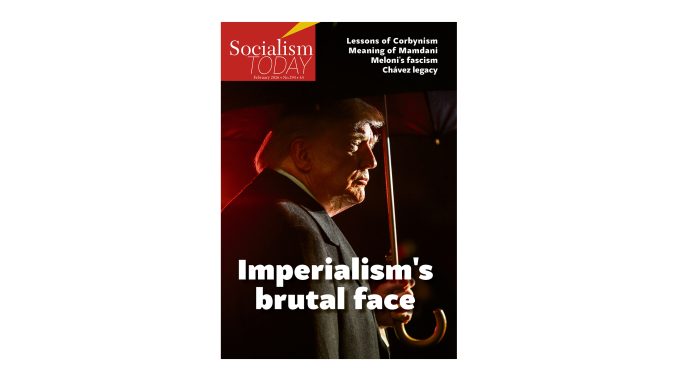
Originally published in Socialism Today, magazine of the Socialist Party (CWI England & Wales).
In November last year the Trump administration published its National Security Strategy of the United States of America. Hard on its heels, as 2026 dawned, the kidnapping of Venezuelan President Nicolás Maduro and his wife by US forces were a graphic demonstration of Trump’s ‘security strategy’ in action. This has been swiftly followed by the ramping up of Trump’s demands for the US to take control of Greenland.
Publishing National Security Strategy documents is not peculiar to Trump. Almost a quarter of a century earlier, in September 2002, the administration of a previous Republican President, George W Bush, produced his version. Comparing the differences between the two shows the gulf between US imperialism and the geopolitical context within which it operates, then and now.
Trump drops all the attempts of previous presidents, including George W Bush, to dress up defence of US imperialism’s interests in diplomatic language. Instead of Bush’s claim that “we do not use our strength for unilateral advantage”, Trump baldly states that “the purpose of foreign policy is the protection of core national interests; that is the sole focus of this strategy”.
But this is not the fundamental difference between the two. Bush’s Security Strategy was written five months before the US launched the invasion of Iraq, backed by a so-called ‘coalition of the willing’ including Britain’s New Labour government. Bush certainly used more linguistic diplomatic fig leaves than Trump, but his strategy nonetheless spelled out in the starkest terms a commitment to maintain US military superiority “beyond challenge”, in nuclear and conventional capacity, across the globe, and even in space. It emphasised the necessity of being prepared to take “pre-emptive military action” and that the US was prepared to do so alone “if necessary”.
US hubris
The difference between 2002 and 2025 is not the level of naked self-interest, but how far US imperialism’s hubris of two decades ago lies in ruins today. In 2002, the US was a hyperpower, the overwhelmingly dominant force on the planet. It believed itself invincible and able to bend the world to its will. Just over a decade earlier Stalinism had collapsed in Russia and Eastern Europe. Brutal totalitarian regimes, they bore no resemblance to genuine socialism but were nonetheless outside the domination of US imperialism, based as they were on very distorted planned economies. They therefore acted as a counterweight to the capitalist powers. Their collapse was a huge ‘shot in the arm’ for capitalism, particularly for the USA as its dominant power.
That is what lay behind Bush’s incredible overconfidence. He declared that “the great struggles of the twentieth century between liberty and totalitarianism ended with a decisive victory for the forces of freedom – and a single sustainable model for national success: freedom, democracy, and free enterprise”. A page later he harped on the same theme: “The great struggle is over. The militant visions of class, nation and race which promised utopia and delivered misery have been defeated and discredited”. This was US imperialism declaring itself the world’s policeman, confident it could impose a New World Order run according to rules made in Washington and Wall Street. The much-vaunted process of globalisation would lower barriers to allow US corporations free rein to exploit across the planet.
His Security Strategy asserted that the US would continue to “seize the global initiative” via the “new global trade negotiations we helped launch at Doha”. It boasted of how the US “led the way in completing the accession of China” to the World Trade Organisation, and would now “assist Russia’s preparations to join the WTO”. Welcoming “the emergence of a strong, peaceful, and prosperous China”, it concludes that China “will find that social and political freedom” that will be needed for “greatness”.
We predicted at the time that the overweening arrogance of Bush at that stage, and behind him of US imperialism, would be shattered by the reality of capitalism in the 21st century. It began to be undermined in the killing fields of Iraq. More than 460,000 US personnel were deployed to carry out the invasion, and it quickly succeeded in toppling the Iraqi regime. The quagmire of the occupation and sectarian conflict which followed was another thing entirely, however. Bush’s 2002 statement confidently predicts that the occupation of Afghanistan, which had already begun, would lead to it being “rebuilt” on a sound basis, never again to be a “haven for terrorists”. Twenty years later the US withdrew leaving the Taliban back in charge.
Iraq and Afghanistan were only one aspect of the body blows suffered by US imperialism. The limits to how far the US could bend the world to its will began to show. World trade increased massively, but nonetheless the World Trade Organisation’s talks which began with the Doha Round in 2001, stalled in 2008 without any agreement. For six years now the WTO has been moribund, paralysed by the US obstructing any new appointments to the WTO judges panel, effectively blocking the body’s ability to settle disputes.
The 2008-09 financial crash and subsequent Great Recession was a further major knock to the capitalists’ certainty in their own system. It also increased the confidence of the Chinese regime in the path it had taken. Today China is very far from the cheap labour assembly plant for US imperialism that it was at the start of the century. And contrary to Bush’s predictions it is still ruled by the powerful Chinese Communist Party state, now at the head of the second biggest economy in the world. It is now the ‘superpower’, at least as far as manufacturing is concerned. It is responsible for around 28% of global manufacturing. In terms of gross production, it outpaces the US threefold, Japan sixfold, and Germany ninefold. Nor is it any longer concentrated in low-tech industries. China now makes more than 70% of electric vehicles globally, for example.
The superpower is sinking
So, while the US still has predominance in military spending and in the world financial system – through the international role of the dollar – its position in global trade has declined markedly, with its share of final demand for imports falling from 22% in 2000 to just 15% in 2020. And while it was the huge US corporations that reaped the biggest rewards from globalisation, they increasingly did not bring them back home. By 2022 two-thirds of their profits were booked into tax havens, twice as much as in 2000.
The US remains the largest economy, but China is close to two-thirds as large. Trump’s Security Strategy is a recognition of this reality. Instead of Bush’s patronising attempts to ‘help’ undeveloped China, Trump refers to it as a “near peer”. His statement is strewn with the defensive posturing of a global power that realises it is on the way down. It aims are not to reach new heights but a desperate fight to maintain the US as the “world’s strongest, richest, most powerful, and most successful country” – not for millennia, but only “for decades to come”.
It completely retreats from any attempt to act as the world’s policeman. “The elites badly miscalculated”, Trump declares, when, “at the end of the Cold War, American foreign policy elites convinced themselves that permanent American domination of the entire world was in the best interests of our country. Yet the affairs of other countries are only our concern as far as they directly threaten our interests”. No more will the US be “lashed” to “a network of international institutions”, which, according to Trump, are in some cases “driven by outright anti-Americanism” and in many cases “by a transnationalism that explicitly seeks to dissolve individual state sovereignty”.
The transnational institutions Trump refers to were, of course, founded by US imperialism, and the so-called ‘rules-based order’ that they have overseen was designed to defend US interests – with the US ruling class always happy to break ‘the rules’ whenever it suited them. Nonetheless, Trump’s Security Strategy reflects that today those institutions no longer serve the interests of a US imperialism in retreat. Trump’s fury at the international institutions has a certain logic, reflecting the outlook of some sections of the US capitalist class, fundamentally because the framework designed to aid US imperialism has not prevented its decline, but instead has facilitated the rise of China.
Instead of Bush’s New World Order, Trump only aspires to US dominance over the ‘Western Hemisphere’. The US wants, he states, a “Hemisphere that remains free of hostile trade incursion or ownership of key assets, and that supports critical supply chains; and we want to ensure our continued access to key strategic assets”. The kidnapping of Maduro was in no small part a warning to China not to get too involved in Latin America. However, it is too little, too late. China is now Latin America’s largest trading partner, with bilateral trade exceeding $500 billion in 2024.
Trump is a personification of the decline of US capitalism, with all of its increasingly short-sighted and rotten characteristics writ large in him. What could be more short-sighted than his ‘drill baby drill’ mantra, which represents an abandonment of any attempt to compete with China over green energy, instead trying to grab as much as he can of the dirtiest energy possible, including by kidnapping Maduro.
None of Trump’s measures will restore the fortunes of capitalism in the US. They are not about developing productive technique or creating new value, but rather an attempt to use might to grab a larger share of value from the world economy for US capitalism, at the expense of other countries – whether a formal ‘ally’ or not. At the same time his rule is seriously deepening divisions within the US capitalist class. Trump could well trigger the next economic downturn, and it is a safe bet that his actions will exacerbate its severity when it comes.
And of course, retreating from aspirations to ‘police the world’ does not mean a retreat from being prepared to use US military might to defend the interests of US capitalism. On the contrary, Trump’s Security Strategy repeatedly calls for “peace through strength” pointing to the vital necessity of the US continuing to have “the world’s most capable military”.
Nationalism on the rise
Tension between the nation state and the world market is nothing new – it has been a fundamental contradiction of capitalism since its inception. However, today that contradiction is being posed more sharply than in the preceding eras when the US was dominant. In the Cold War era the US dominated the capitalist world and then, after Stalinism’s collapse, briefly the whole world. Today, on the one hand the productive forces have massively outgrown the barriers of nation states but at the same time the increasing crises of capitalism, and the decline of US imperialism, is leading to a resurgence of national barriers and a swirling ‘multipolar’ world with little or no stable framework, within which every national capitalist class is struggling to defend its own interests.
Trump is accelerating this process, but capitalism is in a multipolar era whether or not he is in the White House. The US is no longer capable of playing the role it once did, but like any capitalist class, it is compelled to struggle to maintain its position. It is excluded that China will play the role the US once did. It has been able to develop as rapidly as it has only because of its unique character, with the state playing a large directing role in the economy and foreign capital only allowed to operate within huge restrictions. China therefore has fundamental internal contradictions – which will result in huge revolutionary upheavals at a certain stage. For now, however, its unique characteristics also mean that other capitalist powers see it as a threat that they have no choice but to do business with, rather than a possible ‘leader of the world’. Trump’s actions are undoubtedly undermining the dollar, for example, although for now it maintains its position as the global reserve currency, but the renminbi, a currency under the control of the Chinese Communist Party, is a completely unacceptable alternative for the world’s capitalist classes.
Rising militarism
The USA’s retreat into defending its own interests in the narrowest possible sense is driving increased military expenditure in multiple countries. EU military expenditure increased by 17% in 2024 alone, and a number of EU countries are taking some steps towards introducing, or strengthening existing, military conscription laws, although this is at an early stage. Regardless of the formal status of the NATO military alliance, it is clear to the capitalist class of every member country that the US – which has military expenditure of more than double all other NATO members combined – cannot be relied on to defend their interests.
How then, can this new nationalism and militarism be defeated? Hoping for a return to some previous era, when capitalism was less utterly rotten than it is today, is completely utopian. Even when enjoying the temporary lease of life capitalism received after the collapse of Stalinism, it proved incapable of delivering the peace, prosperity and democracy of Bush’s propaganda. Only by overturning capitalism, and beginning to build a new democratic socialist world, will it be possible to begin to deliver those goals in reality rather than words.
The working class is the central force capable of achieving that because of its role in economic production and the collective class consciousness that it generates. It has the potential power to end capitalist rule – and the exploitation, poverty, wars and destruction inherent to it. Nonetheless, faced with the immediate horror of world events – from Gaza to Ukraine – there are bound to be many who search for a seemingly easier, more immediate, means to stop war. These issues have been debated many times in the history of the workers’ movement. It was the working class coming to power in the Russian revolution in 1917, led by the Bolsheviks, and then the revolutionary uprising in Germany in 1918, which brought the carnage of the first world war to an end.
However, outside of Russia the immediate revolutionary wave that followed the war was defeated. Tactical discussions then took place in the new young Communist International, in which Lenin and Trotsky argued against those who thought wars could be stopped by the heroism of a minority. At the third congress of the Communist International in 1921, for example, a group of French delegates argued that they should have called on those drafted to the French military to take part in the occupation of Luxembourg to have resisted “arms in hand”. Trotsky took this mistaken position up on the congress floor, while Lenin then backed Trotsky at a meeting of the executive, explaining that “it was impossible to conquer militarism by the passive opposition of one military age group; what was needed instead was the active intervention of the whole working class”.
Lenin then elaborated that if the working class “as a whole was not ready for a complete revolutionary overthrow, then it could not prevent the military occupation of Luxembourg” and that attempts to solve these kind of problems “by a show of strength when that strength was insufficient for solving the basic problem – the seizure of power – lead to adventurism – a path that could be fatal for young Communist Parties”. What did Lenin suggest instead? He went on, “preparation for revolution in France, one of the biggest countries in Europe, cannot be carried out by one party alone. The French Communists winning the leadership of the trade unions… that is what would please me most”.
This approach is very relevant to the tasks we face today. We do not face world war at this stage, given the underlying class balance of forces and the existence of nuclear weapons, but – like the young Communist International in 1921 – we are in a world where war and conflict is inexorably on the rise. Nonetheless, the class balance of forces does have to be taken into account by the capitalist classes and their representatives, including Trump. For all of Trump’s tub-thumping, and the real likelihood of new foreign interventions, he remains very hesitant about putting more than handfuls of American ‘boots on the ground’, summed up in his Security Strategy document as a “predisposition to Non-Interventionism”. The simple reason for that is the mass opposition he would face in the US, not least among those who have voted for him. It is also true that the global mass Gaza movement was a factor which pushed Trump to put pressure on the Israeli premier Netanyahu to bring the conflict to ‘an end’, although of course in reality the nightmare continues for the Palestinians in Gaza and increasingly the West Bank.
However, when a capitalist class is firmly set on the path to war, as the US was in Iraq when Bush published his Security Strategy, it can only be stopped by a movement powerful enough to threaten its rule. The potential capacity of the working class to overturn capitalism and build a new world has been demonstrated time and time again over the last century. And in this era, although still at its very early stages, the working class is beginning to re-enter the scene of history. In recent months we have seen general strikes in several European countries, including in Italy on the question of Gaza, despite the alleged ‘strong-woman rule’ of Giorgia Meloni (see Assessing The ‘Fascist’ Meloni Government’ by Christine Thomas on page eleven). In the US calls for general strike action against ICE are starting to grow.
There will inevitably be more, and greater, mass movements. But in order to successfully end the horrors of capitalism and war, the working class will need to forge its own mass organisations and parties, able to generalise its experience in a programme for the overthrow of capitalism and the development of socialism. A new generation of anti-war activists is currently being forged by events, but for their struggle to achieve its goals, they will need to join the fight for the working class to conquer power.