
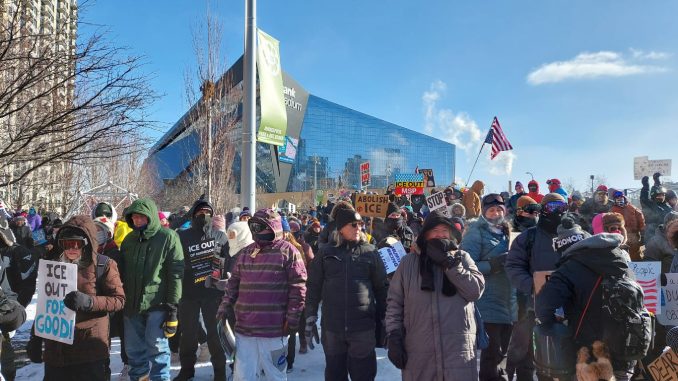
Tens of thousands mobilized in a day of action in Minneapolis on 23 January against the state repression of Trump’s administration and its brutal deployment of three thousand ICE agents to the state of Minnesota.
This mass mobilization was termed an “economic blackout” by sections of the capitalist media, “a shutdown”, a “day of truth and freedom” and importantly a “general strike” by layers of activists, workers, youth and campaigners. The call came from a wide section of society, stretching from labor unions to immigrant organizations, small businesses and churches for Minnesota to “not work, don’t shop, don’t go to school” in protest at the execution by an ICE agent of local mother and protestor Renee Good earlier this month and generalized and escalating repression by ICE and the White House in the state. For background and further analysis see here.
It is a step forward that this mass mobilization took place despite the terror inflicted by ICE and Trump, which has not in any way let up. For example, in the days before the action a five-year-old and a two-year-old were detained in house raids by agents, while the Department of Justice arrested activists who protested in a local church. There is also widespread speculation in the media about the Trump administration invoking the Insurrection Act and sending federal troops into the state that helped mobilize such a turnout of defiance. This would be for the first time since the 1991 LA riots after police severely beat Rodney King.
23 January
In freezing temperatures, Independent Socialist Group (ISG, CWI supporters in the US) activists spoke to many on the mass march through the downtown area, many of whom were on their first ever demonstration. Twenty-thousand packed the indoor rally at the end while militant noise was made by those outside in the cold for hours. Earlier in the day, thousands protested against deportation flights at the airport and blocked roads with over one-hundred being arrested and a section of airport workers walking out.
The turnout of youth stood out. The city’s youth have fought back against ICE thugs tear gassing their schools and physically attacking teachers by organizing walkouts over the last few weeks. There were also families with small children marching. The large turnout in Minneapolis will lift confidence and push back some of the real fear generated by ICE locally and will inspire those enraged by Trump and ICE across the US, over one-hundred solidarity actions took place on the same day.
The action was supported by the Minneapolis and St Paul AFL/CIO union federation and many union locals. In the run-up to the day of action, workers in the letter-carrying and postal sector demonstrated in the city against ICE using their workplaces and attacking fellow workers. However, while ‘supporting’ the action publicly, many union leaderships were not willing to organize the necessary elements of an actual general strike to really disrupt the operations and profits of the bosses in Minneapolis and strike a severe blow that would have echoed across the US and internationally. Despite the demand of “no work” the leaders were not prepared to defy ‘no strike’ clauses in contracts or legal bans on strikes by federal workers.
This meant that although large numbers of workers locally called-in sick and other walked out, most of the city’s operations were still running. Small and independent businesses either supported the action or forced by social pressure to close, but the big chains remained open. This isn’t just the responsibility of local union leaders, but those nationally who missed an opportunity to put the potential power of the labor movement at the center stage of the struggle against Trump. ISG activists met many union members and activists on the mass march, from the construction and transport industries, teachers and nurses, but bar the official stewarding, the visible presence of the labor unions, even in terms of banners, was absent.
Nonetheless it is extremely positive that the response to repression prominently included the idea of a ‘general strike’ and the key role the working class plays in confronting the capitalist state. The tradition and memory of the 1934 Teamster strikes, and general strike led by Trotskyists in the city has been rediscovered and is being discussed now in Minneapolis and across the US by a new generation. Socialists have an even greater responsibility to explain how such action by the working class can be organized and win. Many workers who participated in the day of action will be looking for ways to organize real strike action soon.
Leadership
The idea of independent action by the working class has never been more relevant. Part of the reason for the weakness of the union leaderships is their ties and political support for the Democratic Party and its local Democratic-Farmer-Labor Party (DFLP) political machine. The state governor and city mayor have gained attention and a layer of support for their recent calls for ICE to be removed, despite their failure to stand up to racism, division and attacks by the bosses in the past. Under social pressure for now, they adopt an oppositional stance to Trump. The city council came out in support of the action and there are a range of conflicts around the local police department not cooperating with ICE. This has been enough for Trump, and Vice-President Vance to whip up division with a visit to support locally based ICE agents and local business leaders on the eve of 23 January.
The local Democrats cannot be relied upon to defend people from ICE, let alone lead an effective struggle for their removal. They are attempting to cool down the mood in the city, which is currently failing. Their appeals for fairness, in being allowed to participate in any investigation of the shooting of Renee Nicole Good, alongside legal challenges to ICE brutality, is being ignored by Trump who is going on the legal offensive against them with subpoenas.
It is clear that tens of thousands of people are currently involved in action against ICE across the state. In Minneapolis/St Paul a certain collective action tradition has persisted since the days of heavy industry and the battles of the Teamsters, rediscovered by a new generation since the major ‘Black Lives Matter’ mobilizations after the 2020 police killing of George Floyd. Neighborhoods are organized in mutual aid, but also in “rapid response” teams that disrupt ICE raids and attempt to protect those under attack. This is despite the real risks involved. Activists have been hospitalized and permanently maimed by pepper spray and ‘non-lethal’ munitions.
There is huge interest and large support for the idea of fighting back nationally, with activists preparing in areas like Portland, Maine, for the next major ICE mobilizations. ICE has succeeded in arresting over ten-thousand in the state, and in spreading such fear in communities that aid has even extended to support groups buying groceries for those hiding indoors.
Where next?
The question of ‘where next?’ and ‘how could ICE and state repression be defeated?’ is critical. Many on the march said they were fearful about the future and whether state repression would be stepped up further. Another aspect of the mood, often expressed by the same person, was a total lack of faith in the political establishment and a feeling that there is no option but to fight back. It is a very dangerous situation under the Trump presidency for all working class people and youth. Trump is also creating dangers for his rule, through repression and an utter failure to deal with the ravages of the high cost of living and poverty, while he and his cronies enrich themselves. The ingredients and the social conditions are present for revolutionary conclusions to be drawn by a militant layer who are looking for the best methods and ideas to fight back. There will now be discussion among the most militant workers, youth and activists about the way forward especially in Minnesota.
ISG activists got a warm response for material outlining the following program:
- All out for the January 23rd day of action! Maximum turnout of the working class and youth to send the strongest possible message to Trump and his ICE thugs!
- Minneapolis labor unions to make the day of action a real strike! Organize workplace walkouts and join the demonstrations! Rank-and-file activists should work together to bring our unions over to the position of taking job action.
- Plans should immediately be made for escalating follow-up actions, with all anti-ICE organizations working together to coordinate day-to-day resistance to ICE as well as bigger and more disruptive demonstrations and strike actions until ICE withdraws completely from the city.
- Solidarity events should be organized around the country to show support for Minneapolis, but also to begin to work towards similar actions wherever ICE is present.
- We need a workers’ party! Despite Democrats like Jacob Frey putting on an anti-ICE show, ICE has been expanded, reinforced, and empowered by Democratic Party governments, even when the Democratic Party controlled both the Presidency and Congress. ICE has received local support for its operations from municipal and state agencies, including those run by clear Democratic Party majorities. There are two corporate parties in favor of the deportation machine: the Republicans and Democrats. They both refuse to abolish ICE. The anti-ICE movement, unions, and the working class needs its own political party. Working class activists should run for election with clear pro-labor and anti-ICE platforms, independent of the Democrats and Republicans and the billionaire money that backs their parties. We can start laying the foundation for a workers’ party which not only runs in elections but also builds and unifies the fightback in the streets.
- Organize a mass socialist movement for international working-class solidarity across borders.
After this day of action workers in Minnesota need to discuss and plan the best ways, through resolutions and other mobilizations, to force official strike action, whether legal or illegal. This can lead to an escalation of industrial power, linking the need to fight state repression with action against the impact of the cost of living crisis. Any worker who is victimized for taking action on 23 January needs to be defended.
There is also a need to elevate the current level of community and neighborhood organization, including the rapid response groups, immigrants’ rights organizations and the school student strikers to a higher level, linked with worker and labor struggle. This could take the form of democratic conferences to discuss the best tactics for resisting ICE and Trump’s ‘divide and conquer’ strategy, defense of activists and stewarding and the election of joint committees/ councils of workers, neighborhood activists and school students to conduct a mass coordinated struggle to remove ICE.