
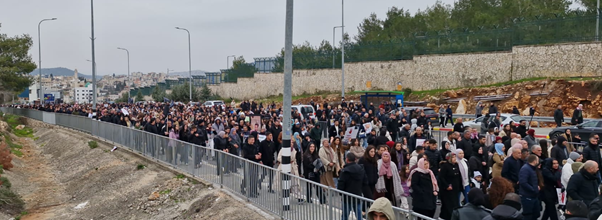
A mass mobilisation of Palestinian citizens of Israel took place on Thursday 22 January as part of a Day of Rage in protest at an all‑time record in the number of Arabs murdered amid the crisis of gun violence within the community — a crisis nurtured by policies of institutionalised crime.
The Day of Rage must not be allowed to become a one‑off “release of steam” — the struggle must continue to be built against Netanyahu’s ultra-right government of blood and for the eradication of anti‑social crime, poverty, and discrimination.
Around 50,000 women, men, young people and children marched along Sakhnin’s main road all the way to the Yuvalim junction, near the Misgav police station. According to some estimates, this was the largest demonstration by the Arab‑Palestinian public within the Green Line since 2019. A demonstration was also held in Rahat, and several additional protest vigils were organised at other locations — including a cross-national vigil initiated by members of Socialist Struggle Movement (SSM) on the Tel Aviv University campus.
Thousands in Sakhnin shouted against crime, the racist police, and the government: “Netanyahu, you despicable, Arab blood is not cheap”, “My people are free, my people have decided, crime will not pass”, and also “The people want to topple crime” – echoing the popular slogan from the revolutionary wave in the Middle East and North Africa in 2011, “The people want to topple the regime”. Some protesters also chanted: “The police are the source of the problem” and “A criminals’ police”, along with more general slogans of the struggle against the national oppression of the Palestinian people.
A team from SSM took part in the demonstration and chanting, spoke with protesters, and distributed placards with the words: “General strike! Against crime, racist police and poverty”, “Crime, massacres and repression — bring down the government of blood, the occupation, and rule of capital”.
At the time of writing, 20 Arab‑Palestinian citizens in the 1948 territories [the land that became Israel in 1948] have been murdered since the beginning of 2026 — almost one murder per day on average. This marks a further worsening of the epidemic of killings, after 252 Palestinian citizens of Israel were murdered last year — an unprecedented number, set in the midst of the war of annihilation in Gaza and the massive displacement measures in the West Bank. The dehumanisation of Palestinians does not stop at the Green Line, and combined with the economic and social crisis, it further increases bloodletting, certainly in the eyes of the police tops appointed by Ben‑Gvir.
Indictments Are Almost Never Filed Against Murderers
It is rare for indictments to be filed in homicide cases when the victims are Arab. According to data from Abraham Initiatives, the Israeli police prosecution rate in such cases for 2025 is estimated at 8%! In recent years the figure stood at around 20%, compared with roughly 65% of incidents in which the victims are Jewish. Most of the murderers are still walking free.
In Sakhnin in particular, organised‑crime gangs have long been terrorising the city’s streets through daily shootings at homes and businesses, including demands for ‘protection’ money. Many of the shooting incidents were filmed by the gangs themselves, who circulated the footage on social media in order to sow fear and increase the pressure on those who refuse to pay.
By contrast, Ben‑Gvir’s police is seen mainly during home demolitions, harassment, political persecution and the suppression of demonstrations and arrests — and it deployed a heavy presence during the Sakhnin demonstration as well. The deadly police raid in Tarabin, in the Naqab/Negev, during which police shot and killed Muhammad Hussein Tarabin al‑Sana in his home, once again illustrated its real role.
The mass demonstration in Sakhnin followed two days of strike action in the city, which began on Tuesday, 20 January, at the initiative of local business owners who launched a commercial strike, alongside a decision by the parents’ committee to shut down the education system. Sakhnin municipality initially opposed the parent committee’s decision, but quickly reversed course under public pressure and announced that it would join the strike.
The local initiative filled the vacuum left by the High Follow‑Up Committee for Arab Citizens of Israel, the leaderships of the established parties among the Arab‑Palestinian public, and the leaderships of the workers’ organisations — and it spread rapidly. On Tuesday and Wednesday a series of demonstrations and protest vigils took place across the country, and dozens of Arab municipalities announced, one after another, that they were joining the strike initiative. On Wednesday evening, under pressure from below, the countrywide Arab schools parents’ committee declared a shutdown of the entire education system in Arab localities, and the chair of the Follow‑Up Committee, Jamal Zahalka (a former Balad party leader) announced that a countrywide strike would take place on Thursday.
Strike Organising by Professionals and Other Workers
Unlike many protest strikes declared by the Follow‑Up Committee, which often amounted to a symbolic commercial shutdown and the closure of some municipal institutions and parts of the education system, Thursday’s strike included additional initiatives aimed at expanding its impact so that it would be felt beyond the Arab localities. Hundreds of doctors and pharmacists from Sakhnin — many of whom also work outside the city — organised in WhatsApp groups to strike, despite receiving no backing from the leaderships of their representative unions, and arrived at the demonstration as a bloc wearing their work uniforms.
Ibrahim Othman, a striking pharmacist from Sakhnin who took part in the demonstration, told us: “The pharmacists’ organising began yesterday. We organised in the evening, and within a few hours it was decided that we would strike. All the pharmacists working in Sakhnin and outside Sakhnin joined this protest. It started in WhatsApp groups. It came from below.” He added what he believes is needed to build the struggle: “We will shut down the entire medical sector — doctors, pharmacists, nurses… and also bus drivers, lorry drivers, we will shut down the entire economy.”
Khaled Abu‑Saleh, a doctor from Sakhnin, told the news site Arab 48 during the demonstration that the strike initiative was organised on Wednesday in a WhatsApp group that, within a few hours, more than 400 doctors from Sakhnin had joined.
Physician Du’aa Ghanayem Hamza conveyed a message to Arab medical staff in an interview with Arab 48 at the demonstration: “We make up a very large percentage of the state’s healthcare system — we have power” (20% of doctors, 27% of nurses and dentists, 49% of pharmacists). “All of us have had the same fear in recent months — whether to take action, whether I might be harmed. And unfortunately, we have experienced that fear over the past two or three years. But it’s important to remember that when we are all together, when we make collective decisions and implement them, we — the Arab medical teams — make up [a high proportion], and there are quite a few Jewish doctors who stand in solidarity with us and participate. So when a large percentage of us take part in actions, the possibility of harming us is significantly reduced. I call on people to join the strike and the additional protest steps that we will examine and announce soon.”
At the same time, lawyers, engineers, and significantly some construction workers in the city also took part in the strike — although the scale is not yet clear. Protesters blocked the entrances to Sakhnin during the day, to strengthen the strike, and according to some reports many workers stayed home and did not go to work. This dynamic, which included substantial mobilisation from below, elements of a labour strike, and strike‑enforcement pickets, recalls aspects of the “Dignity Strike” of May 2021.
The chair of the Sakhnin parents’ committee, Fadi Tarad, told SSM activists that the Afifi Group bus company, which operates the city’s public transport, also halted its services under pressure from the parents’ committee.
What Next?
After the demonstration, party representatives, the leadership of the Follow‑Up Committee, municipalities heads and political activists convened in the Sakhnin city council building to discuss the next steps. It was decided that the shutdown of the education system in Sakhnin would continue on Saturday (a school day in the city). The chair of the Follow‑Up Committee, Zahalka, proposed holding a large demonstration in Tel Aviv soon, although initially the statement issued after the meeting did not include any concrete announcements regarding the continuation of the struggle (later it was confirmed that a rally in Tel Aviv will indeed be organised on 31 January).
In the meantime, just as there was no need to wait for decisions from the High Follow‑Up Committee in order to begin building the current wave of protest, so too it is possible to continue with initiatives aimed at further developing, on the ground, the relative momentum that has been created — including as part of preparations for a major rally in Tel Aviv or Jerusalem. It is also worth recalling that in early 2021, a wave of protest in Umm al‑Fahm strengthened social solidarity and deterrence against the crime gangs, with a sharp drop in the number of shooting incidents.
During the meeting in Sakhnin, pressure was placed on the leaders of the four political parties based in the Arab‑Palestinian community within the Green Line — Hadash/al-Jabha, Ta’al, Balad and the United Arab List — by some activists and attendees in the room to commit to running together in the next election on a single list, based on the view that such unity is necessary to advance the struggle. The party leaders signed a commitment in principle to promote such a list, although it remains unclear whether they will ultimately reach agreement on running jointly.
However, the years of the Joint List’s existence in the past — and even more so the role of the United Arab List under Mansour Abbas, who joined the capitalist occupation government of Bennett–Lapid — have provided a clear warning sign against the idea of such an electoral bloc between forces from the left and the right, which in itself cannot deliver the desired results. The alignment of forces that is needed is one capable of strengthening a strategy for building a mass struggle around a left‑wing platform of radical reforms, as part of a fight to end discrimination and eradicate poverty through socialist change.
The current strike organising and the mass demonstration in Sakhnin have, on the one hand, exposed the lack of direction of the leaderships of those parties — which, generally speaking, do not advance a clear strategy for shifting the balance of forces in the struggle against the racist government of blood — and, on the other hand, have given expression to some of the pent‑up anger among a large layer of the public that is ready to fight to end the crisis and achieve real change in living conditions.
The rapid organising of workers in the healthcare system for strike action, within a short time, points to the need to apply pressure on workers’ committees and on the leaderships of the trade unions to take concrete steps and join the struggle, particularly through strike action, in an effort to succeed in shutting down key sectors of the economy in a way that disrupts “business as usual”.
Efforts to effectively expand actions that disrupt the economy will also need to be combined with continued cross‑community public explanation work, organising to broaden strike‑enforcement pickets, and, decisively, mobilising sections of organised labour so that strike action is implemented in a generalised manner, also without any dependency on the consent of employers — most of whom, sooner or later, will not willingly accept damage to their profits.
It is positive that the trade union organisation Power to the Workers and the Social Workers’ Union issued basic solidarity statements supporting the strike (even though they overlooked the dimension of national discrimination, and Power to the Workers relied on calling on employers to permit workers’ protest action). But active steps are needed to shut down workplaces with the demands to end enforced poverty, national oppression and crime. Massive pressure ‘from below’ can also push the right‑wing bureaucratic leadership of the General Histadrut trade union federation to take organisational steps — and left-wing political coalition Hadash/al-Jabha, which holds positions within the Histadrut, including the leadership of regional branches, must also apply pressure in this direction — and help harness the weight of organised labour as part of a broader struggle against the entire agenda of Netanyahu and Ben‑Gvir’s capitalist government of death, and for profound change in the daily reality of life.
✱ ✱ ✱
Arab Blood Is Not Cheap — Continue Building the Struggle
- Continue developing the struggle through a rolling plan for action and strike days, accompanied by mass protest rallies — including in the major cities — against street thuggery, against the crime gangs, and against the greatest organised crime of all: the entire agenda of the government of blood.
- Organise assemblies in workplaces, on campuses and in the community for public explanation, discussion, and decision‑making on demands and steps against police violence, crime, and gun violence.
- Plan work stoppages and student walkouts as part of preparations for a broad, cross‑community campaign, aiming to disrupt “business as usual”, including where employers do not consent.
- Demand that workers’ committees, trade unions and student unions fully mobilise — including assemblies, solidarity delegations to demonstrations, and organisational measures — to advance the struggle for personal security, equality and welfare, and for profound change in the daily reality of life.
- Promote the establishment of democratic action committees at local and countrywide levels to continue building the struggle, including strengthening strike‑day participation, and to defend the community — including through the creation of an independent community guard.
✱ ✱ ✱
Equality, Housing and Livelihood Instead of Poverty, Oppression and Displacement
- Establish an independent public commission of inquiry — with the participation of community representatives, workers’ representatives and human‑rights organisations — to conduct a public investigation into the roots of the organised‑crime and gun‑violence crisis among Palestinian citizens of Israel and its connection to government policies of discrimination and poverty, as well as to investigate the conduct of the police and the Shin Bet, including examining suspicions of cover‑ups and the granting of impunity to crime gangs.
- An end to ‘divide and rule’, to discrimination, incitement and persecution of the Arab‑Palestinian public. Repeal the “Nationality Law” and all discriminatory legislation. End the criminalisation of community organising — reverse the outlawing by Netanyahu’s government of the community‑based “Conciliation Committee”, which operated under the auspices of the High Follow‑Up Committee.
- No to a police force that serves as a governmental bludgeon against protests and entrenches discrimination and poverty. An end to discrimination in handling complaints of violence, an end to political persecution, to police assaults on communities and to the militarisation of the police. Democratic oversight of police policy and conduct, requiring accountability to elected committees representing neighbourhoods, workers’ committees, local councils and community organisations, which would also supervise weapons licensing.
- A campaign by workers’ organisations against workplace discrimination and for massive investment in avenues for earning a living – crime gangs steal young people whose future has already been stolen by the state. Large‑scale creation of socially necessary jobs at a living wage, with workers’ committees and paid vocational training, as part of a drive to eradicate poverty and youth unemployment in every municipality.
- No to cuts and the privatisation of social services. Transfer the delayed five‑year plan budget to the Arab municipalities. A needs-based increase of the “Balancing Grants” that were cut to all impoverished municipalities. Significant expansion of welfare, education and healthcare services, and the development of public transport and cultural, sports and leisure infrastructure under democratic community oversight. Funding through equitable distribution of industrial‑zone revenues and a tax on billionaires.
- Expropriate resources to combat anti‑social crime and inequality. Expropriate assets of crime gangs from all communities for public benefit. Transfer key economic resources and the banks to public ownership under democratic public oversight — ensuring equitable credit policy for working households — as part of a campaign against the cost‑of‑living crisis and poverty.
- Social housing for all instead of home demolitions. A five‑year plan to create a quarter of a million public‑housing units across communities, at a decent standard and under democratic community oversight. An end to the criminalisation of construction and to home demolitions. End the strangulation of planning in Arab municipalities. Approval of master plans and expansion of municipal boundaries. Repeal the “Kaminitz Law”, used for home demolitions. Recognition of all unrecognised villages and connection to all necessary services and infrastructure.
- An end to the displacement of residents for the benefit of real‑estate tycoons or a settlement enterprise. An end to creeping ethnic cleansing. Cancel all plans for the “Judaization” of the Naqab/Negev and the Galilee. A determined struggle against “Settling in the Hearts” projects designed to deepen national divide‑and‑rule and creeping displacement. An end to national discrimination in land allocation and settlement — dismantle the JNF and the Settlement Division. An end to land privatisation, which deepens inequality. No to admissions committees.
- An end to the war of annihilation, to the occupation and to the settlements. An end to discrimination against citizens who were not drafted into the military machine of occupation and war or into “national service”. An end to attacks on the right to existence, personal security and self‑determination of the Palestinian people. Yes to an independent, democratic, socialist Palestinian state, and to revolutionary socialist change in Israel.
- An alternative to the criminal policies that created the crime crisis, the war of annihilation and poverty. Put forward an alternative to the parties of occupation and rule of capital by advancing the building of a broad party for a struggle of working people across communities and nationalities for democratic rights and socialist change, to eradicate inequality and secure the welfare of all.
Previously published by SSM in Hebrew and Arabic.