
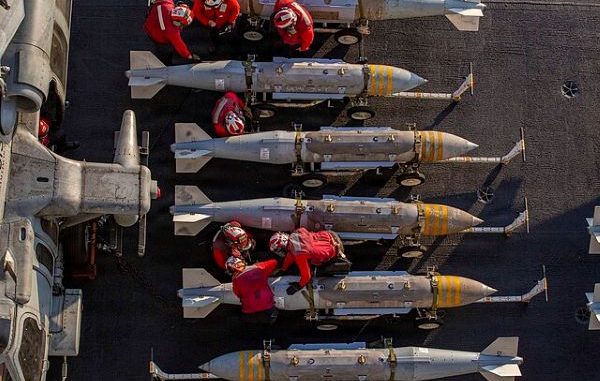
The conflict that has raged for over three weeks in the Gulf, and continues as we go to press, is the third US war in the region since the end of the Cold War more than three decades ago. Every aspect of the current conflict demonstrates the weakening of US imperialism over that period. President Donald Trump’s chaotic and reckless approach is both a reflection of the USA’s relative decline and an accelerator of it. Whatever happens from here, the consequences are certain to include a new, qualitative undermining of the power and authority of US imperialism.
The first Gulf War of the post-Stalinist era, against Saddam Hussein’s Iraq, took place in 1991 in the immediate aftermath of the implosion of the Stalinist states in Russia and Eastern Europe. Brutal totalitarian regimes, they had born no resemblance to genuine socialism but were nonetheless not capitalist and acted as a counterweight to US imperialism. When they collapsed the US was the sole world superpower, able to bend the world to its will to an unprecedented degree.
Just as at all points in US history, and that of other imperialist powers before it, all the claims of acting for ‘democracy’ and the ‘national rights of the Kuwaitis’, following the invasion of their country by Iraq, were window dressing for a war in defence of the interests of US capitalism. When, following calls to do so by president George HW Bush and with US troops over the border in Kuwait, Shia Muslims and Kurds in Iraq rose up against Saddam Hussein, they were slaughtered by the Iraqi army on a huge scale.
In contrast to today, in that war the US had United Nations (UN) backing and was at the head of a 28-country coalition. The majority of Arab regimes took part in the coalition including Saudi Arabia, the United Arab Emirates, Egypt and Syria. To ensure that was the case the US kept Israel out of the conflict. Even so it would have been unimaginable in the previous, ‘Cold War’ era. Following a huge build-up of half-a-million troops in Saudi Arabia the ground conflict was over in a hundred hours. This was US imperialism at the height of its powers.
It was in the aftermath of that war that, under pressure from the mass movement of the Palestinians in the first Intifada, US imperialism negotiated the Oslo Accords, raising widespread hopes of a Palestinian state. The collapse of Stalinism, and therefore the removal of the risk that a Palestinian state would ‘align with Moscow’, was what made that possible. But in fact this period drove home the inability of capitalism to deliver national liberation for the Palestinian people; the ‘Oslo Accords’ did not provide for a Palestinian state. At its most powerful all US imperialism delivered was fundamentally a new form of prison camp. Today it has presided over the genocidal slaughter of the Palestinians in Gaza.
The second US attack on Iraq, in 2003, was imperialist overreach. The disastrous consequences of the US’s incredible hubris in Iraq and Afghanistan were the first major blows to its power and prestige in the post-Stalinist era, quickly followed by the 2008 financial crash and subsequent Great Recession.
Militarily the US easily defeated the decaying regime of Saddam Hussein via a ‘shock and awe’ bombing campaign followed by a ground invasion of 200,000 troops. However, the US, having failed to get the support of all the major imperialist powers, blatantly by-passed the multinational institutions, like the UN, of the very ‘rules-based order’ which it had created in the aftermath of the second world war in order to defend its interests. Instead, the US conjured up a ‘coalition of the willing’ as a fig-leaf for its unchecked power, including Britain under Blair’s New Labour government which provided 45,000 troops in the initial invasion force.
While defeating the Iraqi army was easy, the subsequent eight years of occupation were anything but. President George W Bush, and the ‘neo-conservatives’ he surrounded himself with, had made no serious plans for what would happen in the vacuum left after the old regime was defeated. Well-known neo-con Paul Wolfowitz, then deputy defense secretary, glibly dismissed fears of civil war on the basis that Iraq had no history of “ethnic militias fighting each other”. An estimated 600,000 Iraqi civilians perished during the occupation and terrible sectarian conflict that followed, along with nearly 5,000 US and British troops. The disaster of the occupations of Iraq and Afghanistan were also burned into the consciousness of the US working class, which Trump leant on with his election promises of no more ‘foreign adventures’.
Tragedy and farce
But if George W Bush’s Gulf War was a tragedy for US imperialism and above all the Iraqi people, Trump’s is a farce. A bloody farce that has already led to death and huge destruction. Even if it was to end tomorrow it would have serious consequences for Trump’s presidency, US imperialism, the Middle East, the world economy, and world relations.
In this conflict even the capitalist Labour government of Britain, historically since the loss of its empire the most slavishly pro-Atlanticist of all the European countries, has not simply asked ‘how high?’ when Trump said jump. Britain’s right-wing capitalist opposition parties, the Conservatives and Reform, initially tried to compete to show they were the most enthusiastic about jumping off a cliff if Trump asked them to, but then retreated to an essentially identical position to Starmer. In part this reflects the high level of public opposition to the war in Britain, but it also indicates that British capitalism, like the other European capitalist powers, no longer sees unconditional support for US imperialism as in its best interests. The multipolar character of the world will be written far larger after this war and will not be fundamentally reversed when Trump is gone from the White House.
Nonetheless, in a sense, the current war is a direct consequence of 2003. In 1980 the then new Islamic Republic had been attacked by Iraq, with US support, leading to a devastating eight-year war in which a million died. One unintended consequence of the overthrow of Saddam Hussein – whose Sunni regime ruled over a Shia majority country – was the qualitative strengthening of Iran as a regional power, leading a ‘Shia Crescent’ that contains the majority of Middle East oil and gas reserves. How to deal with that situation, and especially the prospect of the Islamic Republic developing nuclear weapons, has been a serious concern for the world’s imperialist powers, and for Israel, ever since. Reckless as Trump’s warmongering is, it has a logic from the view point of the US ruling class.
Sanctions against Iran have been in place since the 1990s. In 2015, in return for easing some of them, Barack Obama’s presidency agreed the Joint Comprehensive Plan of Action (JCPOA), which also involved China, Russia and the European Union. Iran agreed to dismantle a nuclear reactor and limit uranium production. Trump withdrew the US from JCPOA in his first term, in 2018, rendering the agreement effectively void. In that sense the current war is no surprise. Having abandoned the attempt to contain Iran via diplomatic agreements, attempting to curb or crush it militarily was clearly on US imperialism’s agenda.
In part, Obama’s approach reflected an attempt to ‘pivot to Asia’ and away from the Middle East. This has been a mantra of all US presidents ever since. But while today US imperialism, now a net exporter of oil, is no longer so reliant on Middle Eastern oil and gas as it once was, the region nonetheless retains huge economic and geopolitical importance. Much as it might tempt the strategists of US imperialism to do so, they cannot just ignore the inevitable turmoil that has ultimately been created by imperialism’s brutal oppression of the region for well over a century.
The Gulf is also an important front in the US competition with China. Over the last five years China, via the Belt and Road Initiative (BRI), has prioritised the Middle East and North Africa. The Iran-China ‘Comprehensive Strategic Partnership Agreement’ was in 2023 estimated to make up 10% of China’s BRI spending, in order to build a new port and oil terminal south of the Straits of Hormuz. Weakening or defeating the Islamic Republic would obviously cut across that, damaging China which is far more reliant on Middle Eastern oil than the US.
From October 2023 until the start of this latest war, Israel, aided by arms from the US and other Western powers, had already weakened Iran and therefore altered the regional balance of power in Israel’s favour. In addition to the genocidal slaughter of the Palestinians, Israel had severely damaged the Shia Hezbollah militia in Lebanon. The June 2025 US and Israeli blitzkrieg air assault on Iran destroyed much of its bombing capacity, including two-thirds of its missile launchers. Prior to that, the overthrow of Assad in Syria further undermined the ‘Shia crescent’.
Israeli prime minister Netanyahu saw an opportunity to take a further step in reconfiguring the region in Israel’s interests, ‘finishing the job’ both in Iran and also Southern Lebanon, where to date over a thousand have been killed in the current conflict. Undoubtedly, his timing was in part motivated by the hope of improving his own chances of re-election. Currently the war has the support of a significant majority of the Israeli population, vainly hoping that it would ensure safety from future attacks. It is also backed by wide sections of the Israeli capitalist class, including those hostile to Netanyahu, although this could change if he attempts to continue when the US calls a halt. But as yet it has not improved the poll ratings of Netanyahu’s Likud party significantly.
Israel, in fact, is the only country in the world where this war has majority support in opinion polls. Even in the first days of the war, when support is normally at its peak, only 26% of Americans backed it, an unprecedented low in the first week of a conflict started by the US. When troops went into Iraq in March 2003 opinion polls showed 72% support in the US.
The timing of the war was probably also related to Trump’s desire to distract from his mounting problems at home. Not for nothing have parts of the MAGA movement renamed ‘Operation Epic Fury’ as ‘Operation Epstein Fury’. However, far from making domestic problems more manageable, this war is going to enormously add to them for Trump.
Differences between Trump and Netanyahu
But the US administration and Netanyahu’s approach to the war are not identical. Trump seems to have been drunk on his perceived success in Venezuela, and imagined that he could pull off a variant of the same trick by using brute force to bludgeon a section of the Iranian regime to do the US bidding. Perhaps he also thought that the Islamic Republic would implode. But no regime in history has been overthrown by air power alone. George W Bush’s administration was staggeringly shortsighted, not thinking beyond the day in May 2003 when he declared “mission accomplished”, but it did recognise that a major ground invasion, prepared via a four-month long build of troops, was necessary before the war began.
Under Trump, in contrast, the preparation was for an air campaign alone. That has demonstrated the still huge fire power of US imperialism, which remains the strongest military force on the planet, responsible for about 40% of global arms expenditure. Together with the Israeli Defence Force the bombing campaign quickly succeeded in destroying Iran’s remaining aerial defences. They did so with no losses. All of the few US military personnel who have died so far have lost their lives as a result of accidents rather than enemy fire.
The bombing of Iran is the most intensive opening air campaign in modern history, costing $11.3 billion in its first six days alone, and eclipsing the bombing of Libya in 2011 or even the ‘shock and awe’ that began the invasion of Iraq in 2003. It has seriously depleted Iran’s stockpiles of weapons and caused huge damage to the country. More than 3,000 Iranians have been killed so far and, according to the Red Crescent, more than 67,000 civilian buildings have been damaged or destroyed.
But the Islamic Republic did not respond by coming crawling to do a deal with Trump. Nor has it imploded. Instead it has fought fire with fire – in the form of drones and missiles hitting targets across the region. When Israel escalated the war by hitting South Pars, the Iranian part of the world’s biggest natural gas field, Iran responded in kind by hitting the Qatari part of the same field, damaging the gas facility at Ras Laffan, instantly reducing its export capacity by 17%.
It is not clear how many viable missiles and drones the Islamic Republic still has, but at this stage it appears able to continue its counter-barrage, including unsuccessfully firing two intercontinental missiles at the US/UK Diego Garcia airbase in the Indian Ocean. At the same time stocks of the interceptor missiles used by Israel and the Gulf states to block the majority of Iranian attacks are reported to be running low.
Economic shockwaves
Crucially, at this point Iran continues to threaten any ships passing through the Straits of Hormuz, the primary export route for oil and natural gas produced by Saudi Arabia, the UAE, Kuwait, Qatar, Iraq, Bahrain and Iran, as well as for other vital commodities. Traffic through the straits has virtually ground to a halt. The exception are Iranian exports. Around 90% of Iranian oil goes to China. That does not mean China is unaffected by this crisis. It is the largest single importer of oil through the Straits, receiving almost 40% of the crude which goes via that route, of which only around a fifth comes from Iran.
China, however, has done far more than the US to prepare for a global energy shock, including far greater oil and gas reserves, and more developed solar and wind production. By contrast, US oil reserves had not been fully replenished since the energy shock at the start of the Ukraine war in 2022. The US contribution to the International Energy Agency’s biggest ever emergency release, announced on 11 March, leaves the US reserve at below its legal minimum.
At the time of writing oil prices have more than doubled, effecting the entire world. Asia is particularly hard hit because 80% of oil and oil-related products traversing the Strait are headed there. The governments of Sri Lanka, Bangladesh, Thailand and the Philippines are among those that have taken emergency measures to conserve fuel including a four-day week and school and college closures.
The war is causing panic in the markets, increasing the inflationary trends in the economy, and putting pressure on government debt markets. The cost of UK government borrowing has hit its highest level since 2008. And it is even now hitting the pockets of the working class in the West. In the US forecourt petrol prices have so far increased by around a third. If the war ends quickly its consequences could still trigger a global recession. The more it drags on the greater the economic consequences will be.
The pressure is mounting on Trump and the US regime to find a way to bring the war to an end. Much easier said than done, however. Always happy to fly in the face of reality, there is no doubt Trump is weighing up just declaring a US ‘victory’, just as he claimed to have destroyed Iran’s nuclear potential in June last year, in another example of the ‘Trump Always Chickens Out’ (TACO) tendency not to carry through on his threats. But it takes two to TACO in a war! The Islamic Republic has declared it will decide when there is a ceasefire, and even Trump can’t claim victory if Iran is still firing missiles and blocking the Straits of Hormuz.
If a ceasefire is achieved Trump would undoubtedly trumpet it as a glorious triumph. However, as long as the Iranian regime is still in power and capable of blocking the Straits, and still has 400kg of enriched uranium, the very last thing the war could credibly have claimed to have achieved would be to have removed the ‘threat of Iran’. For the Arab regimes in the Gulf, which would like to see the Islamic Republic weakened or removed but cautioned against this war because they could see the likely consequences, the prospects of it finishing with the Iranian regime weakened but still in power, and enraged, is not a comfortable prospect. Even less so for the Israeli ruling class.
Therefore, there is also pressure on Trump to ‘solve’ these problems before trying to declare a ceasefire. However, all his threats and ravings have not conjured up any solution. Options he has threatened at different points are all extremely high risk, including hitting major Iranian power plants and sending ground troops to capture Kharg Island, the small island which is the main terminal for almost all Iran’s oil exports, as a bargaining chip.
Islamic Republic’s battle for survival
The Iranian regime, meanwhile, is in a battle for survival. Over the last three years, until this war, it had carefully limited its response to Israel and US attacks in order to try and prevent escalation. This time, however, it is obvious that the only chance of stopping the assault – and putting the US off restarting it at a later date – is to cause serious disruption to the world economy.
The theocratic dictatorship also understands that while US and Israeli bombs rain down on Iran it is far less likely that they will face a new domestic revolt. Both Trump and Netanyahu have had to moderate their rhetorical calls on the Iranian masses to rise up and overthrow their government, tacitly accepting that their bombing campaign has cut across the prospects for that, at least while it lasts.
Even Western media reports have included numerous interviews with opponents of the regime calling on the US and Israel to stop the bombing. Under its impact the cities have emptied. The population is inevitably focused on the battle for survival. The regime has announced a ‘shoot to kill’ policy on anyone who dares to protest on the grounds that they would be collaborating with the foreign aggressor. In these circumstances there is bound to be support for this among wider layers of the population than those who would normally support the regime.
The regime’s prestige, having managed to inflict some damage on the world’s strongest military power, may even have recovered somewhat among sections of the Iranian population. Certainly, that will be true for layers of the working class and poor worldwide, especially in the neo-colonial world, who are rightly glad if they see US power checked, understanding that will increase the confidence of future mass struggles against imperialism and its proxies. But for Marxists opposing US imperialism does not mean giving any support to the theocratic dictatorship in Iran, but rather to the Iranian working class and poor, in their struggle against both imperialist bombs and their own regime.
Fundamentally, however, the battering the Islamic Republic has taken will further undermine an already very weak regime, with an increasingly shallow social base. True it still has some support, and its state apparatus has, up until now, remained intact, but it is increasingly enfeebled. One Iranian government poll leaked to the BBC, for example, showed support for a separation of religion and state had jumped from 31% in 2015 to 73% in 2024.
Ultimately, at the root of the increasing fragility of the regime’s social base is growing economic hardship. The official annual inflation rate last year – as in the previous five years – was 40%, with food prices rising 66%. This was an important factor in the heroic mass movement that shook Iran at the start of this year, following on the heels of previous mass protests in 2022 and 2023. The most recent movement had been cut across by savage repression, with more than 36,000 protesters killed by the regime. Prior to the war, however, the movement did not appear fundamentally defeated, as indicated by the funerals of those killed having the character of protests and the second wave of demonstrations on university campuses. In the last national elections in March 2024, turnout was only 41%, the lowest since 1979, with many voters consciously boycotting in protest at the regime’s complete control of who could stand as a candidate. In the aftermath of this war the implosion or overthrow of the Iranian regime is certainly on the agenda.
It is unknowable what would follow, other than that the prospects of a stable client regime for US imperialism are nil! Nor will there be the prospect of any type of alternative regime for Iranian capitalism that will be stable, although for as long as capitalism exists in that country there will inevitably be attempts by pro-capitalist leaders to create governments that will try to hold the country together and maintain capitalist ‘order’. Nevertheless, sectarian conflict, potentially on a scale that would put the nightmare of Iraq into the shade, is a serious possibility. The population, at around 90 million, is double that of Iraq and includes substantial minority ethnic populations, mainly based in the outer areas of Iran. The breakup of the country, with different capitalist elements within and outside Iran struggling for control, could not be ruled out. For the Sunni Arab dictatorships of the Gulf states this scenario is a nightmare.
But there is an even bigger nightmare they could face. Iran is also a country with a numerically powerful working class – with over a million auto-manufacturing workers for example producing more cars than Britain – a young, urban-based population, and a record of mass movements, and revolutions.
The 1979 uprising which overthrew the Shah’s dictatorship ended with a counter-revolution led by reactionary clerics. They suppressed democratic rights and independent workers’ organisations. They were aided by the false policies of many on the left, including the significantly sized Stalinist Tudeh Party, which allied uncritically with the emerging Islamic regime as ‘anti-imperialists’ until they, in turn, were suppressed.
Discussing the lessons of that period will be important for the future. So will the lessons of other past revolutionary movements. Wars have often been the midwife of revolutions. The 1905 Russian revolution, the dress rehearsal for 1917, took place in the aftermath of Russia being badly defeated in a war. The working class in Russia in 1905 was far weaker than in Iran today, comprising just 10% of the population, but it took the lead. It is inevitable that consciousness is mixed in Iran today, with a minority of the movement against the regime even looking towards a return of the Shah’s son. But it was also mixed in 1905, with Father Gapon leading a mass procession to petition the Tsar.
The existing order is being undermined
Already the war is further undermining capitalism and its institutions in every country that has been touched by it, perhaps above all in the US itself. Like in Britain only small numbers have taken to the streets against the war but this does not alter one iota that a big majority oppose it, and will blame Trump for its impact on their living standards, fuelling the growing general opposition to Trump.
Israel will also not escape the consequences of the war, although it will probably take longer. It is a society where deep class divisions exist – as they do in every capitalist society – and have been clearly present in recent years, reflected in the many workplace struggles, including general strikes. For the Israeli elite the war is about regional dominance; for the majority of the working-class support for it is premised on the false hope it will bring security and peace, but there is no prospect of that on a capitalist basis. The need for the working class to begin playing an independent role in opposition to the brutal warmongering Israeli capitalist class will be increasingly clearly posed.
The already unpopular regimes in the Gulf states will also be further weakened by these events. Most have had some damage to their energy-producing infrastructure. Their status as safe havens for Western companies and the billionaires that own them has already been undermined. Most importantly, the prospects for new uprisings by the Arab masses will have increased. For the Arab rulers the dangers of being seen by the masses as being linked to the US, not least by allowing military bases, has increased, but so too has the necessity of relying on US military back up. The mass protests which erupted in Shia-majority Bahrain in defiance of the repressive Sunni Muslim monarchy are a foretaste of what could come.
Over the last three years the Arab masses have not stepped decisively onto the scene, although the slaughter in Gaza has fuelled a burning anger. Fifteen years ago, however, the Arab Spring gave a glimpse of the potential power of the masses of the Middle East to build a new world. The Arab regimes were terrified and forced to temporarily grant huge concessions in the face of the uprisings. In March 2011, for example, total fuel subsidies to the populations of the Arab countries almost doubled to $300 billion, 7.5% of GDP. In Egypt bread prices were kept at a few cents a loaf, while Kuwait offered free food for 14 months.
Ultimately, those revolutionary movements were defeated because the working class of the different countries lacked their own parties with a programme for the socialist transformation of society. Unlike in the Cold War era there are today no mass Stalinist parties, like the Tudeh Party whose false policies misled the heroic Iranian masses, and its equivalents in Iraq, Sudan and other countries. Instead, the working classes lack mass parties of any kind. In the Arab Spring that meant that, while the working class was at the forefront of the movement, it was not decisively leading it with its own mass organisations and parties, able to overcome sectarian divisions, at least partially, and point a way forward for the workers and poor masses.
However, when – back in 1991 surveying the results of Operation Desert Storm – US imperialism imagined that the collapse of ‘communism’ would allow it absolute free rein, it was making a fundamental mistake. Yes, capitalism was given a temporary lease of life, but it was utterly incapable of bringing peace, prosperity and democracy to the world as its propagandists promised. The rotten character of twenty-first century capitalism, which is resulting in increasing chaos, war and turmoil, means that new revolutionary movements are inevitably going to erupt. Learning the lessons of the past, and building the kind of parties that are needed, based on the independence of the working class and with a programme for the socialist transformation of the Middle East and the world, is the key task for the stormy future that is developing before our eyes.