
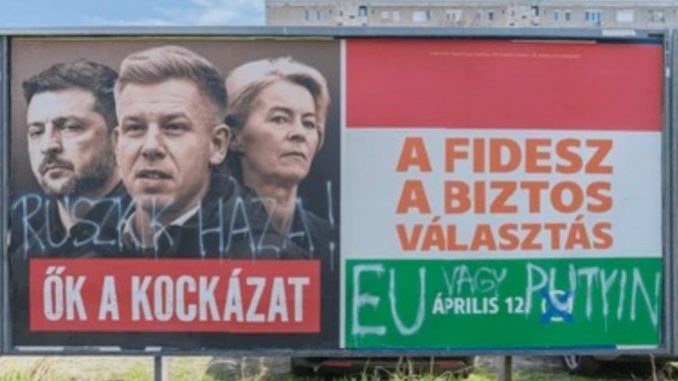
Hungarian Prime Minister Victor Orbán, a pioneer of modern right-wing populism, faces crisis after the upcoming elections on 12 April. The long rule of Fidesz (Alliance of Young Democrats) has been challenged by Magyar Péter and his Tisza (Respect and Freedom) party.
Opinion polls put Tisza in the lead, although gerrymandered election constituencies, a voting system changed to favour Fidesz and some improving living standards in recent months mean the outcome could be close.
Mainstream media in the EU and beyond has tried to paint Orbán’s government as little more than ‘yes-men’ for Putin’s regime. But recently both the Romanian president, Nicușor Dan, and Orbán have been sucking-up to Trump, despite their opposite positions on relations with the Russian government. US Vice-President, JD Vance, has just visited Hungary to boost Orbán’s electoral results.
A long-term strategy of the Hungarian bourgeoisie has been to balance between its dependency on Russian gas and its commitment to NATO imperialism. However, with cracks within NATO increasingly obvious, some of the capitalist class want to curb relations with Russia, keeping a position where they could engage with both sides of an eventual NATO divorce.
In a context of the expansion of EU and global markets, Orbán’s government sought to balance between different regional and global players. He signed a 12-point accord with Russia last December, giving Russian companies more access to the Hungarian market.
Meanwhile Magyar Péter has built his campaign on a heavy anti-Russian platform. Whatever the outcome of the elections might be, it will reshape the political landscape in the country, as the threat of ultra-nationalism continues to rise in the background.
The Rise and Current Crisis of ‘Orbánism’
The coming to power of Fidesz between 1998 and 2004, and again in 2010, was heavily influenced by the anti-‘communist’ mood at the time. Hungary, like other Eastern European states after the Second World War, had been ruled by a corrupt bureaucratic elite resting on state-ownership of much of the economy. This mirrored the Stalinist regime of the Soviet Union. Although there were gains from the abolition of capitalism, these were distorted with workers’ democracy crushed.
When these regimes collapsed in 1989/90 the dream of living “like in the West” wasn’t delivered. Former Stalinist bureaucrats turned themselves into weak capitalist classes which ruled by chipping away at democracy. All manner of bourgeois forces blamed this on “the legacy of communism”. Orbán joined the wave of Eastern European “anti-corruption” politics.
In 2006 the mis-named “Hungarian Socialist Party” (MSZP) was in power, having already faced significant protests against its austerity measures. Anti-corruption protests started, eventually leading to Orbán’s victory in 2010. The anti-corruption protests started after a private speech of the MSZP prime minister at the time (the “Őszöd speech”) got leaked. In it, using vulgar language, he admitted that the MSZP misled the public in order to win the elections that April. Today Fidesz is itself overwhelmingly associated with corruption! Billions of dollars of infrastructure contracts have gone to companies owned by Istvan Tiborcz, Orban’s son-in-law, and Lorinc Meszaros, a childhood friend. Last year 75% of single-bid government contracts went to companies associated with Fidesz. The EU has frozen more than €16bn from its post-covid recovery fund and development scheme for poorer regions, citing Hungary’s corruption.
The unwillingness of Orbán’s government to enforce EU sanctions on Russia has led to a sort of stand-off with Brussels. This has meant repeated threats by the EU oligarchy to suspend Hungary’s voting rights within EU structures. Despite its thin veneer of care about ‘liberal values’, the EU cares primarily about a monopoly on Hungary’s markets. This has been shown in the friendliness of Brussels towards Modi’s regime in India, who has similar politics to Orbán.
Like many other small countries, the ruling class in Hungary is forced to pick a side between these regional and imperialist powers. The dependency on gas from Russia has led to a difference between Budapest and Brussels regarding the war in Ukraine. This is also due to clashes between Ukraine and Hungary regarding the status of the Hungarian populations in the western Kárpátalja region. In May last year, Kiev accused the Hungarian government of running spying operations in Ukraine. Hungary then expelled two embassy workers, accusing them in turn of spying under diplomatic cover. Recently, the Hungarian government accused the Ukrainian side of sabotaging the Druzhba gas pipeline between the two countries.
Clashing with either Brussels or Kiev served Orbán for a while as a source of support. His government has repeatedly said, “Zelensky/Ursula [von der Leyen] is stealing your money”. However, after four years of the same message, the working class seems to be growing weary of it. This might increase support for Magyar Péter, seen as friendlier towards the EU, especially among youth.
Transylvanians living along the border recall the times they used to go into Hungary for cheaper groceries. Now it’s the other way around! Hungarian inflation was higher than most of Europe until recently. However, it fell to 2.1% in January. After changes in tax allowances and an 11% rise in the minimum wage, the net median wage was 12.5% higher than a year ago.
Hungary has seen some big struggles by the working class under Orbán’s long rule, including strikes by teachers and Budapest taxi drivers. The 2025 Pride parade became a symbol of revolt, gathering people around common opposition to the Fidesz regime. Despite being banned, up to 200,000 people participated in one of the biggest queer liberation events in Eastern Europe.
After sixteen years, Fidesz has managed to get rooted into all branches of the state. National TV networks are loyal to the party, spreading Orbán’s ‘good’ word all over Hungary, Székelyföld (the Hungarian-speaking area in Romania) and beyond. The judiciary and police are under their rule. Even the previous election system was changed to give Fidesz an advantage. Besides re-drawing electoral districts, there’s now only one round of elections, advantaging the biggest party. Hungarian-speaking minorities in neighbouring countries have been given the vote.
Tisza – How it sprung up and where will it flow?
This situation also means the Fidesz clique thinks it can act without fear of consequences in almost any aspect of life. Magyar Péter’s rise began after a scandal three years ago. Child sexual abuse in an orphanage was covered up at government level. Outraged people took to the streets, leading to ministerial resignations. Magyar Péter, a long-term Fidesz official, left the party. Riding on this wave of rage, he quickly rose in popularity with the tens of thousands of protesters. He then announced his campaign for prime minister as part of an existing smaller party, Tisza (also the name of a river).
Thus, in a very short time, the biggest threat to Orbán’s long rule materialised seemingly out of nowhere. The broad range of people supporting the Magyar Péter campaign are rightfully demanding change. Opinion polls show he has a big lead among under-30 year olds. The Fidesz regime has brought little more than poverty while public services are crumbling. By most measures, health care is the worst in Europe. Many Tisza supporters are fed-up with being lied to by the pro-Fidesz media while the elite gets richer off their backs. Any dissent against this, be it from opposition parties or smaller radical and workers’ groups, the media attempt to silence.
This is true, however, for any regime which serves the interests of the rich, even those claiming to be democratic. Switching the rhetoric from anti-EU to anti-Russia is an attempt to side-line the genuine wish for change coming from below. What is needed is a mass workers’ movement aimed at taking power from the ruling class and into the hands of the many.
Magyar Péter is campaigning under the slogan: “Not right-wing, not left-wing, just Magyar (Hungarian)”. In an attempt to outdo Orbán on anti-immigration rhetoric, Tisza promises they’ll “preserve peace and remain a safe country free of immigrants.” They go out of their way to present Orbán as a traitor who is giving the jobs to “illegal immigrants”, denouncing the Fidesz policy of accepting guest workers, and using migration to scapegoat all manner of social problems. Tisza goes as far as baselessly claiming “immigrants drive up housing prices by 25-35 per cent”.
Tisza joined the European People’s Party grouping in the European Parliament, the grouping Fidesz was part of until 2021. Péter is backed by a layer of the same elites behind Fidesz, the national bourgeoisie in Hungary. Orbán tries to tell the Hungarian masses the ruling class is not their enemy, but in fact an ally in the struggle against Brussels. Magyar Péter will try to present the same capitalist class as an ally against Fidesz, which he labelled as “Russian” in a chauvinist manner reminiscent of Romanian state propaganda. The aim of the pro-capitalist leaders of his movement is for the rich to rule society in a more orderly fashion.
Magyar Péter’s plan to fight corruption using the judiciary will run up against its loyalty to Fidesz, which appointed many of its members. While most of his voter base would hope he will lead a fight to ‘take back’ the judiciary, surgically removing Orbánism from the Hungarian capitalist state machine would leave it divided, and no-one from Tisza and the ruling class they represent wants that.
Magyar Péter writes: “Tisza represents everyone: right-wing, left-wing, bourgeois, liberals, social democrats, greens, and national-radicals”. Notably, the working class is missing from the list, but Hungarian nationalists are included. This was proven in a striking way recently, as it was revealed that Zsolt Tárkányi, the press director of Tisza, performed the nazi salute as part of an ultras gang at a football game. Magyar Péter tried to run cover for him, calling the gesture mere “waving”. This shows Tisza holding the door open for forces much more hostile to the workers’ unity.
The other opposition parties
The lack of a genuine working class political alternative leads to other forces filling the void. There are political forces more willing to use fascistic methods. A growing number of people dissatisfied with Fidesz and seeing no future in Tisza, are looking towards “Mi Hazánk Mazgalom” (MHM, “Our Homeland Movement”).
MHM appeared in 2018 as a rightward split of the far-right Jobbik party. At the time of writing, they are around 6% in opinion polls. They talk about limiting free speech by declaring “antifa” a “terrorist” organisation, as US president Donald Trump has done in the USA. The banning of the Pride parade was also clearly inspired by MHM.
It promises to use all means to pressure neighbouring countries to allow autonomy in Hungarian majority regions. Places like Székelyföld saw no progress in the past 30 years of Orbán in regards to autonomy, while attacks against the learning and use of language in Slovakia and Ukraine have remained or even gotten worse. To Hungarians outside the current borders MHM might sound appealing. But their backward ideas, like calling mixed marriages the “greatest ethnic difficulty”, can’t advance the struggle that’s needed. In places like Marosvásárhely, the capital of Székelyföld, with significant mixing between all manner of Romanian and Hungarian groups, sowing division by narrowing the definition of “Hungarian” would work directly in the favour of the Romanian state.
Despite the fact the Tisza-Fidesz duo currently have most electoral support, it is possible that now or down the line, we could see a rise in popularity of MHM in Székelyföld. But they have no plan to change the status-quo regarding “economic aid” to the region. The bourgeoisie of Hungary will not simply aid the Székelyföldi bourgeoisie without seeking something in return.
The struggle for national liberation requires class solidarity, no matter their ethnicity. That is something Mi Hazánk is trying to destroy with divisive anti-Roma policies. While Mi Hazánk promises radical change, they defend the system by attacking any possibility of the working class taking power from the capitalists.
2025 Pride was the biggest in the history of Hungary, gathering working class people of all sexualities and genders in a common struggle against the Fidesz rule and other attempts to further limit democratic rights. The real balance of forces was shown then. Such a united movement, and mass mobilisation in general, is what held Orbán and people to the right of him at bay so far.
In such a political environment it’s difficult for the radical youth, with all of their potential political confusions to find a way to bring the struggle forward. The Magyar Kétfarkú Kutya Párt (MKKP, “Hungarian Two-Tailed Dog Party”) registered in 2014, running on a political satire platform while mobilising volunteers to make street art projects to “fight” the establishment. With no alternative supporting a struggle for “the 99%” the MKKP has moved over time in that direction. They announced on Facebook, “The MKKP started out as a joke party, but now we are preparing with professional solutions for real life situations.” This time instead of free beer or lower gravity, they put forward a series of serious social demands, such as a progressive income tax, extending unemployment benefit from 3 to 9 months, and higher wages and longer vacations in the education sector.
If MKKP makes it to parliament, they will be a “thorn in the side” of the establishment. However, without a programme aimed at the working class masses, they will have limited effect.
What comes next?
Both Tisza and Fidesz register similar numbers in the polls, but the influence of Orbán’s party over the judiciary ensures its continued influence over politics, even if they lose the election. If Magyar Péter wins, it remains to be seen how much he’ll deliver to the national bourgeoisie of Hungary and how much to EU institutions and corporations. What is certain, however, is that Tisza will have a hard time governing, marked by constant struggle with institutions Fidesz will retain power over.
If Magyar Péter’s government will want to push for austerity, join any imperialist NATO endeavour or any actions that would enrage the working class, Fidesz might again become attractive to some layers. We have seen this in Poland, another country with a long-lasting right wing populist party, where PiS, the Law & Justice party, won the presidency after losing the government two years earlier in favour of the liberal “Civic Platform”. This party and its leader Donald Tusk, managed to alienate the masses in just two years by pushing for a war-mongering policy in relation to Russia and a pro-corporation economic policy.
In reality, such an outcome foreshadows a two-party system taking form in Hungary, with third parties such as Mi Hazánk or maybe even MKKP. Against the dissatisfaction with traditional politics, even in this special Hungarian context, the extra-right wing populist illusions of Mi Hazánk might temporarily gain traction among a disillusioned layer of the working class. However, they in turn will also be unable to solve the problems of the capitalist system, doing nothing but dividing the workers so that it remains in place.
What is the way forward? We argue all over the world for strong working class parties, understanding of the need for fundamental system change. Democratically controlled by the organised working class from the workplace, these parties need to stand on an independent working class basis and the greatest class unity, irrespective of gender, sexual orientation or ethnicity. With such a power it could fight not only for higher wages, but pensions, scholarships, a higher standard of living and all that is in the interest of the working class, in other words armed with a socialist programme.
Such a party is needed in Hungary to struggle against the oligarchy, national and European. Knowing that decisions taken outside affect the workers inside Hungary, we understand the need for this party to have an international outlook, fighting against the national and class oppression of the Hungarian speaking people outside of the border. Furthermore, it must reject all imperialist blocks for a democratic worker’s world free from hunger and war, with national liberation for all.