
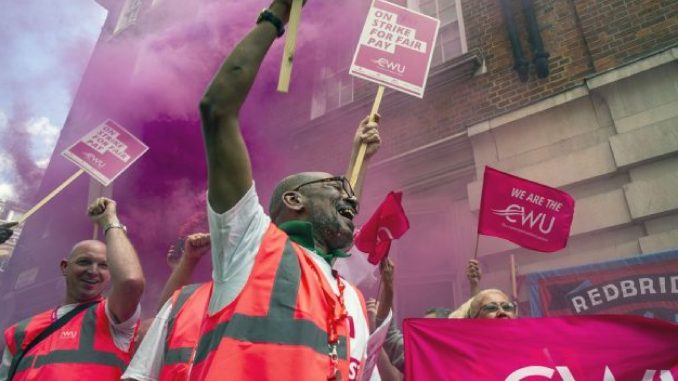
The Socialist Party, the England & Wales section of the CWI, organises caucuses of party members in most British trade unions. CWI trade unionists work as part of ‘broad left’ organisations wherever possible, collaborating with other lefts and militants to build the trade unions as fighting, democratic, organisations for the class struggle against the bosses and capitalist governments.
Below are four reports on our trade union work in Britain which has taken important steps forward in recent months as the crisis of the Starmer-government and British capitalism deepens and workers look for the best ideas, programme and leaders to fight back.
Big Win for Left in PCS Leadership Elections
by Socialist Party members in PCS
The left ‘Coalition for Change’ in the Public and Commercial Services (PCS) union executive election has achieved a stunning 21:14 victory, including president and deputy president, standing on a fighting democratic programme. The PCS organises civil servants.
The coalition includes supporters of the PCS Broad Left Network, in which Socialist Party members participate. Six Socialist Party members have been elected to the new NEC, including deputy president Dave Semple.
On the same day as the PCS results were announced, Starmer’s Labour [Keir Starmer, British prime minister, and the ruling Labour Party – editor] was humiliated in local elections – hammered due to its continuation of austerity and its attacks on the working class, that previous Conservative governments (the Tories) had implemented since 2010.
Public services and the infrastructure continue to crumble; the Tory anti-trade union laws remain in place; and with the war in the Middle East, prices are beginning to rise faster and faster while wages stagnate. For the majority of workers the central issue in the period ahead will be the new cost-of-living crisis and how to make ends meet.
Left Unity Refusal to Challenge Starmer
The defeat of the Left Unity-led leadership in the NEC elections is in large part due to its refusal to put up even the most modest of challenges to the Starmer government and its austerity measures.
They refused to implement 2025 Annual Delegate Conference (ADC) motion A383, in which conference demanded a serious national campaign on pay, pensions, cuts and working conditions. They instructed bargaining groups to negotiate within the government’s 2025-26 pay limits. In the face of historic civil service job cuts to the tune of tens of thousands, they failed to launch a national campaign to defend jobs and services. They have paid the price!
This is the backdrop to 2026 ADC. Instead of covering for Starmer’s Labour government, the new NEC will now need to mount a fight in the interests of members. We call upon delegates to vote for motion A5, which sets out the Broad Left Network programme for a serious national campaign – though it is possible this will be updated by emergency motions submitted before conference meets.
Political Strategy
Conference motion A4 from the outgoing NEC on political strategy needs to be opposed. Its commentary on Labour’s austerity programme is incredibly weak. Lots of warm words and meetings with Cabinet officials don’t amount to a political strategy – all the threats to our members remain in place.
PCS already has a stronger political strategy, which includes a commitment to supporting candidates aligned to our union policies. Following the electoral humiliation of Labour on 7 May, PCS should be actively promoting this policy. PCS should take the lead in calling a trade union conference to discuss the crisis of working-class political representation, at which the Socialist Party will raise the need for a new workers’ party with a socialist programme.
While the incoming NEC has committed to a serious fight, PCS general secretary Fran Heathcote remains in place and is part of the now-ousted Left Unity grouping.
There was a left coalition majority on the NEC from 2024 to 2025, but Left Unity also maintained the president’s position at that stage. Martin Cavanagh abused presidential powers to prevent the left majority implementing its programme for change.
Who Controls the Union
Cavanagh has now been defeated. However, ‘who controls the union’ will be a major theme running through many of the conference debates. Power under Left Unity has increasingly been concentrated in the hands of the leadership, which has resisted attempts to bring it to account. Despite instructions from previous conferences, the Left Unity leadership continued to falsely cite GDPR issues to restrict reps’ access to membership details. In reality, it was all about Left Unity maintaining control.
The outrageous abuse of presidential powers by Cavanagh, the outgoing president, demonstrates the need for rule changes. The two rule amendments in motions A15 and A19 substitute an NEC simple majority instead of the current two-thirds majority to overturn a presidential ruling. They must be supported.
Union disciplinary rules have a history of being used to suppress dissent, usually against the left. The incidence of such cases appears to have increased under Left Unity’s leadership. Motion A70 makes the disciplinary process clearer and more transparent. It should be supported.
Again this year many Trans+ motions, and other motions which ask who controls the union, have been axed from the agenda. Conference must support a reference back to hear a motion to amend Rule 6.22(g) which is currently being misused and abused.
Fight division
This is a period of upheaval worldwide: of war, racism, climate change and austerity. Labour’s pro-capitalist government does not start from the standpoint of what is needed for working-class communities. Its betrayals fuel the rise of the right-populist Reform party and runs the risk of increased racism and division.
It is vital that the unions put themselves at the head of the movement against this ‘divide and rule’, which weakens the workers’ movement in the interests of the fat-cat bosses. The Labour government’s answer has been to follow Reform into the political gutter by stepping up their anti-migrant rhetoric and policies.
The trade union movement, with over 6.5 million workers across all communities, must lead the fight against Farage and the far right on the slogan passed by TUC Congress in 2018 – Jobs, Homes, Not Racism – alongside a massive programme of socialist public ownership of utilities.
Delegates to ADC this week must send a clear message to Starmer: PCS members are up for the fight. Join us in the struggle to transform PCS into the fighting union we need. ▪
CWU Conference Debates Labour Party Affiliation
by Deji Olayinka, United Tech and Allied Workers branch delegate
Communication Workers Union general conference started just three days after a local election slaughter, which saw the public overwhelmingly reject Keir Starmer’s Labour Party at the polls.
It was initially scheduled to be a normal conference. But after multiple branches submitted motions for Labour Party disaffiliation, the National Executive Committee (NEC) changed the agenda.
The NEC proposed a special report that called for a continuation of their existing attempt to fight within the Labour Party. This stopped those original disaffiliation motions from being included, and gave branches just a few weeks to submit amendments to the NEC report.
Before the debate on the union’s relationship with the Labour Party began, Angela Rayner gave a speech to the conference. Another delegate from my branch suggested we walk out during Rayner’s speech and so we did.
Rayner said Labour should be judged by its actions not words, so I had to use time in my speech to explain that the 2025 Unite union conference overwhelmingly voted to suspend her Unite membership for her actions in the Birmingham bin dispute, where a Labour council, backed by Labour MPs, threatened fire and rehire on striking bin workers.
Renationalisation
My main point was to call for our union to disaffiliate so that we could use our resources to only support candidates, politicians and parties that advocate our policies – such as renationalisation of Royal Mail and British Telecoms – and fight for the wider working class.
General secretary Dave Ward asked that speakers include their party membership when they introduced themselves, and at three points across conference he talked about the Socialist Party’s influence. This year, I was the only Socialist Party delegate at the conference.
Dave Ward himself and several Labour members spoke against disaffiliation, arguing that the union has the chance to change Labour by remaining in it. I pointed out the role of the RMT rail union, which is not affiliated and yet was able to give the second biggest union donation to Jeremy Corbyn in his Labour leadership bid, and has achieved more in its campaign for renationalisation of the railways than CWU has in renationalising Royal Mail. Almost all the speakers called in were Labour councillors and members, and the vote was lost.
In the final item on the section’s agenda, Dave Ward introduced the NEC’s policy, which was a continuation of the existing approach. Unlike standard practice at previous conferences, there was no debate allowed on the item, the chair went straight to a vote.
The UTAW tech workers’ branch hosted a fringe meeting entitled ‘Labour disaffiliation: What might the future look like?’
Despite a long day of conference, the fringe was packed with over 50 attendees. Paul Holden, author of ‘The Fraud’, introduced the meeting with a deep dive into the sabotage of the Labour Party by the pro-capitalist right wing to stop Corbyn.
While Corbyn was Labour Party leader, the Socialist Party advocated for mandatory reselection and other democratic measures to enable the surging membership and the organised working class in the trade unions to gain control of the party and fight the inevitable sabotage by capitalist interests. Once Starmer won the leadership, we recognised the need for the trade union movement to put its resources into the building of a new mass workers’ party.
Angry mood of members
There was an attempt by some delegates and elements of the leadership to paint a picture that the mood for disaffiliation was being fomented by a minority misled by the Socialist Party. However, the facts proved different. A Facebook post by the CWU advertising that it “remains affiliated to Labour” was flooded with comments from members angry at the outcome.
And within hours of the vote, several members of my branch have complained too, with some asking how to opt out of paying a political levy to Labour. In fact, every time the CWU publicises its affiliation with Labour by sending members emails or letters, I receive angry complaints from members asking to quit the union or stop political funding. So much so that we’ve created a template response to explain that it’s branch policy to advocate for the CWU to disaffiliate!
A delegate from another branch suggested that this UTAW branch policy was achieved with a small minority in our meeting. But it’s a position that’s been voted on several times over the last few years. I am the branch chair, but the Socialist Party is wholly against the use of leadership positions to bureaucratically impose your will on members or prevent democratic debate.
Last October, a large branch meeting voted to support disaffiliation. The draft was shared to branch members and was emailed to the NEC with the request for “discussion at all levels of the CWU about our relationship with Labour and the need for a political strategy that supports our members taking action.
“Our branch would like you to help organise an all-member union-wide consultation, including meetings, about the best use of the union’s political fund, including the question of funding candidates outside the Labour Party who support CWU-agreed policy. We think that this could be a key part of establishing processes and practices that can engage the membership politically and raise their sights on what genuine political representation should be.” ▪
Big Win for Left in Unite the Union Elections
by Rob Williams, Socialist Party Executive Committee and Unite member
As we go to press, it has been announced that the left ‘Workers Unite/Back to the Workplace’ slate of candidates has won an overwhelming victory in the election for the Unite Executive Council (EC), the leading lay member body of the union. They have defeated the candidates supported by the Members United/United Left group by 41 to 18 seats, with 2 independents.
Those elected include four Socialist Party members and fellow Unite Broad Left supporters, as part of this slate that supported the manifesto that Sharon Graham stood on when she won the union’s general secretary election in 2021.
The margin of victory shows that Unite reps and activists do not want a retreat from the militant industrial record under Sharon Graham’s leadership. This would have been posed if the Members United/United Left group had won.
This result will have a major impact on Unite’s EC, which has been hamstrung by the machinations and spoiling tactics of the United Left over the last three-year term, with no clear majority.
Mandate for Militant Strategy
This victory gives a clear mandate for the union to drive its militant industrial strategy and face up to the political challenge posed by Starmer’s Labour government.
This has come into sharp focus during the heroic 15-month long Birmingham bin strike, indefinite since March last year. Starmer has stood full-square behind brutal fire and rehire by the cutting Labour council. This titanic struggle was the catalyst for an emergency motion at last year’s Unite policy conference, initiated by Socialist Party members who were delegates, to support the binworkers and suspend any of the councillors who were Unite members from membership of the union, along with the then Labour deputy prime minister Angela Rayner. It passed virtually unanimously, with only a handful of United Left delegates not supporting it.
But the motion also agreed to open a discussion in Unite about its relationship with Labour. This must now take place at all levels of the union.
The Executive Council election leads on to the general secretary election, which will take place over the next few months, where Sharon Graham will be seeking re-election. A strike by a layer of Unite officers who have joined the Community union took place on Monday 27 April, the day that the election closed. It was a clear attempt at de-stabilising the union and is a warning that the fight for Unite is still on.
But this Monday was also the day that Birmingham binworkers forced a new offer that could end the bin dispute. One of the lead bin reps, Danny Taylor, was elected to the EC from the Workers Unite slate. This is the basis of the clash in Unite, and the EC election result opens up the opportunity to move the union forward industrially and politically. ▪
Duncan Moore Re-Elected in UCU
Members’ support for a fighting strategy in the University and College Union was expressed by Further Education members in the NEC elections. This year, 67% of first preference votes went to left candidates in the UK-elected seats. Duncan Moore, a Socialist Party members, was re-elected with the second-highest number of first preference votes and a stronger percentage of the vote than when he was first elected two years ago.
Our campaigning material stood out with demands for an aggregated strike, and for the union to work with other unions in taking up the question of working-class political representation. However, overall the right-wing groupings have preserved their narrow majority on the FEC and on the union’s wider national executive, primarily because of gains made last year. ▪