
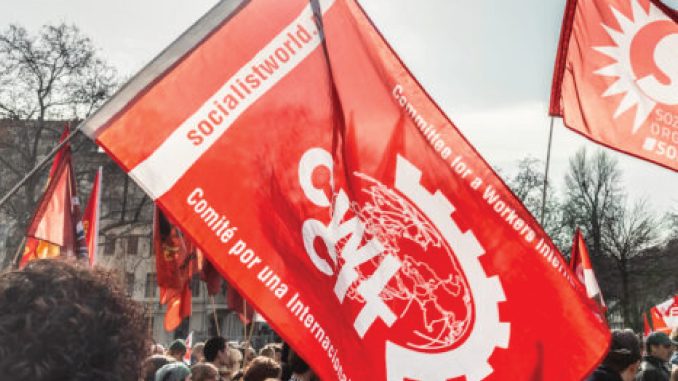
Between May 15th-17th, representatives of over 30 revolutionary organisations – Trotskyist, Leninist and one anarcho-syndicalist – from around the world, met in Paris, France, at an ‘Internationalist’ meeting to discuss the world situation and major issues of the class and social struggles in different countries. The first ‘Internationalist’ meeting, sponsored by five Italian and one French organisation, took place in Milan, Italy, in 2023.
Fifty organisations made submissions to the Paris meeting and three sent short video statements were sent. Unfortunately, due to visa issues, cost and other issues some organisations could not send representatives. One result was that there was no-one present from Africa.
The meeting started with one day discussion on activity, especially amongst young people, followed by two days on ‘Imperialist militarisation and social war against the world proletariat’.
While this meeting was not designed to reach decisions, it did allow the representatives to directly discuss amongst themselves, sometimes in a detailed manner, different political, organizational and solidarity issues.
On a number of points there were clear disagreements between the different participants. These issues included on the attitude to the Iranian regime during the current war; the question of whether China was capitalist and, if it was, was it also imperialist; what programme Marxists should argue for in Israel/Palestine; and should Marxists participate in the activities and debates within non-revolutionary parties like Die Linke in Germany.
The Committee for a Workers’ International attended the meeting, argued for its views in the discussions and sent the following statement which, along with all the others, was circulated to all the groups before the meeting began.
socialistworld.net
Greetings Comrades,
This meeting is taking place amid an extremely turbulent situation across the globe.
Given the word limit, the following brief statement outlines the CWI’s characterisation of the current era and brief comments on programmatic demands relating to the war in West Asia.
The horror that capitalism can unleash is once again laid bare for everyone. From the genocidal slaughter in Gaza to brutal wars across West Asia, Ukraine, Afghanistan and conflicts in every continent, millions suffer death, displacement, and the destruction of homes and loss of essential infrastructure. These atrocities occur alongside relentless attacks on wages and working conditions in a number of countries, creating economic hardship for tens of millions. This also paralleled with rising authoritarianism, the erosion of democratic rights, and unprecedented levels of militarization. The growth of far‑right populism in many countries further deepens the danger facing working class everywhere.
These are product of the crises that capitalism is going through – one of the deepest and most protracted in its history. The Committee for a Workers’ International (CWI) characterises this period as a new era for capitalism -a multipolar world facing multiple crisis -in economy, political and social. Singular domination by one imperial power militarily, politically or over the world economy had ended.
What is becoming norm is a capitalism tumbling from one crisis to another – with competing imperialists, rival regional powers, and fractured capitalist institutions. Capital pursues competing strategic, economic and political interests — exploiting war, occupation and proxy conflicts to secure markets, resources, spheres of influence and profits.
This new era has also seen mass movements across the globe and the beginning of a renewed wave of working‑class action. However, these mass movements have generally politically been cross‑class and focused on limited objectives, such as removing corrupt regimes. This limitation, and the absence of viable alternative, has allowed different factions of capital to return in one form or another as “reformed” or “clean” capitalist representatives, maintaining their grip on power. Although strikes — including general strikes — have been used to advance mass struggles and resist the capitalist offensive against workers, the working class has not yet emerged as the dominant, leading force.
Setbacks from the past—particularly the collapse of the Stalinist Soviet Union and the capitalist triumphalism and ideological confusion that followed—continue to weigh heavily on the workers’ movement. The emergence of so‑called “new formations” on the left, from Syriza to Podemos, initially enthused sections of workers and youth. However, these forces later contributed to despair when their leaderships sought solutions within capitalism and ultimately capitulated to pressure and bullying from capital and its representatives. Hopelessness, combined with the rotten conditions facing young workers and the spread of divisive ideologies—including the scapegoating of immigrants and refugees—has created an ideal breeding ground for far‑right populism. Sections of the capitalist class that favour decisive measures to protect profits have bankrolled or even led the rise of right‑wing populism.
We must also note the subjective factor: sections of the labour movement — including some “left parties” and trade‑union bureaucracies — remain anchored in past reformist strategies and tactics, undermining effective mobilisation today.
Imperialist aggression in this era is shaped by a multipolarity in which a relative decline of US and Western economic and geopolitical dominance parallel with the rise of China and other resurgent regional powers. We see shifting coalitions and proxy conflicts as states and capital seek to secure access to energy, raw materials, supply chains, and spheres of influence while circumventing against rivals. This generates enormous instability—militarisation, and wars and conflicts. This feature likely to last as capitalism cannot find a way out of the crisis that opens a long period of economic upswing. There will also be no permanent winners but instead shifting competition that deepen global inequality, provoke geopolitical conflict, and generate prolonged social suffering unless fundamental systemic transformation is achieved.
Marxists, while opposing the aggression of dominant imperial states, must not reduce their position to uncritical support for rival regional powers or authoritarian regimes. Anti‑imperialism should be grounded in building an independent working‑class opposition and an internationalism that unites the class regardless of religion, ethnicity, or other differences.
We stand together for unconditional end to imperialist war – immediate end to all attacks. And for humanitarian assistance and aid to rebuild the shattered livelihood. And for withdrawal of military from occupied areas and defend all democratic rights. Return to normalcy – ending military rule and the establishment of democratic rights is vital part of development of working class to act as a class and for itself.
However, to secure their survival, political forces of the ruling classes frequently exploit genuine social grievances and the material hardships faced by workers, poor and sections of the middle class, to fragment opposition and neutralise mass mobilization. The Iranian regime, for example, faced series of mass protests — over economic stagnation, pension cuts, unemployment, corruption, and political repression just a few weeks before this war, thousands took to the streets despite threat of mass murder and arrest. No amount of killings was sufficient to fully silence the popular opposition, anger which flows from objective condition. If the solidarity developed across the region to support their action, not just the Iranian regime but it will send shock wave in to the heart of all the regimes in the region and beyond.
From Arab and North African ‘Spring’ to Sri Lanka to Bangladesh, it was the masses, though limited in its objective, achieved the “regime change”. However, weakened reactionary forces in the region were temporarily given a lease on life by US imperialist intervention. Many feel they have no alternative but to rally behind their leaders and governments to defend themselves against a killing machine bent solely on securing regional resources and geopolitical advantage.
The remnants of the regime present themselves as “defenders” of the nation, mobilising patriotic and religious sentiment and branding dissenters as traitors—who are then jailed, persecuted, or killed. This is not unique to the Iranian government; it is a recurring characteristic of capitalist states that seek to rally working people behind national elites and then send them to slaughter. There is a precedent in how we oppose this: the Zimmerwald Left (1915) refused to suspend the class struggle in deference to warring governments and instead called for its intensification as the path to peace. The Zimmerwald Left rejected any support for belligerent governments or illusions in their promises, insisting that working‑class independence, international solidarity, and socialist struggle are the only reliable bases for combating war and oppression.
Resistance must not subordinate the working class to reactionary bourgeois forces; it must build workers’ organisations -independent from pro-capitalist forces and the ruling class -to resist and take the struggle forward.
Those subjected to horrific attacks may understandably join any force that appears to resist the offensive. Yet—even amid the horrors of genocidal slaughter—such alignment will not secure true emancipation, relief from suffering, or lasting rights. While we must oppose all reactionary forces, the decisive struggle against imperialism must be built without compromise. Simple slogans such as “Hands off Iran” are therefore inadequate on their own; While we stand firm against the genocidal slaughter in Palestine, annexation of Lebanon, attacks on Iran, we must reject national elites and reactionaries, regimes – and our slogans should reflect that.
It is insufficient to claim that the overthrow of the Iranian regime is solely the responsibility of Iranian workers, with the international workers’ role is limited to merely opposing attacks on Iran. This position risks a nationalist reduction of internationalism that the Communist International was formed to oppose. The regional and global working class has a responsibility to articulate a program and strategy that opposes both imperialist intervention and national ruling classes.
This – as some perceive wrongly – is not a “neutral” position: US and Israeli imperialism must be defeated. The only effective force capable of doing so is a mobilised, independent working class organised across borders. Such a movement would seek active solidarity with workers inside the US and Western countries. Domestic politics shape imperial policy: Trump is increasingly unpopular among many US workers and attempts to bolster standing through war—similar to Netanyahu’s strategy—have failed.
The Trump regime is now in crisis. Prolongation of the war, high causalities, and military defeats abroad can produce bigger cracks within ruling elites—including dissension within the Republican Party—and precipitate electoral setbacks, political and social turmoil and upheaval. At this time a politically organised and mobilised US working class could strike at the economic foundations of US capitalism, advancing its class interests. The challenge is to build such a force. International solidarity is not separable from national class struggles: rather strengthen domestic organising can help to undermine the geopolitical capacity of imperialist states.
Similarly, slogans against Israel that fail to make class distinctions will not help to build a class opposition to the state within Israel. The overwhelming majority of the Israeli working class currently support the war out of fear and insecurity; however, a minority opposes it. Our task is to win that minority and broaden it by addressing material grievances, exposing how capitalist elites and the arms industry benefit from the conflict, defending democratic rights, opposing repression of the Palestinians – and that the way out of the “trap”, as Trotsky called it – is by promoting solidarity between Palestinian and Israeli workers, and workers in all countries in the region.
Uncompromising anti‑war demands with a clear class orientation—joint action such as workplace campaigns and coordinated strikes—can break the mobilising power of chauvinism and build a cross‑border movement for peace, security and freedom.
As the Socialist Struggle Movement within Israel/Palestine aptly put it, “Military actions of Netanyahu’s government of death, which are neither intended nor will provide any fundamental solution to the security concerns of millions of Israelis. There is no basis for such a solution without a struggle for regional peace founded on an end to the occupation, the oppression, and the dispossession of the Palestinian people, and for equality in rights and a decent standard of living for all peoples in the region — there is no solution without a struggle for socialist change, to be able to guarantee genuinely and sustainably personal security, welfare, democracy, and freedom from oppressive regimes, from imperialist subjugation, and from weapons of mass destruction”.