
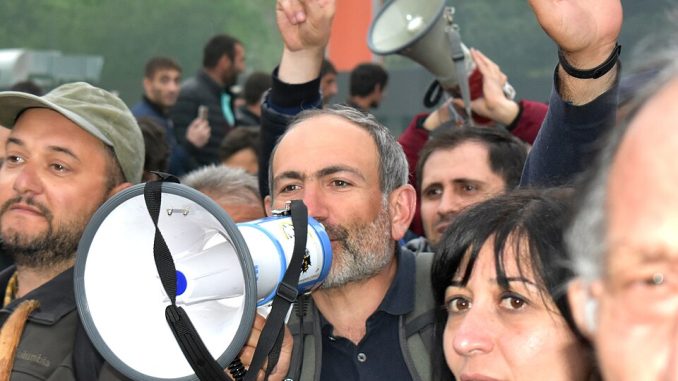
Nikol Pashinyan has emerged victorious in Armenia’s parliamentary elections, securing a mandate that will shape the country’s geopolitical orientation in the coming years.
The election took place amid growing tensions between Yerevan and Moscow. Pashinyan, who has sought closer ties with the European Union, recently clashed with the Kremlin after reminding Vladimir Putin of the censorship, bans and political repression that exist in Russia but not in Armenia. Moscow responded with warnings about a possible “Ukrainian scenario” akin to the aftermath of Euromaidan. Belarus and Kazakhstan, both tightly bound to the Kremlin’s orbit, joined the pressure campaign by demanding that Armenia hold a referendum forcing voters to choose between the EU and the Eurasian Economic Union (EAEU).
Long before the election campaign, both the EAEU and the CSTO had already demonstrated their worthlessness as military allies. During the conflict in Nagorno-Karabakh, they effectively stood aside while Azerbaijan seized the territory of Artsakh.
In the run-up to the vote, Russia once again imposed embargoes on Armenian fruit, vegetables, flowers, wine and brandy. Meanwhile, the EU offered deeper economic cooperation and dispatched specialists to help the country counter hybrid threats.
Moscow’s immediate objective was to weaken Pashinyan and fragment the vote. Virtually every significant opponent of the prime minister had some form of connection to the Kremlin. Samvel Karapetyan, fronting the “Strong Armenia” party, is a Russian citizen. Constitutional restrictions prevent him from becoming prime minister, but Kremlin strategists had already floated a scenario in which his nephew Narek would be installed first, followed by constitutional amendments removing the obstacle without requiring a referendum.
Another challenger was Robert Kocharyan, often described as a close ally of Putin. Yet he increasingly appeared to be a spent force, having failed to mobilise significant protests after his defeat in 2021. Despite substantial Russian efforts to influence the political situation, the pro-Kremlin opposition failed to prevent another Pashinyan victory.
All of this is the day-to-day noise of the news cycle. But the task of socialists is not merely to repeat headlines. We are not a media outlet in the conventional sense; we are the militant bulletin. Amid the noise, it is easy to lose sight of the perspective that reflects the interests of the majority in Armenia: workers, students and small business owners — ordinary people. That is the socialist perspective we want to address.
Pro Kremlin forces
What would a victory for pro-Kremlin forces have meant? The answer can already be seen in Georgia, where the presidency has largely ceremonial powers while the government pushes through Russian-style “foreign agent” legislation. In Kazakhstan, President Tokayev’s government has closely mirrored Russia’s anti-LGBTQ+ legislation, placing some of the country’s most vulnerable communities at greater risk of repression and violence. It also joined the Kremlin’s economic pressure campaign against Armenia.
For that reason, there could be no support for the pro-Russian opposition. Their defeat removes an immediate threat of deeper Kremlin influence over Armenian political life. Yet it is equally important to understand what Pashinyan’s victory can and cannot achieve. Pashinyan presents himself as acting in Armenia’s national interests, but in practice he remains a representative of a ruling-class faction that seeks closer integration with Europe. Russian imperialism leaves missile craters; European imperialism leaves debt traps.
The reality, however, looks rather different from what is often imagined in theoretical discussions. Political pressure, sanctions and embargoes do not eliminate trade flows; they merely make them more expensive, creating fertile ground for speculation.
In practice, this functions as a kind of “tax on common sense”. Goods from Armenia, Europe or elsewhere do not simply disappear from the market. Instead, they pass through intermediary countries such as Kazakhstan or Belarus, where labels are changed and paperwork adjusted before the products are resold at a higher price.
What does this mean in practice?
First, it creates inflationary pressures. Resale schemes and transit networks expand monetary circulation without creating corresponding real value. Rising prices on shop shelves become an inevitable consequence of these grey-market chains.
Second, it undermines domestic production. Why should businesses invest in manufacturing, advanced technology or agriculture when speculative trading and intermediary services generate faster and easier profits? The result is stagnation and a shortage of productive, skilled jobs.
Third, it concentrates wealth in fewer hands. As economies are transformed into transit hubs for circumventing sanctions and embargoes, the greatest profits accumulate among a narrow layer of oligarchic interests controlling these flows. Ordinary people are left with higher prices, while national economies become even more dependent on the instability and conflicts of neighbouring states.
This is not a struggle conducted in the interests of working people. It is the reinforcement of a system in which speculative capital prospers while productive labour becomes comparatively less rewarding. Such a model turns entire societies into hostages of geopolitical rivalries and deprives them of the possibility of developing their own productive economies.
These elections matter. But they are not a historic Rubicon. The struggle between rival imperial blocs for economic and political influence over Armenia will continue regardless of the outcome, and neither bloc offers a genuine path to liberation.
The problem is not simply which imperial power gains greater influence. The problem is the system itself: an economic order organised around the profits of a few, and political institutions dominated by property owners, bureaucrats and professional politicians. It is this system that repeatedly generates wars over markets and resources, economic crises and austerity policies, while the costs are borne by the majority.
The alternative is democratic economic planning carried out by working people themselves. Not the power of bureaucrats over society, but society’s power over its own economy. Decisions about what to produce, how resources should be allocated and where public investment should go should be made according to human need rather than corporate profit or geopolitical ambition.
Such democratic planning is impossible while the commanding heights of the economy remain in private hands. The major banks, energy companies, natural resources, transport infrastructure and key industries would need to be brought into public ownership (nationalised) under democratic workers’ control and management. Without the expropriation of the major concentrations of capital, economic power remains in the hands of a small minority regardless of which government wins elections.
Only such a system can address the root causes of war, national antagonism and endless struggles over spheres of influence.
We need the politics of working hands, not talking heads. We need more than Tokayev’s Kazakhstan, Pashinyan’s Armenia or Zelensky’s Ukraine. We need a socialist world in which industry, finance and the wider economy are democratically owned, managed and planned from below by the organised working class.