
An interview with a socialist activist from India
The recent mass movement of youth against the policies of the Narendra Modi government in India was a key topic of discussion at the recent CWI Summer School in Berlin. Laura Rafetseder, from the Austrian CWI section, spoke with Youvraj, a comrade from New Socialist Alternative (CWI India), about the origins of the protests, the rise of the “Cockroach Janata Party,” and the vital lessons for the students’ and workers’ movement.
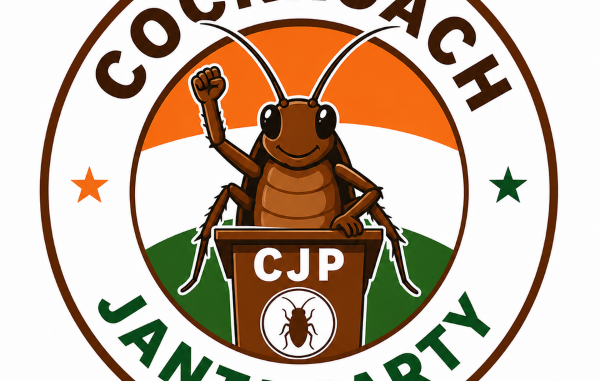
What began as a response to educational scandals—specifically the cancellation of the NEET-UG medical entrance examination following a massive paper leak—rapidly evolved into a nationwide political movement. While the media outlets focused on the “Cockroach Janata Party” (CJP)—the satirical online movement launched by “communication strategist” Abhijit Dipke—the true engine of the struggle was the mass mobilisation of youth on the ground.
During the 35-day sit-in strikes in Delhi, particularly following the state’s crackdown on protesters, the movement demonstrated that, despite the authoritarian consolidation of the Modi regime, deep-seated disillusionment and anger are bubbling to the surface. As Youvraj explains in this interview, the movement was a classic case of “leadership being pushed from below,” as students and youth forced the agitation beyond its initial, limited demands for the Education Minister’s resignation, increasingly challenging the Prime Minister and the broader capitalist regime itself.
In this interview, Youvraj analyses the movement’s strengths and weaknesses regarding political organisation, and why the “Cockroach” phenomenon serves as a powerful example of the growing void between India’s masses and the ruling establishment. He also discusses the urgent necessity of linking such youth movements with the organised working class to move beyond protest and toward a socialist alternative.
socialistworld.net
Can you tell me about the conditions that led to the movement?
There has been a significant amount of discontent and kind of disillusionment that had been building up in India because of the expectations of “New India”, that was what Prime Minister Modi had promised. That’s how he came to power. But all the hopes and promises were going to be hollow. He was going to betray. But it took the masses around six years to realise that. Especially after COVID things started changing and the mood was slowly turning to anger. Especially because of joblessess and employment. In addition the educational system was broken. But the opposition was weak. This is why Modi could continue to control the situation. But discontent had been building up and disillusionment and anger. You just needed a match to light it. And the trigger was the university entrance exams for Medical Schools. Medical school is one of the few ways in India to move up, so a lot of young people want to get in, because of how low the wages in other jobs are. You don’t really get decent wages. So there’s a huge competition for that entrance into medical schools.
Can you tell me about the movement’s strengths and weaknesses?
I think the strength of the moment was that it captured the imagination of the students and youth. It started as a students’ movement around that educational issue. But it turned into a mass movement and in effect challenged the very regime on some points. It started with a single issue, but later it turned into a generalised mass political movement. Its limitations were that it was lacking organisation. Instead it was a spontaneous online social media thing. The media talk about the “cockroach movement”, and yes, the Cockroach Party started it. But the movement went far beyond. The left student unions did the real mobilisation for the 35 days of sit-in strikes. The rallying point was in Delhi. The sit-in strikes started from June 20 and were successful on July 24 when the Education Minister stepped back. The commitment came from the left student organisations, but there were no democratic structures to coordinate the movement. The Cockroach Party leadership at one point tried to limit the movement. In effect, it tried to divert attention from the notion of resignation of the minister. When it was pushed from below, it adopted some general demands like having the right to access to education. But the leadership really did not have the broader outlook.
So the movement showed that Modi is not invincible. Others on the Left had claimed that the Modi Government is fascist, how does the CWI in India characterise the Modi Government?
We have been saying for quite some time that this is not a fascist government. For us fascism is not a loose term. Fascism implies a mass moment to smash the working class. So it is true that this is a very right wing, extremely authoritarian government. At one point, there was possibly a mass movement, let’s say between 2014-2017/18. But again, it was not based upon very fundamentalist ideology. Even when it had more popular support, it was based more on Modi’s promises of better days. It wasn’t an ideologically right wing mass movement. More importantly, in the last seven years, it is very clear that it is no longer a mass movement. A section does support it, but that is a tiny section. Many more are against the Modi government. Which is why we say we must always distinguish between authoritarianism and fascism.
So has the movement managed to overcome some communal divisions?
In the moment to an extent. It is part of the slogans and chants in the demonstrations: “Whenever Modi is scared of the people he attacks Muslim people. Whenever Modi is scared of the people he brings in the Police. When Modi is scared of the people he will bring in division.”
India has been known for general strikes in the past and has had a big strike a couple of months ago. Can you tell me a bit about that?
The Indian working class is quite large. That means when they go on strike a large number is on strike. But of this huge working class, only 7% or less is organised in trade unions. Which means around 94% of the working class is outside the trade unions. Nonetheless this organised working class is very important. I think the one of the major reasons why we had more strikes in the last years was that the government attempted to bring in new labour laws. In 2020, this government abolished labour laws. They said we are simplifying the laws. But in fact it was an attempt to deprive the working class of its collective bargaining power. The new labour laws are absolutely anti-working class. Workers could sense that. Which is why since 2020, there have been general strikes almost every year, at times even twice a year. And because of that in 2020 even though the laws were passed the government said for next fears we’re not going to implement these laws. This is a partial success of the strikes. But this year, the government decided to implement these laws. And there was a general strike after that. But they were really not full throttle. The union leadership is unable to fully mobilize workers. Because if they get mobilised, even 5-10% of the working class is a huge power. But the trade union leaders are afraid of that power and they hesitate because it could challenge the government.
What is the programme and demands that we raise in the movement and how can the movement be linked up to the organised working class?
I would say there are several things we try to do. One is during the movement itself. We had put a transitional approach. We launched a campaign that we could connect the youth to – the “RRR”-campaign. What we said is, “resist this regime”. The second R is “reclaim democracy”. And the third R is “rebuild the society along socialist lines”. “RRR – resist, reclaim and rebuild.” Resisting and reclaiming democracy is good – but it is not enough because those who are in power do not represent the workers and the masses.
Another thing we did is that we issued appeals to the left student unions. That they should – along with the Cockroach Party – form coordination committees. These committees should coordinate the whole movement with a democratic structure. Because the left student unions played a crucial role. We welcome that, but they did not take leadership of the movement. Which is why we appeal to them that there should be joint coordination committees and that this whole movement should be coordinated.
We also called on the unions to mobilize to support the students, that they must call for strikes and demonstrations in support of the movement. At one point the situation was dangerous, the government was going to attack the movement. So in that situation it was important to show that the students have much larger support. We called upon the trade unions to join the struggle so we can connect them to the youth, so they know the workers are with us. And this was no hollow call. We also did that. We have our own construction workers’ union. We are not a large union, but we did not only hold one, but two demonstrations in support. “Construction workers stand with students and youth”, that was the slogan. Then our students union also joined that. We have two front organisations, one is the construction workers union and one is a student union. It was the workers union that called for it and the student union joined it so that it was a joint struggle. We also formed a solidarity committee for the youth movement at the city level. We organised demonstrations and multiple things in support.
Usually the weakness of movements against right wing governments is that the opposition is so weak. The question of an alternative is unclear.
Yes, they feel they have no alternative. Absolutely. How do we confront it? Most of the left had been rallying behind the Congress Party. They have been saying we need Congress as a lesser evil because this is fascism. So they don’t really have an independent programme. But the fact is we would need a workers’ government with a socialist programme. And you could see the same internationally in movements in other countries, like in Sri Lanka, the GenZ movements in Indonesia etc.