
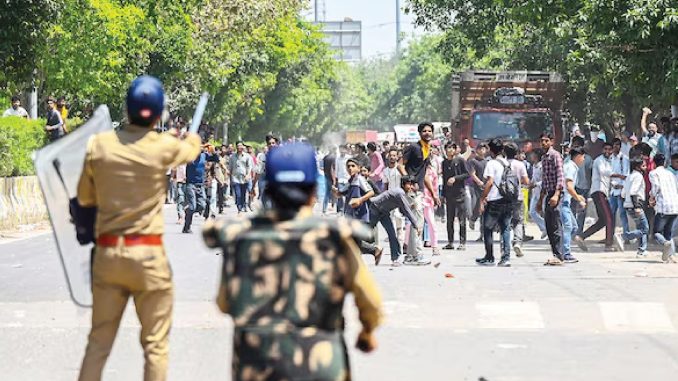
A growing wave of unrest is beginning to sweep across the Indian working class, reflecting worsening living conditions and intensifying contradictions within the capitalist system. This trend has become visible through a series of protests across multiple regions.
The chain of struggles began on 9 April in Noida, an industrial hub in Uttar Pradesh, and intensified over the following days with road blockades and sit-in protests. With 12-hour workdays becoming the norm, workers are paid a paltry ₹10,000–₹12,000 a month ($100-$115). In Noida—a city with high living costs—this effectively amounts to a starvation wage. The unrest continued until 13 April, when the situation escalated. Around 45,000 workers, mainly from the garment and hosiery industries, gathered at nearly eighty locations across the city. Frustrated by the continued neglect of their grievances, sections of the protest turned violent, with damage to vehicles and property and instances of stone-throwing. In some cases, workers entered factory premises, forcing shutdowns.
The sheer scale of the protests stunned the authorities and sent shockwaves. The state responded with repression to curb further unrest. Shunning any pretence of democratic engagement, the right-wing BJP government unleashed a crackdown, arresting around 300 workers and activists and filing serious criminal charges. In a familiar pattern, the government alleged ‘foreign links’, particularly with Pakistan, to justify its actions and suppress the movement.
The protests in Noida were soon followed by similar demonstrations across Delhi, Uttarakhand, Gujarat, and Maharashtra, continuing until 23 April 2026. The spontaneous nature of these protests highlights the depth of frustration among workers.
The situation in Gujarat further exposed the vulnerability of migrant workers. The rush of thousands attempting to return home led to massive, uncontrollable crowds at Surat railway station. Workers endured acute distress, standing in queues stretching up to three kilometres under the scorching sun, with temperatures reaching forty degrees Celsius. Many fainted, while others suffered serious health complications, though no casualties were reported. Drawn from poorer regions such as Bihar and Bengal into industrial centres, these workers often labour under harsh, insecure, and inhuman conditions. The shutdown of production due to fuel shortages forced more than 400,000 workers in the ceramic industry to return to their homes, highlighting the fragility of their livelihoods. Similarly, protests by taxi and cab drivers in Maharashtra exposed the precarious nature of labour in the so-called “platform economy,” where flexibility often masks exploitation and income instability. The state also witnessed a five-day strike by government employees across various departments over their longstanding demands.
At the core of this unrest lies the sharp rise in living costs, further exacerbated by the ongoing war in the Middle East. Workers are increasingly unable to meet even their basic needs, and the mounting economic pressure has triggered widespread anger across industrial sectors. Demands for fair wages and dignified working conditions are now resonating across regions and industries.
These developments cannot be viewed as isolated events. Though they may appear fragmented at this stage, they point to a deeper reality: the intensification of contradictions within Indian capitalism. Taken together, these struggles signal the emergence of a broader current of working class resistance. However, this resistance has yet to consolidate into a sustained and coordinated movement. What remains absent is not merely leadership, but a political force capable of linking immediate struggles to a broader program of transformation. At the same time, such a movement cannot be conjured overnight; it must emerge through a process of accumulated experiences, struggles, and organization, through which the working class develops both confidence and clarity.