
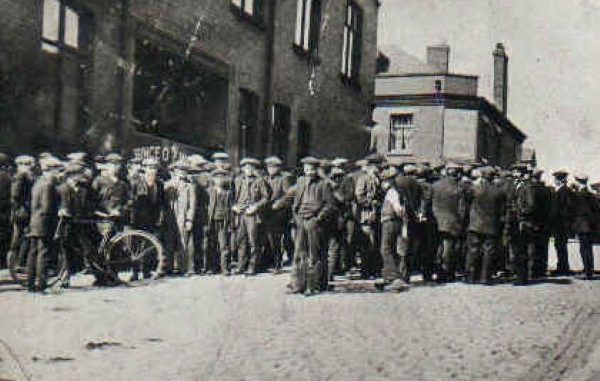
2026 marks the centenary of Britain’s general strike. From 4-12 May 1926, workers tasted power, in what is the most important event yet in the history of the British working class. Ian Pattison describes events.
socialistworld.net
When the trade unions were discussing the possibility of a general strike in 2012, John Hannett, then the right-wing general secretary of shop workers’ union Usdaw, said: “We tried it once, and it didn’t work.”
In the Socialist Party (CWI England & Wales), we take a very different view. The nine-day general strike in 1926 is one of, if not the most important event in the history of the working class in Britain.
1926 showed that the working class has the power to change society. It demonstrated that the working class in Britain is not ‘conservative’. Instead, it has massive revolutionary potential.
Soldiers returned from World War One expecting a ‘land fit for heroes’. Instead, they came home to find British capitalism in decline. And, like today, the working class had to fight a bitter class struggle to defend its living standards from bosses’ attacks.
1926 came towards the end of a period of major working-class struggles across Europe, which began at the end of the first world war, and with the Russian Revolution in 1917.
The Russian Revolution, led by the Bolsheviks, was a massive example to workers in Britain and across Europe, demonstrating that it was possible for the working class itself to take power.
The level of social unrest and strikes in 1919 prompted the Liberal prime minister, David Lloyd George, to say that the country had “never been nearer to Bolshevism”. Even the police were on strike.
In 1921 – known as Black Friday – the ruling capitalist class came back for the concessions the working class had won in 1919. Scandalously, the workers were sold out by the trade union leaders. Six million workers suffered pay cuts.
But the working class learnt from this defeat. They elected more left-wing union leaders to defend their interests, in some unions.
If the working class is defeated in one arena, it can turn to another. Defeated industrially, the working class turned to the political field.
And the first Labour government was elected in 1924. But Labour prime minister Ramsay MacDonald cut pay and repressed the trade unions, and soon the Labour government was out.
Now, defeated politically, the working class turned back to industrial struggle.
In the Socialist Party, we say there needs to be both. We need to combine the struggle in the workplaces, link those different battles together, and combine that with a political alternative – a new political party for the working class.
But even the best new left-wing trade union leaders in the 1920s – like giant miners’ leader AJ Cook – mistakenly believed that the working class could win control by solely conducting a workplace struggle, without challenging capitalist political power.
Ruling class prepares
1925 saw attacks on miners’ pay and a lengthening of hours. But the threat of general strike action at that stage forced the Tory government to concede, on what was known as ‘Red Friday’.
The ruling class used the next nine months to prepare to inflict a defeat on the miners and the working class. Compare that to the TUC General Council, which only met six days before the general strike to plan it.
If only the TUC had prepared. The working class was ready to fight, and would have responded.
In 1926, the mine owners cut miners’ pay. Even the TUC leaders agreed that the miners would have to accept pay cuts.
But the miners said ‘no’. They had the whole working class behind them. Workers knew that if miners’ pay was cut, they would be next.
The TUC leaders wanted to do everything to avoid a confrontation. But they knew, if they failed to call a general strike, they would lose control. And others would lead the working class. In this scenario, they felt compelled to lead the struggle down ‘safe’ channels.
While his union was voting for the general strike, Charlie Cramp, deputy general secretary of the National Union of Railwaymen (NUR), turned to the person next to him and said: “We can’t win”.
Instead of listening to workers’ demands of everybody striking together – the quickest and most effective way to win the strike – the TUC held some workers, like shipbuilders and engineers, in ‘reserve’.
This led to frustration. But workers that hadn’t been called out were striking without permission.
Four million workers joined the general strike. Only nine out of 2,000 London trams ran, and just 1% of rail freight.
The print trade unions refused to allow a Daily Mail article attacking the general strike to go through. And the capitalist newspapers struggled to get out throughout.
Workers you wouldn’t expect were taking part. House of Commons business was affected by workers there striking.
Telegraph workers were angry they weren’t included in the action. Even specialist gold workers sent a delegation to the TUC asking how they could help.
In Shrewsbury, even leading local Tories joined the strike. And in Bolton, 2,300 people turned up to the first day of the strike volunteering to help
The strike was so powerful in some areas that vehicles could only move if they displayed a ‘By permission of the TUC’ sign in their window.
One striking worker said: “Employers were coming, cap in hand, begging for permission to allow their workers to perform some customary operations. They were turned away. I thought of the many occasions when I had been turned away from the door of some workshop in a weary struggle to get the means to purchase the essentials of life.”
Even Mussolini’s fascist regime in Italy was shaken, and had to take steps to quell support for the strike.
Repression fails
The government and rest of the capitalist state used repression to break the strike. But this failed.
Police attacked striking workers. The government organised a strikebreaking operation. But it was ineffective.
The government took over running the BBC. It was only permitted to put the government line. The union position was banned from being broadcast.
The capitalist newspapers sided with the government. But they weren’t even allowed to give the appearance of a ‘balanced’ debate or quote from the unions.
And the government went further, producing its only daily newspaper, British Gazette, edited by Winston Churchill, to spout lies to undermine the strike.
The government didn’t use the army, as it had to crush previous workers’ struggles. But it’s questionable whether this would have worked. There was too much sympathy for the strikers from rank-and-file soldiers.
It wasn’t capitalist state repression which brought an end to the strike and a defeat for the working class. Instead it was the treacherous role of the right-wing trade union leaders, and the weakness of the left union leaders.
After nine days, the TUC leaders called off the strike. It was a complete capitulation. They hadn’t been ‘offered’ anything more than when the strike started.
Had the workers won?
When the strike was called off, many workers thought they’d won. They felt themselves in power on the ground. They couldn’t believe it was any other way.
Describing events in Birmingham, the Socialist Party’s Peter Taaffe, in his book ‘1926 General Strike – Workers Taste Power’, says: “The strike committee produced a special ‘victory bulletin’. And why not? The strike had been solid here”.
“There was no other reason to think otherwise”. Even “victory arrangements were put in hand”.
The biggest day of strike action was actually the day after it was called off! This shows that talk from some of the right-wing union leaders that the strike was weakening was rubbish. And, as victory hadn’t been won, one million miners continued to strike.
The defeat of the general strike led to pay cuts, unemployment, repression of both the trade unions and the recently formed Communist Party. In the immediate aftermath, union membership fell to its lowest level for ten years.
Summing up the anger towards the TUC leaders after the strike, at the TUC conference in September 1926, one young miners’ delegate said: “We will have another general strike without you, and we’ll win next time.”
An all-out general strike, like 1926, is different. It poses the question ‘who is in power – the working class or the ruling class?’ Workers have to answer that question, and go forward, or retreat and go back.
During the 1919 strikes, prime minister David Lloyd George, said: “If you carry out your threat and strike, you will defeat us. But if you do so, have you weighed the consequences? For, if a force arises which is stronger than the state itself, then it must be ready to take on the functions of the state, or withdraw and accept the authority of the state.
“Gentlemen, have you considered? And if you have, are you ready?”
Union leaders retreat
In 1926, the union leaders weren’t prepared to take that step. Even the best left-wing union leaders didn’t have an idea about how things could be different. So, facing that, they retreated.
But, the fledging Communist Party of Great Britain, formed after the Russian Revolution, had the chance to play a history-defining role in 1926.
The National Minority Movement organised the left-wing of the trade unions. It was established and led by the Communist Party. At its height, it counted the support of trade unionists representing 1.25 million workers.
But in the long run-up to the strike, and during the nine days, the Communist Party used the mistaken slogan: “All power to the TUC General Council”. This was the same TUC General Council that was about to sell out the strike!
Many Communist Party activists played a heroic role during the strike, many others were arrested and persecuted. However, the party’s leadership was relatively young and inexperienced, it also took its political lead from the leaders of the Communist International (Comintern) – increasingly pushing a political line in the interests of an emerging bureaucracy headed by Joseph Stalin.
The huge authority of the Russian Revolution was used by Comintern leadership to mislead the strategy of the young party in Britain.
The mistaken Stalinist approach was typified by the Anglo-Russian Trade Union Committee – an alliance between the trades unions in Russia and Britain.
On the surface, that sounds like a good thing – working-class solidarity from Britain for the Russia Revolution. But, in reality, the Anglo-Russian Committee allowed British trade union leaders to talk up their radical credentials with their links to Russia. At the same time, these union leaders failed to organise for the same socialist ideas on the ground in Britain.
Leon Trotsky summed up this approach. Commenting on the 1925 TUC Congress, he said: “This sort of leftism remains only as long as it does not impose any practical obligations. As soon as the question of action arises, the lefts respectfully surrender the leadership to the rights.”
The Anglo-Russian Committee became a straitjacket for the Communist Party. It failed to prepare the working class that the right-wing union leaders would sell them out.
Who did workers trust?
And it wasn’t just the TUC right-wing. Alf Purcell, International Federation of Trade Unions, and George Hicks, construction workers’ union, were part of the previous wave of left-wingers winning union positions. But both stayed silent on the TUC General Council, while the general strike was sold out.
And it was similar for AJ Cook – the great union militant. After the strike, he proposed longer hours for the miners. At the September TUC Congress, he used his massive authority in the movement to manoeuvre to get discussion of the general strike off the agenda.
It’s debatable whether the opportunity for revolution was lost in 1926. The trade union leaders still held enormous authority in the eyes of the working class. If the Communist Party had taken the correct approach, preparing the working class for the role the union leaders could go on to play, including by systematically putting demands on them, it would have strengthened its authority.
It may or may not have been sufficient to change the outcome of the strike. But it would have best positioned the party to – with the correct strategy and approach – go on to transform the class battles that were to take place in Britain in the rest of the 1920s and 1930s.
Would you like to read more?
- ‘1926 General Strike – Workers Taste Power’ by Peter Taaffe
- ‘Where is Britain Going?’ by Leon Trotsky
- Available from leftbooks.org.uk